Quantify and qualify look and sound similar, but they have very different meanings. If you want to talk about measuring an amount, you usually need quantify. If you want to describe a condition, limit a statement, or show that someone meets a requirement, qualify is generally the right word.
In this guide, we’ll explain quantify vs qualify, show their meanings with simple examples, compare them side by side, and give you practical ways to remember which word to use.
Also Read: Transferred vs Transfered: Which Is Correct?
What Is the Difference Between Quantify and Qualify?
The simplest distinction is:
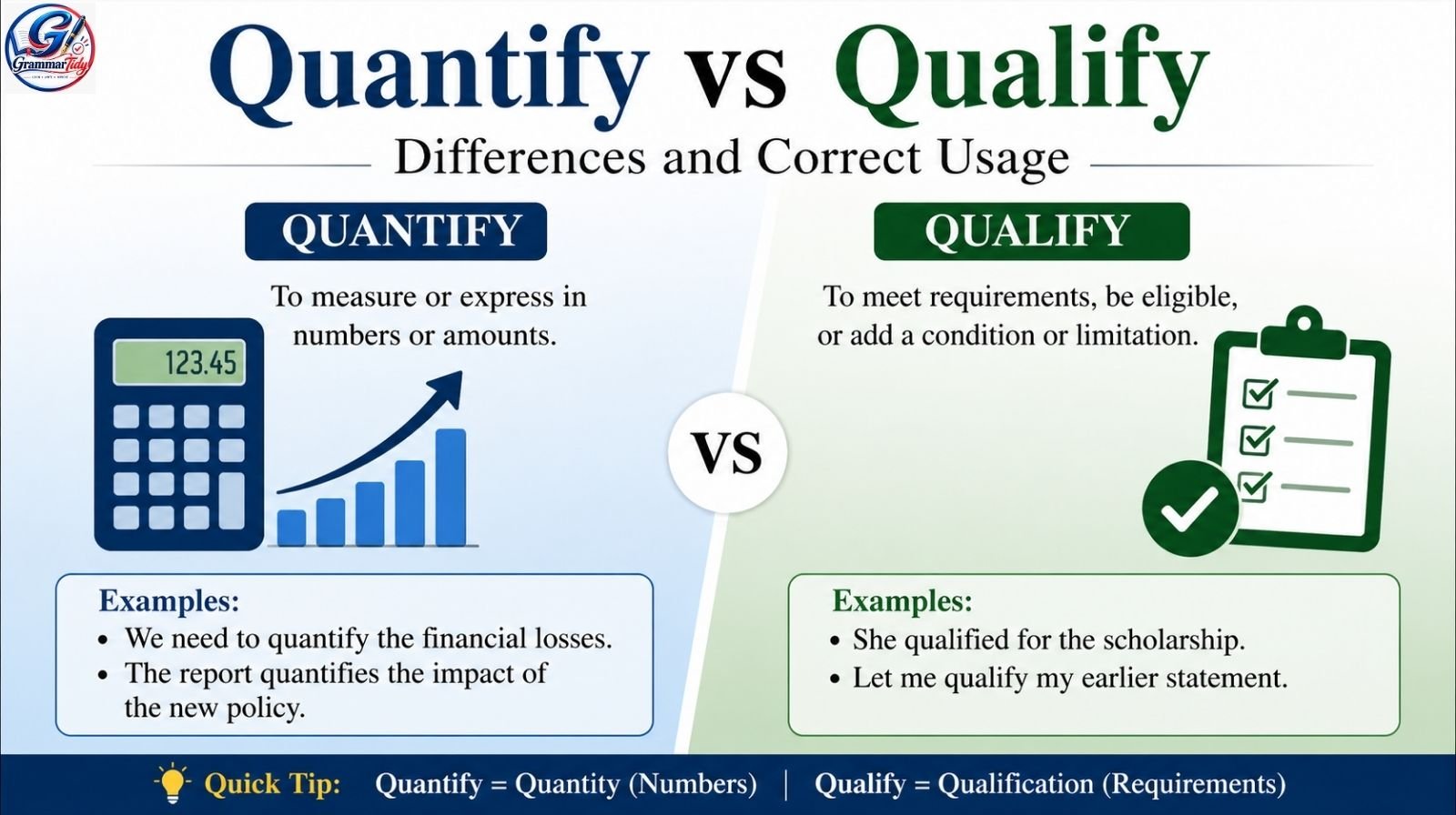
- Quantify means to measure or determine the amount or number of something.
- Qualify can mean to meet a requirement, become eligible, or add a condition or limitation to a statement.
Cambridge Dictionary defines quantify as measuring or judging the size or amount of something.
Qualify, on the other hand, has several meanings. It can refer to meeting a standard, having a right to something, entering a competition, or limiting the strength or meaning of a statement.
Quantify = Measure or Count
Use quantify when you can think in terms of:
How much? How many? What amount? What number?
Examples:
- The researchers quantified the amount of pollution in the river.
- We need to quantify the financial losses.
- It is difficult to quantify the impact of the decision.
- The report attempts to quantify customer demand.
Qualify = Meet a Requirement or Add a Limitation
Use qualify when the idea involves:
Eligibility, requirements, conditions, or limiting a statement.
Examples:
- She qualified for the scholarship.
- He qualified as a professional engineer.
- You must meet certain conditions to qualify for the program.
- I want to qualify my earlier statement.
Therefore, if you’re talking about amount, think quantify. If you’re talking about conditions or qualifications, think qualify.
Quantify vs Qualify: Meaning and Usage
Understanding each word separately makes the distinction much easier.
What Does Quantify Mean?
Quantify is a verb meaning to measure, calculate, count, or express the amount or extent of something.
It is especially common in business, science, research, finance, statistics, and data analysis.
For example:
The company quantified the cost of the project.
Here, the company is determining the cost in measurable terms.
Another example:
Scientists are trying to quantify the effects of climate change.
The focus is on measuring the effects rather than simply describing them.
Cambridge’s Business English definition specifically describes quantify as measuring the size or amount of something and expressing it as a number.
Also Read: Symptomatology vs Symptomology: Differences, Meaning, And Usage
What Does Qualify Mean?
Qualify has several meanings, which is one reason it can be confusing.
It can mean to:
- Meet the necessary requirements.
- Become eligible for something.
- Successfully complete training.
- Enter or advance in a competition.
- Add a condition or limitation to a statement.
Examples:
- She qualified for the final round.
- He qualified as a doctor.
- They qualify for financial assistance.
- Let me qualify that statement.
Notice that none of these meanings is simply “measure an amount.”
Quantify vs Qualify: The Key Difference
A useful memory trick is:
Quantify → Quantity → Numbers
Qualify → Qualification → Conditions or requirements
The spelling itself gives you a helpful clue. Quantify begins with quant-, which connects naturally with quantity and quantitative. Qualify is connected with qualification and qualified.
How to Use Quantify and Qualify in a Sentence
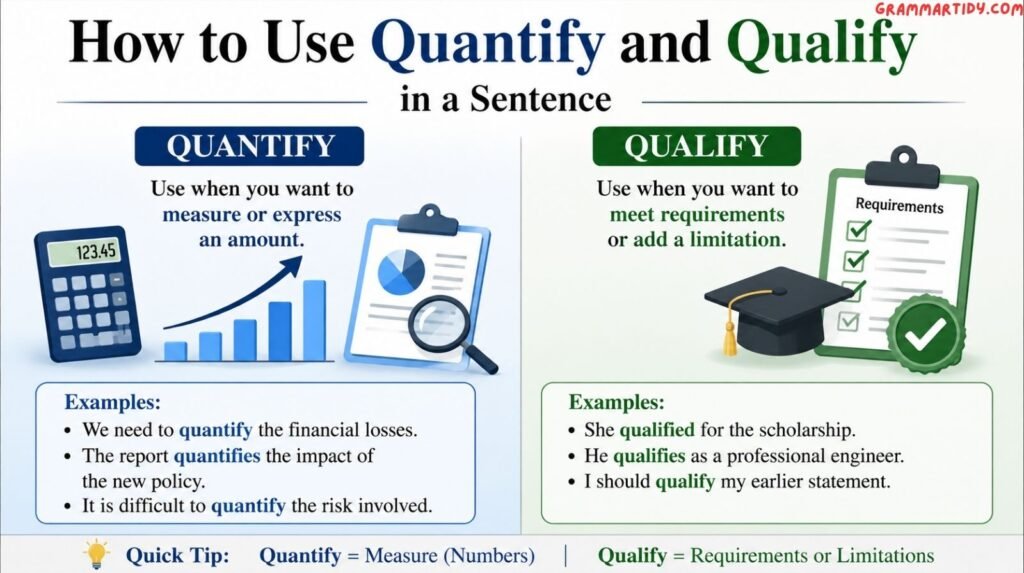
Knowing the definitions is useful, but seeing the words in realistic sentences makes the difference much clearer.
Examples of Quantify in a Sentence
Here are some natural examples:
- The survey helped us quantify customer satisfaction.
- The team could not quantify the exact damage.
- We need to quantify the benefits before making a decision.
- The study quantified the risk associated with the treatment.
- It is difficult to quantify the value of good leadership.
In each case, the verb refers to determining an amount, degree, size, or measurable effect.
Examples of Qualify in a Sentence
Now compare those with qualify:
- She qualified for the national competition.
- Does this experience qualify him for the position?
- He qualified as an accountant last year.
- You may qualify for a discount.
- I should qualify that statement before anyone misunderstands it.
Here, qualify is connected with eligibility, professional status, or limiting a statement.
Quantify vs Qualify in Similar Sentences
Compare these:
Incorrect for measurement:
We need to qualify the financial losses.
Better:
We need to quantify the financial losses.
Why? Because the writer wants to determine the amount of the losses.
Now consider:
We need to qualify the claim.
This can be correct if the writer means that the claim needs a condition, limitation, or clarification.
The difference comes down to the intended meaning.
Quantify vs Qualify: Quick Comparison Guide
| Feature | Quantify | Qualify |
|---|---|---|
| Part of speech | Verb | Verb |
| Main idea | Measure an amount | Meet a condition or limit a statement |
| Connected idea | Quantity | Qualification |
| Often involves | Numbers, amounts, measurements | Requirements, eligibility, conditions |
| Example | Quantify the damage | Qualify for the program |
| Another use | Quantify the risk | Qualify a statement |
| Common pattern | Quantify something | Qualify for/as something |
A Simple Rule to Remember
Ask yourself:
Am I measuring something?
If yes, use quantify.
We need to quantify the losses.
Am I talking about eligibility or requirements?
If yes, use qualify.
She needs three years of experience to qualify for the position.
Am I adding a limitation to what I said?
Use qualify.
I should qualify my earlier comment.
Also Read: Commit vs Comit: Correct Spelling And Usage
A Real-Life Example: Quantify vs Qualify in the Workplace
Imagine a marketing manager is reviewing a company’s latest advertising campaign.
The manager tells the team:
“We need to understand whether this campaign actually worked.”
The first task is to look at measurable results. The team examines website traffic, conversion rates, sales, customer acquisition costs, and revenue. They determine that the campaign generated 25% more website visits and increased online sales by 12%.
The team has quantified the campaign’s results because they have measured its effects using numbers.
However, the manager then says:
“Before we call the campaign a complete success, we should qualify that conclusion.”
This means the manager wants to add an important limitation. Perhaps sales increased, but the campaign also had unusually high advertising costs. The numbers are positive, but they do not tell the entire story.
Later, the company offers a performance bonus to employees who meet certain targets. An employee asks whether they are eligible. The manager explains that employees must have worked for the company for at least six months to qualify for the bonus.
This one workplace situation demonstrates three different uses:
- Quantify the results = measure them.
- Qualify the conclusion = add a limitation or condition.
- Qualify for the bonus = meet the requirements.
This is why replacing quantify with qualify can change the meaning of a sentence completely.
Why Do People Confuse Quantify and Qualify?
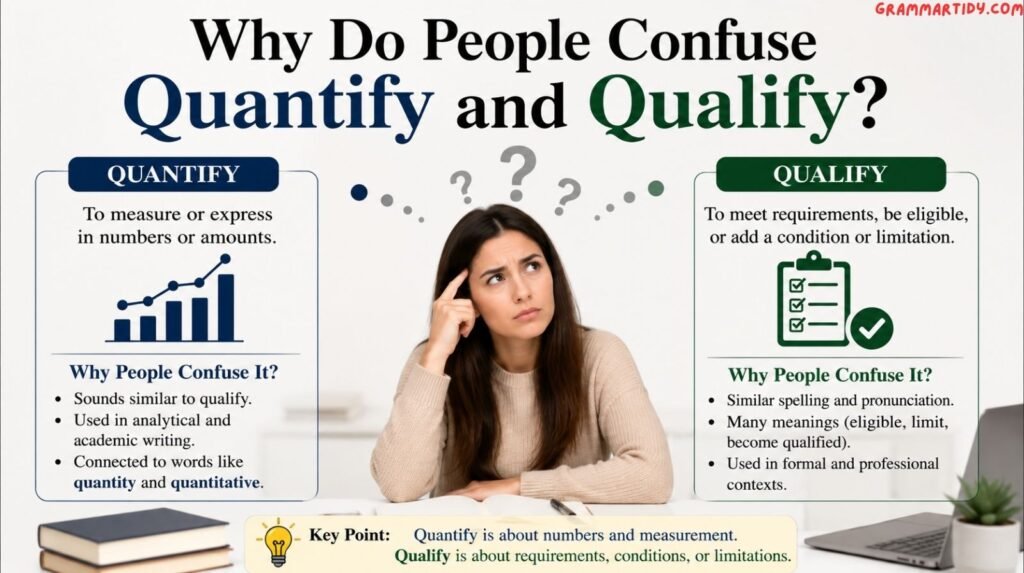
The confusion is understandable because the two verbs have similar spelling and pronunciation.
They Have Similar Endings
Both words end in -ify:
- quantify
- qualify
They also have a similar rhythm when spoken, so someone learning English may accidentally substitute one for the other.
Their Meanings Are Related to Analysis
Both words frequently appear in professional, academic, and technical writing.
For example, a research report might say:
Researchers quantified the effects.
Elsewhere, the same report might say:
The findings should be qualified by additional evidence.
Because both words occur in analytical writing, their meanings can become blurred for learners.
Their Noun Forms Can Add to the Confusion
Compare:
- quantify → quantification
- qualify → qualification
The words look closely related, but they describe different concepts.
Quantification concerns measurement or determining quantity. Cambridge defines quantification as the act of measuring or judging the size or amount of something.
Qualification generally concerns a requirement, credential, condition, or limitation.
Quantify vs Qualify: 2025–2026 Usage and Research Context
The distinction is especially useful in modern research because quantitative and qualitative approaches are frequently discussed together.
A 2025 Public Opinion Quarterly special issue highlighted how qualitative methods can provide contextual understanding that surveys and quantitative approaches may not capture easily.
Research published in 2025 also examined how online surveys, which are commonly associated with quantitative methods, can produce qualitative insights through open-ended questions.
A 2026 analysis of Library and Information Science research reported that 58.9% of the analyzed 2025 articles used quantitative analysis, compared with 17.6% using qualitative analysis and 7.8% using mixed approaches. The analysis covered 1,045 articles.
These figures are not measurements of how often the individual words quantify and qualify occur. Instead, they demonstrate why understanding the underlying concepts matters: modern academic and professional writing regularly distinguishes between measuring something quantitatively and understanding or limiting its meaning through qualitative or contextual analysis.
Common Mistakes With Quantify and Qualify
Mistake 1: Using Qualify When You Mean Measure
❌ We need to qualify the amount of damage.
✅ We need to quantify the amount of damage.
The second sentence correctly expresses the idea of measuring the damage.
Mistake 2: Using Quantify for Eligibility
❌ She quantified for the scholarship.
✅ She qualified for the scholarship.
Eligibility requires qualify, not quantify.
Mistake 3: Confusing Qualify With Clarify
These words can sometimes appear in similar contexts, but they are not identical.
Clarify means to make something easier to understand.
Qualify can mean to limit or modify the meaning of a statement.
For example:
Let me clarify my point.
means “Let me make my point clearer.”
But:
Let me qualify my statement.
means “Let me add a condition or limitation to what I said.”
Mistake 4: Forgetting the Common Patterns
Remember these patterns:
- quantify something
- quantify the amount
- quantify the impact
- qualify for something
- qualify as something
- qualify a statement
Learning these structures can make correct usage much more automatic.
How to Remember the Difference Between Quantify and Qualify
Use the “Quantity” Trick
Think:
QUANTify → QUANTity
If you see numbers, amounts, measurements, or measurable effects, quantify is probably the word you need.
Quantify the cost.
Use the “Qualification” Trick
Think:
QUALify → QUALification
If someone needs to meet requirements, obtain eligibility, or satisfy a standard, use qualify.
She qualifies for the position.
Use the “Limit a Statement” Trick
When you want to make a statement less absolute or add an important condition, use qualify.
The results are promising, but we should qualify that conclusion because the sample was small.
This meaning of qualify is particularly important in formal and academic writing. Cambridge explicitly lists limiting the strength or meaning of a statement as one of the word’s uses.
Also Read: Accross vs Across: Which Is The Correct Spelling?
Mini Quiz: Quantify vs Qualify
Quiz 1: Which word means “measure an amount”?
A) Qualify
B) Quantify
C) Clarify
D) Verify
Answer: B) Quantify
Quiz 2: Which sentence uses “quantify” correctly?
A) She quantified for the scholarship.
B) He qualified the amount of water.
C) We quantified the financial losses.
D) They qualified the competition results.
Answer: C) We quantified the financial losses.
Quiz 3: Which sentence uses “qualify” correctly?
A) She qualified for the scholarship.
B) She quantified for the scholarship.
C) She qualified the number of students.
D) She quantified as a doctor.
Answer: A) She qualified for the scholarship.
Quiz 4: Complete the sentence:
“We need to ___ the cost of the project.”
A) Qualify
B) Quantify
C) Clarify
D) Approve
Answer: B) Quantify
Quiz 5: Complete the sentence:
“He ___ for the final round.”
A) quantified
B) qualified
C) clarified
D) measured
Answer: B) qualified
Quiz 6: What does “qualify for” usually mean?
A) To measure something
B) To count something
C) To meet requirements
D) To calculate a total
Answer: C) To meet requirements
Quiz 7: What is “quantify” most closely connected with?
A) Quantity
B) Qualification
C) Permission
D) Explanation
Answer: A) Quantity
Quiz 8: Which sentence is correct?
A) We need to quantify the damage.
B) We need to qualify the amount of damage.
C) We need to quantify for the program.
D) We need to qualify the number of dollars.
Answer: A) We need to quantify the damage.
Quiz 9: Choose the correct word:
“I should ___ my earlier statement.”
A) quantify
B) qualify
C) calculate
D) measure
Answer: B) qualify
Quiz 10: Which word fits the sentence?
“The researchers tried to ___ the effects of pollution.”
A) qualify
B) quantify
C) qualify for
D) certify
Answer: B) quantify
Quiz 11: Which sentence is about eligibility?
A) We quantified the cost.
B) They quantified the damage.
C) She qualified for the job.
D) The study quantified the risk.
Answer: C) She qualified for the job.
Quiz 12: Pick the correct sentence:
A) He quantified as an engineer.
B) He qualified as an engineer.
C) He qualified the amount of money.
D) He quantified for the position.
Answer: B) He qualified as an engineer.
Quiz 13: Which word should you use for numbers and amounts?
A) Qualify
B) Clarify
C) Quantify
D) Modify
Answer: C) Quantify
Quiz 14: Choose the best word:
“The manager wanted to ___ the campaign’s results using sales data.”
A) qualify
B) quantify
C) qualify for
D) clarify
Answer: B) quantify
Quiz 15: Quick Challenge!
Which sentence correctly uses both words?
A) We qualified the cost and quantified for the program.
B) We quantified the cost, and she qualified for the program.
C) We qualified the amount, and she quantified for the program.
D) We quantified as a professional, and she qualified the cost.
Answer: B) We quantified the cost, and she qualified for the program.
FAQs
Q1. Is quantify the same as qualify?
A: No. Quantify means to measure or determine an amount, while qualify can mean to meet requirements, become eligible, or limit a statement.
Q2. What does quantify mean in simple words?
A: Quantify means to measure, count, or express something in terms of an amount or number.
Example:
The researchers quantified the level of pollution.
Q3. What does qualify mean in simple words?
A: Qualify can mean to meet the requirements for something or to add a condition or limitation to a statement.
Example:
She qualified for the scholarship.
Q4. Is it correct to say “qualify the amount”?
A: Usually, no, if you mean “measure the amount.” In that situation, quantify the amount is the natural expression.
Q5. Is it “quantify the results” or “qualify the results”?
A: Use quantify the results when you mean to measure the results.
Use qualify the results only when you mean to place a limitation or condition on how the results should be interpreted.
Q6. What is an easy way to remember quantify vs qualify?
A: Remember:
Quantify = quantity = measurement.
Qualify = qualification = requirement or limitation.
Q7. Can qualify mean “clarify”?
A: Not exactly. Qualify can modify or limit the meaning of something, while clarify means to make something clearer or easier to understand.
Final Takeaway:
The difference between quantify vs qualify becomes simple once you focus on the intended meaning.
Quantify is about quantity, measurement, and numbers:
We need to quantify the financial impact.
Qualify is about requirements, eligibility, professional status, or limiting a statement:
She qualifies for the program.
I would like to qualify that statement.
So, whenever you’re unsure, ask yourself: Am I measuring something, or am I talking about a condition or limitation? If you’re measuring it, choose quantify. If you’re discussing eligibility or adding a condition, choose qualify.
Mastering this small distinction can make your academic, professional, and everyday writing much more precise. If you found this guide helpful, save it as a quick reference and use the example sentences whenever you need to choose between quantify and qualify.
Keep learning with more easy grammar lessons on GrammarTidy.com

Hi, I’m Noor Fatima, the author and creator of Grammar Tidy. I’m passionate about grammar, writing, and making language learning simple and enjoyable. Through Grammar Tidy, I share helpful tips, clear explanations, and practical guidance to help readers improve their writing, avoid common mistakes, and communicate with confidence. My goal is to make better grammar easy, useful, and accessible for everyone.