Understanding the difference between stigmatism and astigmatism can be confusing, especially when both terms appear in conversations about eyesight. They sound similar, and many people use the word stigmatism when they are trying to describe an eye condition that affects how clearly they see. However, there is an important distinction between the two terms.
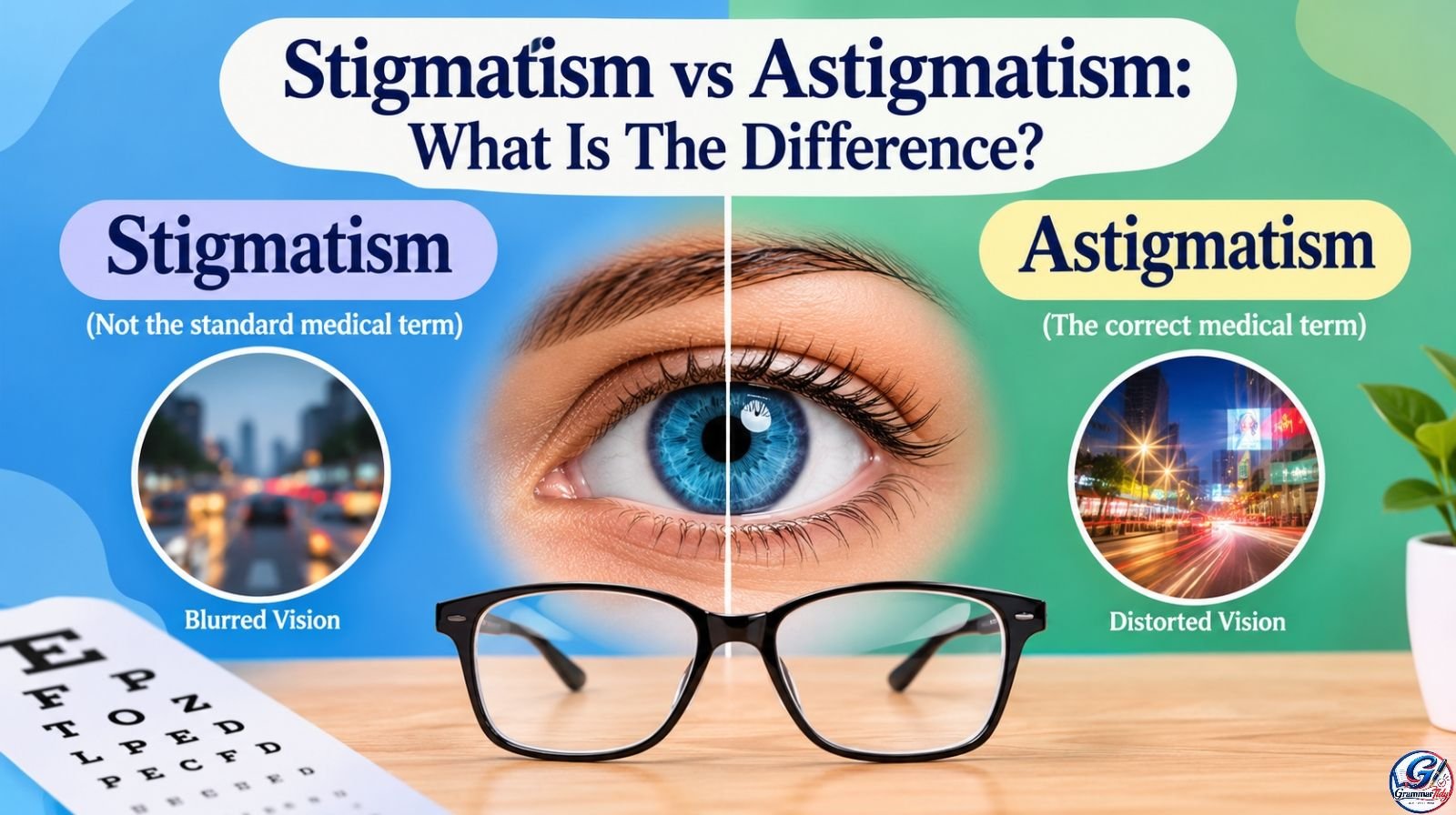
Astigmatism is a common refractive error that affects how the eye focuses light. It can cause blurred or distorted vision, difficulty seeing fine details, eye strain, and headaches. In contrast, stigmatism is not the standard medical term for this eye condition. People often use it informally as a shortened or mistaken version of astigmatism.
The confusion is understandable. If someone says, “I have stigmatism,” they may mean that an eye care professional has diagnosed them with astigmatism. Knowing the correct terminology helps people communicate more clearly with optometrists, ophthalmologists, teachers, employers, and others.
In this guide, we will explore stigmatism vs astigmatism, explain the correct spelling and meaning of each term, discuss common symptoms and causes, and provide practical examples of how to use the words in everyday conversations, emails, and professional situations.
Also Read: Skiis or Skis
Stigmatism vs Astigmatism: Quick Comparison
The easiest way to understand these terms is to compare their meanings, medical accuracy, and everyday usage.
| Feature | Stigmatism | Astigmatism |
|---|---|---|
| Standard medical term for the eye condition | No | Yes |
| Meaning in eye care | Often an informal or mistaken reference to astigmatism | A refractive error affecting how light focuses in the eye |
| Correct spelling for the condition | Astigmatism is preferred | Astigmatism |
| Commonly associated with blurred vision | People may intend this meaning | Yes |
| Used in eye prescriptions | Not normally as the diagnosis | Yes |
| Appropriate for formal medical writing | Generally no when referring to the eye condition | Yes |
The main takeaway is straightforward: astigmatism is the correct medical term for the eye condition, while stigmatism is commonly used as a nonstandard substitute.
For example, if a person says, “My doctor told me I have stigmatism,” the intended meaning may be clear. However, in a medical report, eye prescription, health article, or formal email, astigmatism is the appropriate word when referring to the refractive error.
What Does Stigmatism Mean?
The word stigmatism is often used in everyday conversation by people discussing eyesight. In many cases, the speaker intends to refer to astigmatism, but the word they use is not the standard name of the condition.
For instance, someone might say, “I have stigmatism, so I need to wear glasses when driving.” The listener may understand the intended meaning, but an eye care professional would generally use the term astigmatism in a diagnosis or prescription.
It is important to distinguish informal speech from medical terminology. A word can be understandable in a conversation without being the correct technical term.
Also Read: Says or Sais
Is Stigmatism a Correct Word?
The answer depends on what you mean by correct.
When referring to the common eye condition that causes blurred or distorted vision, astigmatism is the correct and widely recognized medical term. Stigmatism is not the standard name used for that refractive error.
However, the word stigmatism may appear in historical, specialized, or nonstandard contexts. It should not automatically be treated as incorrect in every possible context. The important point is that it should not replace astigmatism when describing the eye condition.
Consider these examples:
- Nonstandard: “The optometrist diagnosed me with stigmatism.”
- Correct: “The optometrist diagnosed me with astigmatism.”
- Nonstandard: “My stigmatism makes road signs look blurry.”
- Correct: “My astigmatism makes road signs look blurry.”
The corrected versions use the accepted medical term and communicate the intended meaning clearly.
Why Do People Say Stigmatism Instead of Astigmatism?
There are several possible reasons for this confusion.
1. The words sound similar. Both words share a similar ending, and astigmatism can be unfamiliar to someone who has never encountered it in writing.
2. People repeat what they hear. If a family member or friend uses stigmatism in conversation, others may adopt the same wording without checking it.
3. The beginning of the word may be overlooked. The initial letters in astigmatism can be easy to miss when someone hears the word quickly or remembers it imperfectly.
4. Informal speech favors convenience. People often simplify unfamiliar medical terms. That can make a conversation easier, but it does not change the accepted terminology.
For example, Ahmed might tell his colleague, “I need new glasses because my stigmatism has been bothering me.” His colleague may understand the intended meaning immediately. Nevertheless, if Ahmed writes to an optometrist about his diagnosis, using astigmatism is more precise.
Also Read: Vice Versa or Visa Versa
What Is Astigmatism?
Astigmatism is a common refractive error that occurs when the cornea, the clear front surface of the eye, or the lens inside the eye has an irregular curvature. As a result, light does not focus as it should on the retina, the light-sensitive tissue at the back of the eye. This can make objects appear blurry or distorted.
Astigmatism is not necessarily a serious eye disease. Many people have it, and its effects range from barely noticeable to significant enough to interfere with everyday activities.
How Does Astigmatism Affect Vision?
Think of a basketball and an American football. A basketball is approximately round, while a football has a more oval shape.
The cornea of an eye without significant astigmatism has a relatively even curvature. With astigmatism, the curvature differs in different directions. This uneven shape changes how light bends as it enters the eye.
Instead of focusing light as intended at a single point on the retina, the eye may focus it unevenly. The result can be blurred vision, distorted details, or difficulty focusing at near or far distances.
For example, Maria works as a graphic designer. She notices that small text looks slightly blurred and that bright lights appear distorted when she drives at night. After a comprehensive eye examination, her optometrist identifies astigmatism and discusses suitable corrective lenses.
Maria’s experience illustrates how astigmatism may affect everyday activities, although these symptoms alone cannot confirm the condition.
Is Astigmatism Common?
Yes. Astigmatism is a common vision condition that can affect children, teenagers, and adults. Some people have it from birth, while others develop it as they grow or experience changes in their eyes.
It can also occur alongside other refractive errors, including myopia (nearsightedness) and hyperopia (farsightedness). This means someone may have difficulty seeing distant objects clearly and also experience distortion caused by astigmatism.
The severity varies from person to person. Some individuals have mild astigmatism and do not notice obvious symptoms, while others benefit from prescription glasses or contact lenses.
Common Symptoms of Astigmatism
Recognizing possible symptoms can help someone decide when to arrange an eye examination. However, symptoms alone cannot establish whether a person has astigmatism.
Common signs may include:
- Blurred vision: Letters, objects, or fine details may not look sharp.
- Distorted vision: Straight lines or shapes may appear less clear than expected.
- Eye strain: The eyes may feel tired after reading, studying, or using a computer.
- Headaches: Some people experience headaches after prolonged visual concentration.
- Squinting: A person may squint in an attempt to see more clearly.
- Difficulty seeing at night: Bright lights may appear to have glare or halos, and night driving may become more challenging.
These symptoms can also occur with other vision problems, so an eye examination is the appropriate way to identify the cause.
Scenario Example: Astigmatism at Work
Consider Daniel, who works in an office and spends most of his day reading spreadsheets.
Recently, he has started experiencing eye fatigue and headaches after several hours at his computer. He initially assumes that he simply needs more breaks. However, the symptoms continue, so he schedules an eye examination.
The optometrist identifies astigmatism and recommends an appropriate prescription.
Daniel can now explain his situation more accurately by saying:
“My eye examination showed that I have astigmatism, which may be contributing to my visual discomfort.”
This example demonstrates the correct use of the term. It does not mean every computer-related headache is caused by astigmatism; other causes may need to be considered.
Also Read: 22th or 22nd
What Causes Astigmatism?
Astigmatism develops when the cornea or the lens has a curvature that causes light to focus unevenly. In many cases, the precise reason for an individual’s eye shape is not known.
Possible factors include:
- Inherited characteristics: Astigmatism can run in families.
- Normal eye development: The condition may be present from birth or develop during childhood or young adulthood.
- Eye injury: Certain injuries may change the shape of the eye’s optical surfaces.
- Eye surgery: Some procedures can affect corneal curvature.
- Other eye conditions: Conditions such as keratoconus can cause irregular changes in corneal shape.
Astigmatism is not generally caused by reading in dim light or sitting too close to a television.
Scenario Example: A Child Struggling to Read
Suppose a teacher notices that eight-year-old Hassan frequently squints at the classroom board. He also struggles to read small words from a distance and sometimes loses his place while copying notes.
His parents arrange an eye examination, and the optometrist identifies astigmatism.
In this situation, the teacher should not diagnose the child or assume that he is inattentive. Instead, the teacher can share observations with his parents and encourage them to seek professional advice.
This scenario also illustrates why regular eye examinations are important for children. Young children may not recognize or explain that their vision is unclear.
How Is Astigmatism Diagnosed?
Astigmatism is diagnosed through an eye examination performed by a qualified eye care professional, such as an optometrist or ophthalmologist. A person cannot reliably determine whether they have astigmatism simply by noticing blurry vision or comparing their symptoms with those of someone else.
An examination may include several tests, depending on the individual’s needs.
Visual Acuity Test
A visual acuity test checks how clearly someone can see letters or symbols at a specified distance. It helps the eye care professional assess visual clarity and determine whether further testing is needed.
Refraction Test
A refraction test helps determine the prescription needed to correct a person’s vision. The professional may ask the patient to look through different lenses and compare which options provide clearer vision.
Corneal Curvature Measurements
Specialized instruments can measure the curvature of the cornea. These measurements help identify whether the surface has an irregular shape associated with astigmatism.
A comprehensive examination may involve additional tests when the clinician needs more information about the eye’s health.
Also Read: Todays or Today’s
Scenario Example: Preparing for an Eye Appointment
Ayesha has been experiencing blurred vision while reading road signs. She wants to book an appointment but is unsure how to explain her concern.
She could say:
“I have noticed blurred vision when looking at distant signs, and I would like to have my eyesight checked. Could you please arrange a comprehensive eye examination?”
This is better than self-diagnosing the problem as astigmatism before an examination. The professional can determine whether astigmatism or another vision condition explains her symptoms.
How Is Astigmatism Treated?
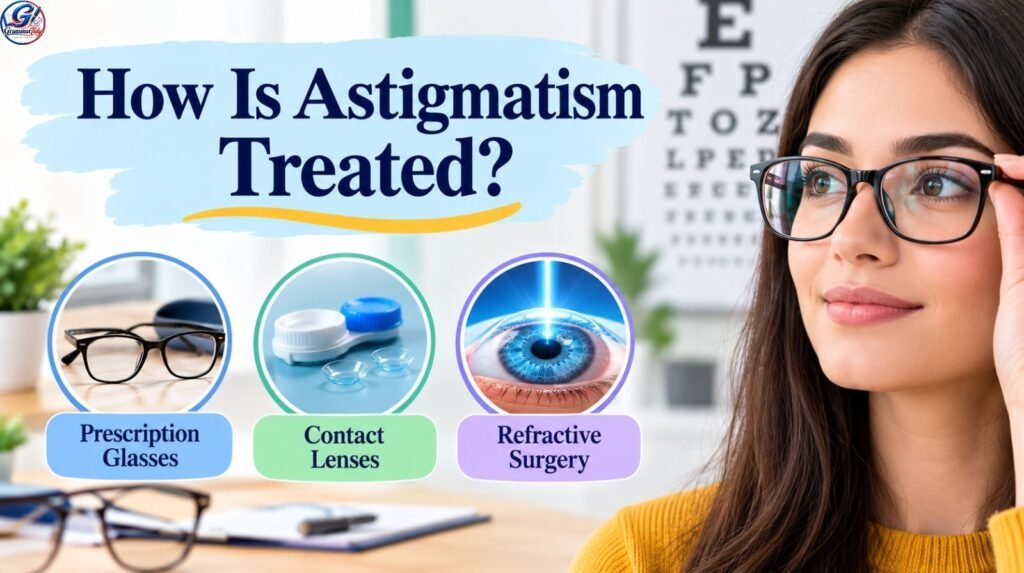
Treatment depends on the degree of astigmatism, the person’s symptoms, and their overall eye health. Some people with mild astigmatism may not need correction, while others benefit from prescription lenses or, in selected cases, surgery.
Prescription Glasses
Eyeglasses are a common way to correct astigmatism. Specially prescribed lenses compensate for the eye’s uneven focusing and help light reach the retina more appropriately.
For example, a student who struggles to read the classroom board may find that properly prescribed glasses make the text clearer.
Contact Lenses
Contact lenses are another option. Depending on the prescription and the individual’s eyes, an eye care professional may recommend lenses designed specifically to correct astigmatism.
The appropriate choice depends on comfort, suitability, lens care, and professional advice.
Refractive Surgery
Some people may be suitable candidates for refractive surgery, which changes the way the eye focuses light. However, surgery is not appropriate for everyone and involves potential risks. A qualified ophthalmologist can explain the available procedures and assess whether a person is a suitable candidate.
The best treatment is individual: it should be selected with an eye care professional rather than based on symptoms or advice from friends.
Stigmatism vs Astigmatism in Everyday Communication
The difference between the two terms becomes particularly important when communicating with health professionals, writing medical documents, or discussing eyesight in a workplace or school setting.
In casual conversation, a listener may understand what someone means by stigmatism. In formal writing, however, astigmatism should be used when referring to the diagnosed refractive error.
The following examples show how the correct terminology can be used naturally in different situations.
Scenario 1: Asking a Friend About Glasses
Imagine that Bilal notices his friend Omar wearing new glasses.
Incorrect or nonstandard wording:
“Did you get those glasses because of your stigmatism?”
Correct wording:
“Did you get those glasses to correct your astigmatism?”
The second version uses the accepted medical term. It is also a natural way to ask a question without making assumptions about the person’s eyesight.
Also Read: Combatting vs Combating
Scenario 2: Writing an Email to an Optometrist
Suppose Sarah needs to ask her optometrist about an existing diagnosis.
Subject: Question About My Astigmatism Prescription
Dear Dr. Ahmed,
I recently had an eye examination and was prescribed glasses to correct my astigmatism. I would like to confirm whether I should wear them throughout the day or primarily during activities such as reading and driving. Could you please advise me on the recommended usage based on my prescription? Thank you for your time and assistance..
Kind regards,
Sarah Malik
This email uses astigmatism correctly and provides enough context for the recipient to understand the question. It also avoids making assumptions about how often Sarah should wear her glasses.
Scenario 3: Explaining the Condition to a Teacher
A parent may need to inform a teacher that a child has a vision condition affecting classroom activities.
Example:
Dear Ms. Wilson,
I wanted to let you know that Adam has been diagnosed with astigmatism. He may occasionally have difficulty reading text on the classroom board. We are following the advice provided by his eye care professional. Thank you for your understanding and support.
Best regards,
Michael
In this example, astigmatism is the appropriate term because the parent is communicating a medical diagnosis. The message is respectful, clear, and suitable for a school setting.
Scenario 4: Writing a Health Article
Suppose a writer is preparing a blog post about common vision conditions.
Nonstandard sentence:
“Stigmatism can make it difficult for people to see clearly at different distances.”
Improved sentence:
“Astigmatism is a refractive error that can cause blurred or distorted vision at near and far distances.”
The revised version is more precise and appropriate for an educational article. It also introduces the technical term that readers can use when seeking reliable information.
Scenario 5: Discussing a Diagnosis at Work
Imagine that Emily has difficulty reading small text on a presentation screen. Her manager asks whether she needs any adjustments.
Emily could explain:
“I have astigmatism, which can affect how clearly I see certain text and images. I am arranging the appropriate vision correction, and a larger presentation font may also help me read the slides comfortably.”
This example shows how correct terminology can support practical communication. It does not imply that every person with astigmatism requires workplace adjustments; needs vary between individuals.
Common Mistakes to Avoid When Using Stigmatism and Astigmatism
Even though the distinction is relatively simple, several mistakes can lead to confusion.
Mistake 1: Treating Both Words as Equally Standard Medical Terms
The most important mistake is assuming that stigmatism and astigmatism are interchangeable names for the eye condition.
Better approach: Use astigmatism in medical conversations, formal documents, educational content, and health-related writing.
Mistake 2: Assuming Blurred Vision Always Means Astigmatism
Blurred vision may have several causes, including different refractive errors and other eye conditions.
Better approach: Describe the symptoms accurately and arrange an eye examination instead of assuming a diagnosis.
Mistake 3: Confusing Astigmatism With Nearsightedness
Nearsightedness primarily makes distant objects difficult to see clearly. Astigmatism results from uneven curvature of the cornea or lens and can affect vision at different distances. Both conditions may occur together.
Better approach: Learn the differences between the terms and rely on a professional assessment to understand your prescription.
Also Read: Vender vs Vendor
Mistake 4: Using Informal Wording in a Medical Email
A recipient may understand an informal expression, but using the accepted medical term helps avoid ambiguity.
Better approach: Write, “I have been diagnosed with astigmatism,” rather than “I have been diagnosed with stigmatism.”
Mistake 5: Assuming Glasses Are Necessary for Everyone
Not every person with astigmatism requires the same treatment. Some have mild cases, while others need prescription correction.
Better approach: Follow the recommendations of an eye care professional who has examined your eyes.
Mini Quiz: Stigmatism vs Astigmatism
Question 1: Which spelling is correct for the common vision condition?
A) Stigmatism
B) Astigmatism
Answer: B) Astigmatism
Question 2: Which symptom may be associated with astigmatism?
A) Blurred or distorted vision
B) Improved night vision
Answer: A) Blurred or distorted vision
Question 3: Which option can help correct astigmatism?
A) Prescription glasses or contact lenses
B) Reading in dim light
Answer: A) Prescription glasses or contact lenses
Frequently Asked Questions
1. Is stigmatism or astigmatism correct?
Astigmatism is the correct and widely recognized medical term for the eye condition that affects how light focuses inside the eye. Stigmatism is often used informally or mistakenly when referring to astigmatism, but it is not the standard medical term for this condition.
2. Is stigmatism the same as astigmatism?
People who say stigmatism often intend to mean astigmatism. However, astigmatism is the accepted medical term for the refractive error that can cause blurred or distorted vision. Using the correct term helps avoid confusion in medical conversations and formal writing.
3. What is astigmatism in simple words?
Astigmatism is a common vision condition that occurs when the cornea or lens has an irregular curvature. This affects how light focuses on the retina and may cause blurred or distorted vision. Many people manage the condition with prescription glasses or contact lenses.
4. What are the common symptoms of astigmatism?
Common symptoms of astigmatism may include blurred vision, distorted details, eye strain, headaches, squinting, and difficulty seeing clearly at night. These symptoms can also occur with other vision problems, so an eye examination is necessary to identify the cause.
5. What causes astigmatism?
Astigmatism occurs when the cornea or lens has an uneven curvature that affects how light enters and focuses inside the eye. It may be present from birth, run in families, or develop over time. Certain eye injuries, surgeries, and eye conditions can also affect corneal shape.
6. Can astigmatism be corrected with glasses?
Yes, prescription glasses are a common way to correct astigmatism. Special lenses compensate for the eye’s uneven focusing and help improve visual clarity. Contact lenses and certain surgical procedures may also be options, depending on the person’s eye health and individual needs.
7. Can you have astigmatism without knowing it?
Yes, some people have mild astigmatism without noticeable symptoms. They may discover it during a routine eye examination. Other people experience blurred vision, eye strain, or difficulty focusing. Regular eye examinations can help identify vision problems and determine whether correction is needed.
8. Can astigmatism affect both near and distance vision?
Yes, astigmatism can affect both near and distance vision. Objects, letters, and fine details may appear blurred or distorted at different distances. The severity varies from person to person, and astigmatism can occur alongside nearsightedness or farsightedness.
9. How do you pronounce astigmatism?
Astigmatism is commonly pronounced “uh-STIG-muh-tiz-um.” Breaking the word into smaller sound groups can make it easier to pronounce and remember the correct spelling.
10. Should I see an eye doctor if my vision is blurry?
Yes, you should arrange an eye examination if you experience persistent blurred vision, eye strain, headaches, or difficulty seeing clearly. Do not assume that astigmatism is the cause without a professional assessment. Seek urgent medical attention for sudden vision loss or sudden significant changes in vision.
Conclusion
Understanding Stigmatism vs Astigmatism helps you recognize the correct spelling and understand what this vision condition actually means. Astigmatism is the medically correct term for a common refractive error that occurs when the cornea or lens has an irregular shape, causing light to focus unevenly on the retina.
This can lead to blurred or distorted vision, eye strain, headaches, and difficulty seeing clearly at different distances. Although many people mistakenly write “stigmatism,” using astigmatism is important when discussing eye health, writing articles, or searching for reliable information about vision problems.
The good news is that astigmatism can often be managed with prescription glasses, contact lenses, or, in some cases, refractive surgery, depending on a person’s eye health and individual needs. If you experience persistent blurry vision, frequent headaches, or difficulty focusing, an eye examination can help identify the cause and determine the appropriate treatment.
By learning the difference between these terms, recognizing common symptoms, and understanding available correction options, you can communicate more accurately about astigmatism and make better-informed decisions about your eye care.
Keep learning with more easy grammar lessons on GrammarTidy.com

Hi, I’m Noor Fatima, the author and creator of Grammar Tidy. I’m passionate about grammar, writing, and making language learning simple and enjoyable. Through Grammar Tidy, I share helpful tips, clear explanations, and practical guidance to help readers improve their writing, avoid common mistakes, and communicate with confidence. My goal is to make better grammar easy, useful, and accessible for everyone.