Have you ever wondered whether to write labelling or labeling? You might notice both spellings in emails, product packaging, school assignments, and business documents. So, which one is correct?
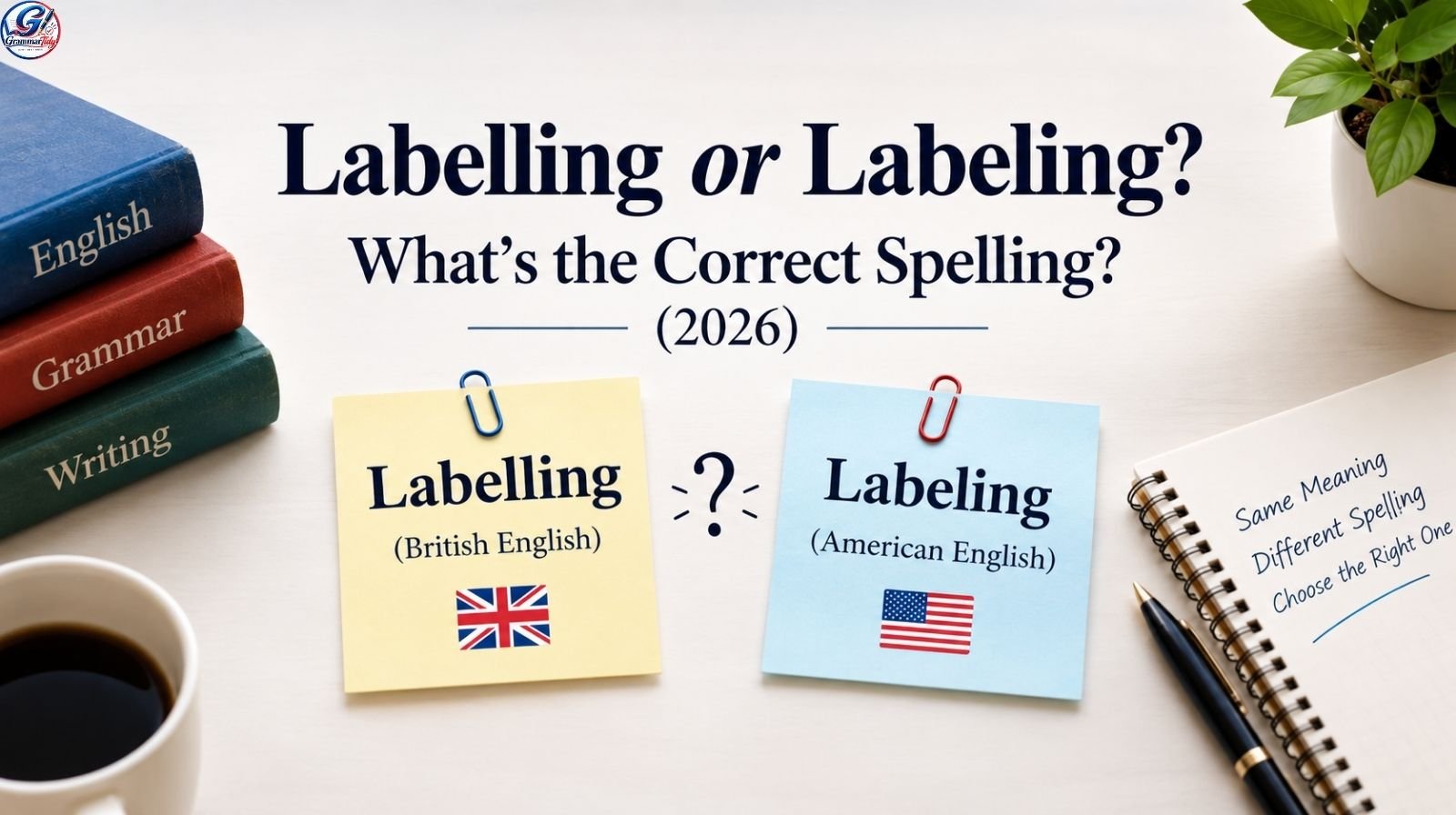
The answer is that both labelling and labeling are correct spellings. The difference depends mainly on the variety of English you use. Labeling is standard in American English, while labelling is standard in British English.
In this guide, you’ll learn why the spellings differ, how to use each form correctly, and which version to choose for professional writing in 2026.
Also Read: Accross vs Across: Which Is The Correct Spelling?
Labelling or Labeling: Which Spelling Is Correct?

Both spellings are correct, but they follow different regional spelling conventions. Choosing the appropriate version depends on your audience and the English style you follow.
- Labeling: Preferred in American English.
- Labelling: Preferred in British English.
For example:
- American English: The team is labeling the boxes.
- British English: The team is labelling the boxes.
Both sentences have the same meaning. Neither spelling is inherently wrong; the important thing is to use the form that suits your audience.
What Does Labelling or Labeling Mean?
Both words refer to the act of attaching a label to something or identifying something with a name, description, or category.
Examples include:
- Products: The company is labeling each bottle with its ingredients.
- Schoolwork: The student is labelling the parts of a flower.
- Storage: We are labeling every box before moving.
- Data: The researcher is labeling images for a computer vision project.
The meaning remains the same regardless of which spelling you choose.
Is Labelling Wrong in American English?
Labelling is understandable, but labeling is the standard American spelling. If you’re writing for an American company, publication, or school, use labeling unless a specific style guide requires otherwise.
Similarly, British readers will generally expect labelling in UK English writing.
Why Do Labelling and Labeling Have Different Spellings?
The difference comes from regional spelling conventions. British English often doubles a final consonant when adding certain endings to words, while American English frequently keeps the single consonant in words such as label.
The Rule Behind the Extra L
The base word is label. When adding -ing, the two common forms are:
- American English: label + ing = labeling
- British English: label + ling pattern in British spelling = labelling
More precisely, British English doubles the final l in label before adding -ing, whereas standard American English generally does not.
Also Read: Vinal vs Vinyl: Which Is The Correct One To Use?
Compare these related forms:
| American English | British English |
|---|---|
| Labeling | Labelling |
| Labeled | Labelled |
| Labeler | Labeller |
These differences are part of wider spelling patterns, although English has exceptions and not every word follows exactly the same rule.
Other Words With Similar Differences
You can see the same general pattern in several familiar words.
| American English | British English |
|---|---|
| Traveling | Travelling |
| Canceled | Cancelled |
| Modeling | Modelling |
| Signaling | Signalling |
| Labeling | Labelling |
These pairs demonstrate why writers sometimes hesitate over a single letter. The preferred spelling often depends on the regional variety of English, not a difference in meaning.
Does the Extra L Change Pronunciation or Meaning?
No. In ordinary use, labelling and labeling mean the same thing and are pronounced essentially the same way.
For example:
- “She is labeling the folders.”
- “She is labelling the folders.”
Both sentences describe someone marking folders with identifying information. The extra l is a spelling difference, not a change in meaning.
How to Choose Between Labelling and Labeling
The easiest way to choose the correct spelling is to identify your target audience before writing. If you’re preparing a school assignment, business report, blog post, or product description, follow the spelling conventions expected by your readers.
Also Read: Win or Lose Episodes: Complete Episode Guide (2026)
American vs. British English: Quick Comparison
| Feature | American English | British English |
|---|---|---|
| Preferred spelling | Labeling | Labelling |
| Past tense | Labeled | Labelled |
| Present participle | Labeling | Labelling |
| Common audience | United States | United Kingdom |
| Example | Labeling the packages | Labelling the packages |
Quick rule: Use labeling for American English and labelling for British English. If your organization has a style guide, follow that guide consistently.
Examples of Labelling and Labeling in Sentences
Here are practical examples showing how each spelling works in everyday writing.
American English examples
- The company is labeling its new products.
- I spent the afternoon labeling my storage boxes.
- The teacher is labeling the diagram for her students.
- Proper labeling helps customers identify ingredients.
- The workers finished labeling every package.
British English examples
- The company is labelling its new products.
- I spent the afternoon labelling my storage boxes.
- The teacher is labelling the diagram for her students.
- Proper labelling helps customers identify ingredients.
- The workers finished labelling every package.
Notice that the meaning and sentence structure remain unchanged. Only the spelling differs.
Also Read: GitLab or GitHub: Which One Should You Choose?
Real-Life Case Study: Choosing the Right Spelling for a Business
Imagine a small business that sells skincare products in both the United States and the United Kingdom. Its marketing team prepares product descriptions, packaging labels, website pages, and customer emails for both markets.
Initially, the team uses labeling throughout its content because its original website was written for American customers. However, when the company expands into the UK, its British marketing editor notices that the website uses American spellings in several places.
The editor recommends changing labeling to labelling on the UK-facing website and using labelled instead of labeled wherever the past-tense form appears.
What the Team Does
The business creates two editorial checklists:
- The US checklist specifies labeling, labeled, and other preferred American spellings.
- The UK checklist specifies labelling, labelled, and other preferred British spellings.
The team then reviews product pages, email templates, packaging descriptions, and other customer-facing material. It also checks that the spelling used in each document matches the intended market.
What Can We Learn From This Example?
This hypothetical case illustrates why spelling consistency matters in professional communication. The company doesn’t need to change the meaning of its product descriptions or rewrite every sentence. It simply adapts the spelling to the expectations of each audience.
It also demonstrates a useful editorial principle: choose a regional spelling standard and apply it consistently across related content.
This approach is especially helpful for international businesses, bloggers, translators, and writers who publish in multiple English-speaking markets. Although neither spelling is universally superior, the right choice can make content feel more natural and polished to its intended readers.
Also Read: Who Won The Vietnam War: U.S. Or Vietnam?
Labelling or Labeling: Statistics and Usage in 2025–2026
There is no verified, authoritative 2025–2026 statistic establishing a precise percentage of English writers who use labelling compared with labeling. Giving an exact percentage without a reliable dataset would be misleading.
However, established dictionary conventions provide a clear explanation of the regional distinction.
What Do English Spelling Conventions Tell Us?
- British English: Generally uses labelling and labelled.
- American English: Generally uses labeling and labeled.
- International writing: The preferred form depends on the publication’s style guide and target audience.
What These Findings Mean for Writers
The evidence supports three practical conclusions for 2026:
- Both spellings are established English forms.
- Regional conventions determine which spelling is normally preferred.
- Writers should prioritize clarity, consistency, and their audience’s expectations rather than assume one spelling is universally correct.
For SEO content, use the appropriate spelling throughout your article while naturally including spelling variations when they genuinely help readers. Neither spelling automatically guarantees better search rankings.
Also Read: Winter Spring Summer or Fall: Meaning, Movie, And Season Order
Frequently Asked Questions
1. Is It Labelling or Labeling?
Both are correct. Labeling is the standard American English spelling, while labelling is the standard British English spelling.
2. Is Labelling With Two Ls British English?
Yes. British English generally uses labelling, with two consecutive l letters before the -ing ending.
3. Is Labeling With One L American English?
Yes. American English typically uses labeling, with one l before the -ing ending.
4. Is It Labeled or Labelled?
Both are correct. Use labeled in American English and labelled in British English.
5. Does Labelling Mean Something Different From Labeling?
No. Both forms have the same meaning. The difference is regional spelling rather than grammar or vocabulary.
6. Which Spelling Should I Use for SEO in 2026?
Choose the spelling that best fits your target audience. For US readers, use labeling; for UK readers, use labelling. Keep the spelling consistent throughout your article and use natural variations when they genuinely help explain the topic.
Conclusion:
The answer to labelling or labeling is simple: both spellings are correct, but each belongs to a different regional spelling convention.
Use labeling when writing in American English and labelling when writing in British English. The same distinction applies to labeled and labelled. Neither version changes the word’s meaning, so there’s no need to worry that one is inherently incorrect.
The most important thing is consistency. Choose the spelling that suits your audience, follow your preferred style guide, and apply the same rule throughout your writing.
Ready to improve your spelling? Check your next article, email, or business document for regional spelling differences and make sure your word choices match your readers’ expectations.
Discover More Article
- Goodmorning or Good Morning: The Correct Usage (And Why It Actually Matters)
- Bougie vs Boujee: The Real Difference Most People Miss
- Cancellation vs Cancelation: Which Spelling Is Correct?
- Unenroll vs Disenroll: Which One Is Correct?
Keep learning with more easy grammar lessons on GrammarTidy.com

Hi, I’m Noor Fatima, the author and creator of Grammar Tidy. I’m passionate about grammar, writing, and making language learning simple and enjoyable. Through Grammar Tidy, I share helpful tips, clear explanations, and practical guidance to help readers improve their writing, avoid common mistakes, and communicate with confidence. My goal is to make better grammar easy, useful, and accessible for everyone.