Have you ever typed “shinning” when you meant “shining”? You are not alone. The two words look almost identical, but the extra n changes the meaning completely. In most everyday writing, shining is the correct spelling when you mean giving off or reflecting light, looking bright, or doing exceptionally well. Shinning is also a legitimate English word, but it comes from the verb shin and has a very different meaning.
In this guide, you will learn the difference between shinning vs shining, see real examples, understand why people confuse them, and discover a simple way to remember which spelling to use.
Shinning vs Shining: Which Spelling Is Correct?
The answer depends on what you are trying to say.
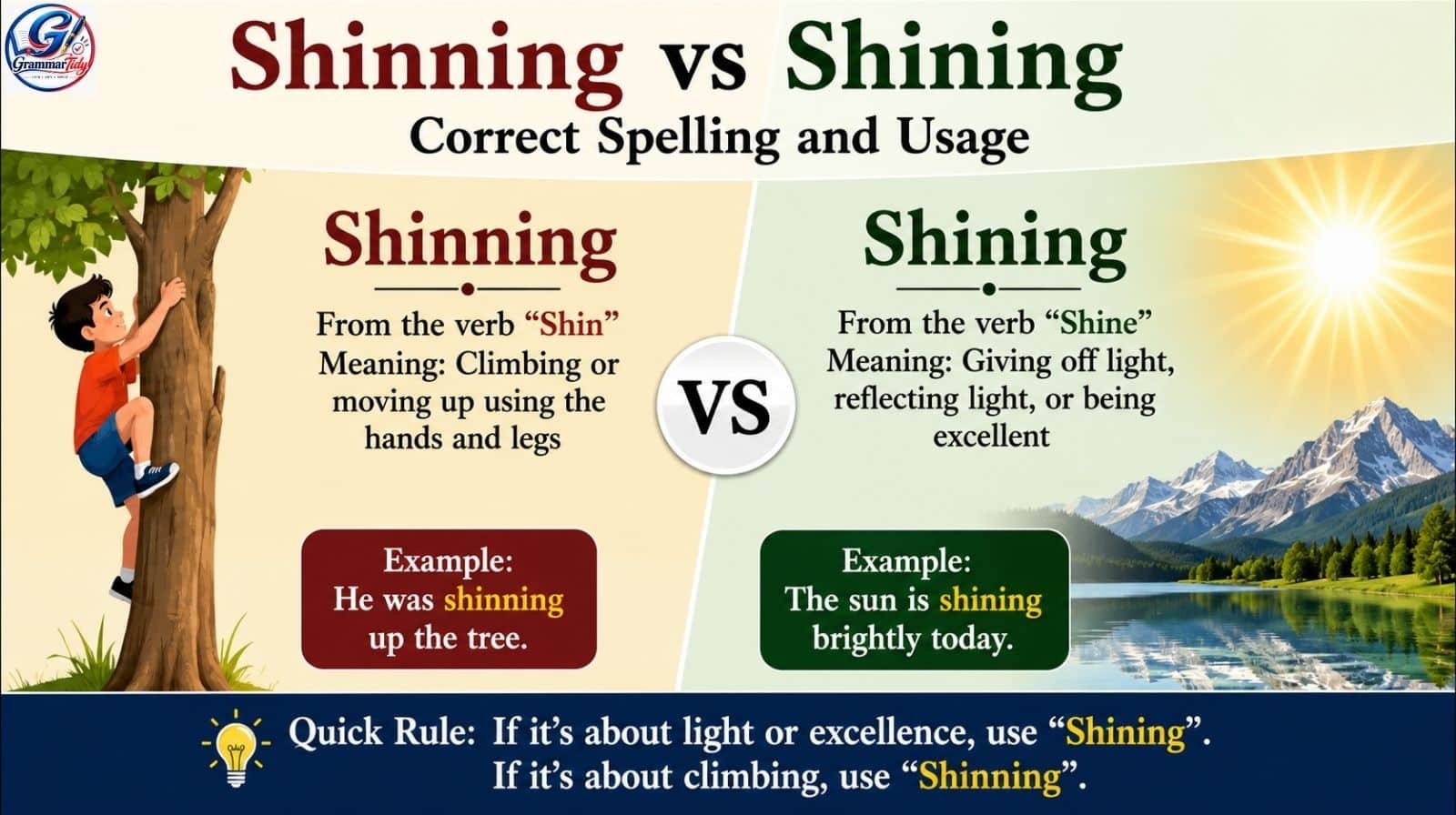
Shining is the correct word when you are talking about light, brightness, attractiveness, excellence, or the present participle of shine. Cambridge Dictionary defines shining as something that sends out or reflects light and also uses it to describe something excellent or admirable.
Shinning, on the other hand, is a real but uncommon word. It is the present participle of shin, meaning to climb or move using the hands and legs, often up a pole, tree, rope, or similar object. Merriam-Webster and Collins both recognize this usage.
When to Use “Shining”
Use shining when the subject:
- Gives off light
- Reflects light
- Looks bright
- Performs exceptionally well
- Shows a positive or admirable quality
Examples:
- The sun is shining brightly today.
- Her eyes were shining with happiness.
- He is a shining example of dedication.
- The stars were shining in the night sky.
When to Use “Shinning”
Use shinning only when you mean the action associated with shin—climbing or moving by gripping something with your hands and legs.
Examples:
- The boy was shinning up the tree.
- They watched him shinning up the pole.
- He injured his leg while shinning up the fence.
This meaning is much less common in everyday English, which is one reason people may mistakenly use shinning when they actually mean shining.
What Does “Shining” Mean?
Shining is the common word most people are looking for when they type “shinning.” It comes from the verb shine.
Cambridge Dictionary gives shine several relevant meanings, including producing or reflecting light and being extremely good at an activity.
Shining Means Giving Off or Reflecting Light
The most common meaning relates to brightness or light.
Examples:
- The moon is shining tonight.
- The polished floor was shining.
- A bright lamp was shining through the window.
- The stars were shining above us.
Here, shining describes something that produces or reflects light.
Shining Can Mean Excellent or Impressive
The word can also be used figuratively.
For example:
She is a shining example of what hard work can achieve.
Here, shining does not mean literally producing light. It means excellent, admirable, or outstanding. Cambridge specifically recognizes this figurative sense.
Other examples include:
- He had a shining career.
- Her performance was a shining success.
- This is a shining example of teamwork.
Shining as the Present Participle of “Shine”
The basic verb is shine, and its -ing form is shining.
Shine → Shining
For example:
- The sun shines every morning.
- The sun is shining now.
- She shines on stage.
- She is shining on stage tonight.
Notice that the word does not normally become shinning when you add -ing.
Why Do People Confuse Shinning and Shining?
The confusion is understandable because the words differ by only one letter.
The Extra “n” Looks Natural
English has many short verbs that double their final consonant before adding -ing, such as:
- run → running
- sit → sitting
- swim → swimming
- plan → planning
Because of this familiar spelling pattern, some writers assume:
shine → shinning
But that is not the standard spelling.
The correct form is:
shine → shining
The spelling removes the final e before adding -ing.
Also Read: Courtesy vs Curtesy: Meaning, Usage And Common Mistakes
Pronunciation Does Not Clearly Help
In normal speech, shining and shinning can sound similar enough that pronunciation does not always reveal the spelling.
Therefore, writers may know exactly what they want to say but still choose the wrong spelling.
Spellcheck May Not Always Catch the Error
There is another important problem: shinning is actually a dictionary word. Merriam-Webster lists shinning as a form of shin, while Collins also recognizes it as the present participle of shin.
So a spelling checker may not treat shinning as a simple spelling mistake.
That makes this a word-choice problem as well as a spelling problem.
Shinning vs Shining: Quick Comparison
| Feature | Shining | Shinning |
|---|---|---|
| Base word | Shine | Shin |
| Meaning | Giving off/reflecting light; excellent | Climbing or moving using hands and legs |
| Common in everyday English? | Yes | No, relatively uncommon |
| Example | The sun is shining. | He was shinning up the tree. |
| Correct for “giving light”? | ✅ Yes | ❌ No |
| Extra “n” | No | Yes |
Quick rule: If you are talking about light, brightness, success, or excellence, choose shining.
Shining vs Shinning in Real Sentences
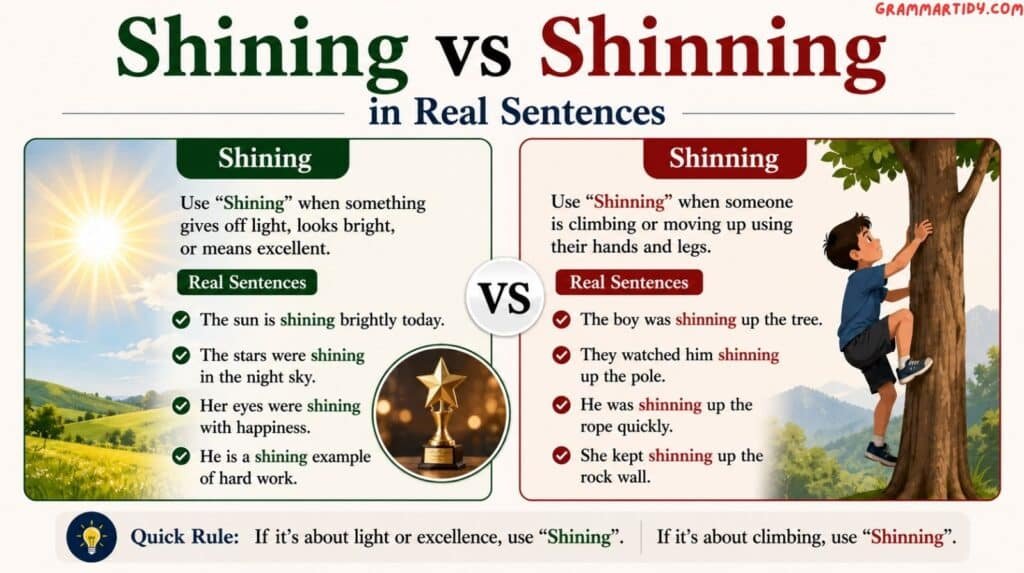
Seeing the words in context makes the distinction much easier.
Examples With “Shining”
Light:
The sun was shining through the window.
Reflection:
Her shoes were clean and shining.
Positive quality:
He is a shining example of leadership.
Performance:
She is shining in her new role.
These uses all connect to the idea of brightness or excellence.
Examples With “Shinning”
Climbing:
The children were shinning up the old tree.
Moving upward:
He was shinning up the pole when someone called him.
Climbing with the body:
The athlete practiced shinning up the rope.
The meaning is completely different from shining.
Also Read: Quantify vs Qualify: Differences And Correct Usage
Incorrect vs Correct
| Incorrect in the intended meaning | Correct |
|---|---|
| The sun is shinning. | The sun is shining. |
| Her eyes were shinning with joy. | Her eyes were shining with joy. |
| He is a shinning example. | He is a shining example. |
| The stars are shinning. | The stars are shining. |
However, shinning can be correct when the sentence genuinely describes climbing:
The boy was shinning up the tree.
That distinction is important because calling shinning simply “wrong” would be inaccurate. Dictionaries recognize it as a legitimate form of shin.
Case Study: A Simple Writing Mistake That Changes the Meaning
Imagine a student preparing a school presentation about astronomy. She writes the sentence:
“The stars were shinning brightly across the night sky.”
At first glance, the sentence looks perfectly understandable. The reader can easily guess what she means. However, the spelling is wrong for the intended meaning. The correct sentence is:
“The stars were shining brightly across the night sky.”
The problem becomes clearer when we examine the two words. Shining comes from shine, which is exactly the verb needed to describe stars producing or reflecting light. Shinning, by contrast, comes from shin and describes climbing or moving by gripping something with the hands and legs.
Now imagine that the same student writes a second sentence:
“The climber was shinning up the rope.”
This time, shinning is appropriate because the sentence describes climbing.
This example demonstrates why the issue is not simply “one spelling is right and the other is wrong.” The words have different meanings and grammatical roots. In normal writing about sunlight, stars, polished surfaces, success, or admirable people, shining is the word you want. Only use shinning when the context specifically involves the verb shin.
What the 2025–2026 Evidence Tells Us
A useful point from current dictionary evidence is that the distinction remains unchanged in modern English.
Cambridge’s current dictionary entry identifies shining as the -ing form associated with shine and gives both literal meanings related to light and figurative meanings related to excellence.
Meanwhile, current Merriam-Webster material continues to list shinning under shin, including meanings connected with climbing and moving on foot.
What We Can Safely Conclude
There is no need to treat “shinning” as a new spelling of “shining.” Current dictionary evidence supports two separate words:
- shine → shining
- shin → shinning
This is more useful than simply memorizing that one spelling is “correct.”
Why Searchers Still Find Both Forms
Because shinning is a genuine English word, online searches and spellcheckers can return both forms. That does not mean they are interchangeable.
For SEO writers, students, editors, and professional communicators, context is therefore more important than relying solely on an automated spelling check.
How to Remember the Correct Spelling of Shining
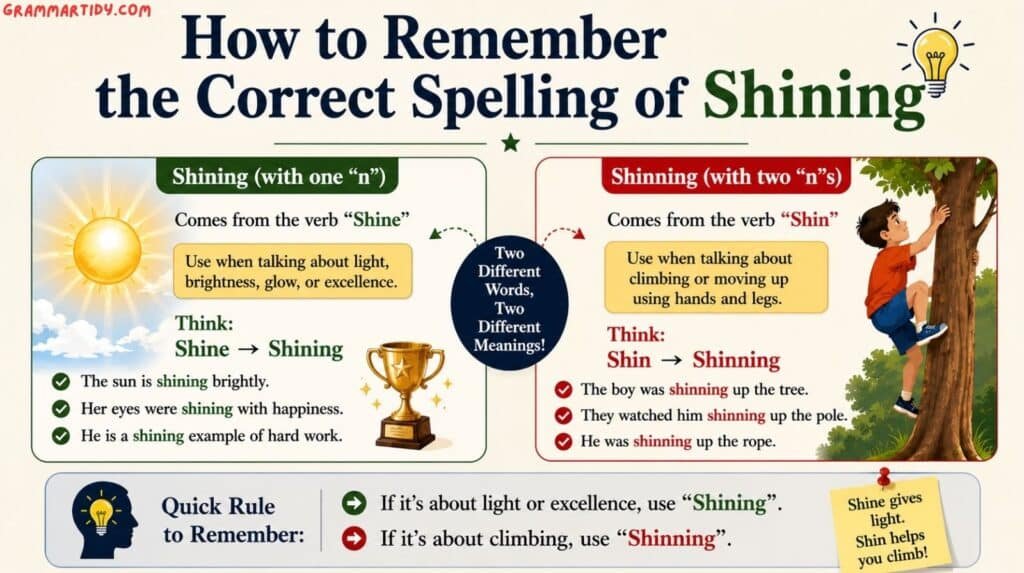
The easiest method is to remember the base word.
Think: Shine → Shining
Start with:
SHINE
Remove the final e and add -ing:
SHINE → SHINING
There is only one n after the “i.”
Use the Meaning Test
Ask yourself:
“Am I talking about light or excellence?”
If yes, use:
SHINING ✅
For example:
- shining sun
- shining stars
- shining eyes
- shining example
- shining career
If you are talking about climbing using the body and legs, then:
SHINNING ✅
This quick meaning test can prevent the mistake even when autocorrect does not.
A One-Line Memory Trick
Light shines; people shin up things.
That simple contrast gives you the two base verbs:
shine → shining
shin → shinning
Common Mistakes With Shining
Mistake 1: Writing “The Sun Is Shinning”
❌ The sun is shinning brightly.
✅ The sun is shining brightly.
The verb is shine, not shin.
Mistake 2: Writing “A Shinning Example”
❌ She is a shinning example of courage.
✅ She is a shining example of courage.
Here, shining means admirable or excellent.
Mistake 3: Assuming Shinning Is Always Wrong
❌ “Shinning” is never a word.
That statement is also inaccurate.
✅ Shinning is a real word when it comes from shin, especially in the sense of climbing or moving using the hands and legs.
The better rule is:
Use the word that matches the meaning.
Also Read: Accross vs Across: Which Is The Correct Spelling?
Mini Quiz Shinning vs Shining
Quiz 1: Pick the Right Word
The sun is ______ brightly today.
A) Shinning
B) Shining
Answer: B) Shining
Because the sentence is about giving off light.
Quiz 2: Which One Looks Right?
She is a ______ example of kindness.
A) Shinning
B) Shining
Answer: B) Shining
“Shining example” means an excellent or admirable example.
Quiz 3: Spot the Spelling
Which sentence is correct?
A) The stars are shinning.
B) The stars are shining.
Answer: B) The stars are shining.
Stars give off or reflect light, so “shining” is correct.
Quiz 4: What About Climbing?
The boy was ______ up the tree.
A) Shining
B) Shinning
Answer: B) Shinning
“Shinning” can describe climbing or moving upward using the hands and legs.
Quiz 5: Easy One!
Choose the correct form:
Shine → ?
A) Shinning
B) Shining
Answer: B) Shining
The -ing form of “shine” is “shining.”
Quiz 6: Light Check
The moon was ______ through the clouds.
A) Shinning
B) Shining
Answer: B) Shining
The sentence describes light, so “shining” fits.
Quiz 7: Meaning Matters
Which word relates to climbing?
A) Shining
B) Shinning
Answer: B) Shinning
“Shinning” comes from the verb “shin” and can mean climbing.
Quiz 8: Complete the Sentence
Her eyes were ______ with happiness.
A) Shinning
B) Shining
Answer: B) Shining
“Shining” can describe eyes that look bright or full of emotion.
Quiz 9: Quick Grammar Test
Which sentence uses “shinning” correctly?
A) The sun is shinning.
B) He was shinning up the pole.
Answer: B) He was shinning up the pole.
Here, “shinning” refers to climbing.
Quiz 10: One-N Rule
Which spelling is correct for brightness?
A) Shinning
B) Shining
Answer: B) Shining
When “shine” becomes an -ing form, it is spelled “shining.”
Quiz 11: Find the Mistake
Which sentence needs correction?
A) The stars are shining.
B) The polished floor is shining.
C) The sun is shinning.
Answer: C) The sun is shinning.
It should be “The sun is shining.”
Quiz 12: Meaning Match
“Shining example” usually means:
A) A glowing object
B) An excellent example
Answer: B) An excellent example
“Shining” can have a figurative meaning of excellent or admirable.
Quiz 13: Remember the Base Word
Which pair is correct?
A) Shine → Shining
B) Shine → Shinning
Answer: A) Shine → Shining
The correct present participle of “shine” is “shining.”
Quiz 14: Final Challenge
Which sentence is completely correct?
A) The moon is shinning brightly.
B) The climber was shining up the rope.
C) The sun is shining brightly.
Answer: C) The sun is shining brightly.
“Shining” is the correct form when describing light.
Quiz 15: The Golden Rule
If you are talking about light or excellence, which word should you choose?
A) Shinning
B) Shining
Answer: B) Shining
Remember: shine → shining. Use “shinning” for the separate verb “shin,” such as climbing.
FAQs
Q. Is “shinning” the correct spelling?
A: It depends on the meaning. Shining is correct when you mean giving off or reflecting light, or being excellent. Shinning is a legitimate but uncommon word related to the verb shin, meaning to climb or move using the hands and legs.
Q. Is it “the sun is shinning” or “the sun is shining”?
A: The correct sentence is:
The sun is shining.
The verb is shine, so its present participle is shining.
Q. Is “shinning” a real word?
A: Yes. Shinning is the present participle of shin and can refer to climbing or moving by gripping something with the hands and legs.
Q. Why is shining spelled with one “n”?
A: Because the base verb is shine. When forming the present participle, the final e is dropped before -ing:
shine → shining
It does not become shinning.
Q. What is the difference between shine and shin?
A: Shine relates to producing or reflecting light and can also mean performing extremely well. Shin refers to the front part of the lower leg and, as a verb, can mean climbing by gripping with the hands and legs.
Q. Which is more common: shining or shinning?
A: Shining is much more common in ordinary English because talking about light, brightness, and figurative excellence is far more frequent than using shin to describe climbing. The dictionary distinction is nevertheless important because shinning is still a valid word in its specific context.
Conclusion:
When comparing shinning vs shining, the key is to focus on meaning rather than simply counting letters.
Shining is the word you normally need when talking about light, brightness, attractive appearance, success, or excellence:
The stars are shining brightly.
Shinning has a different meaning and comes from shin. It can describe climbing or moving by gripping something with the hands and legs:
The boy was shinning up the tree.
So remember the simple rule: shine → shining when something gives off light or stands out; shin → shinning when someone is climbing or moving using the shins and limbs.
If you are writing an email, school assignment, article, website, or professional document, choosing shining instead of shinning will usually be the correct choice when you mean brightness or excellence.
Want to avoid more confusing English spelling mistakes? Keep this rule handy: when in doubt, check the base word first.
Keep learning with more easy grammar lessons on GrammarTidy.com

Hi, I’m Noor Fatima, the author and creator of Grammar Tidy. I’m passionate about grammar, writing, and making language learning simple and enjoyable. Through Grammar Tidy, I share helpful tips, clear explanations, and practical guidance to help readers improve their writing, avoid common mistakes, and communicate with confidence. My goal is to make better grammar easy, useful, and accessible for everyone.