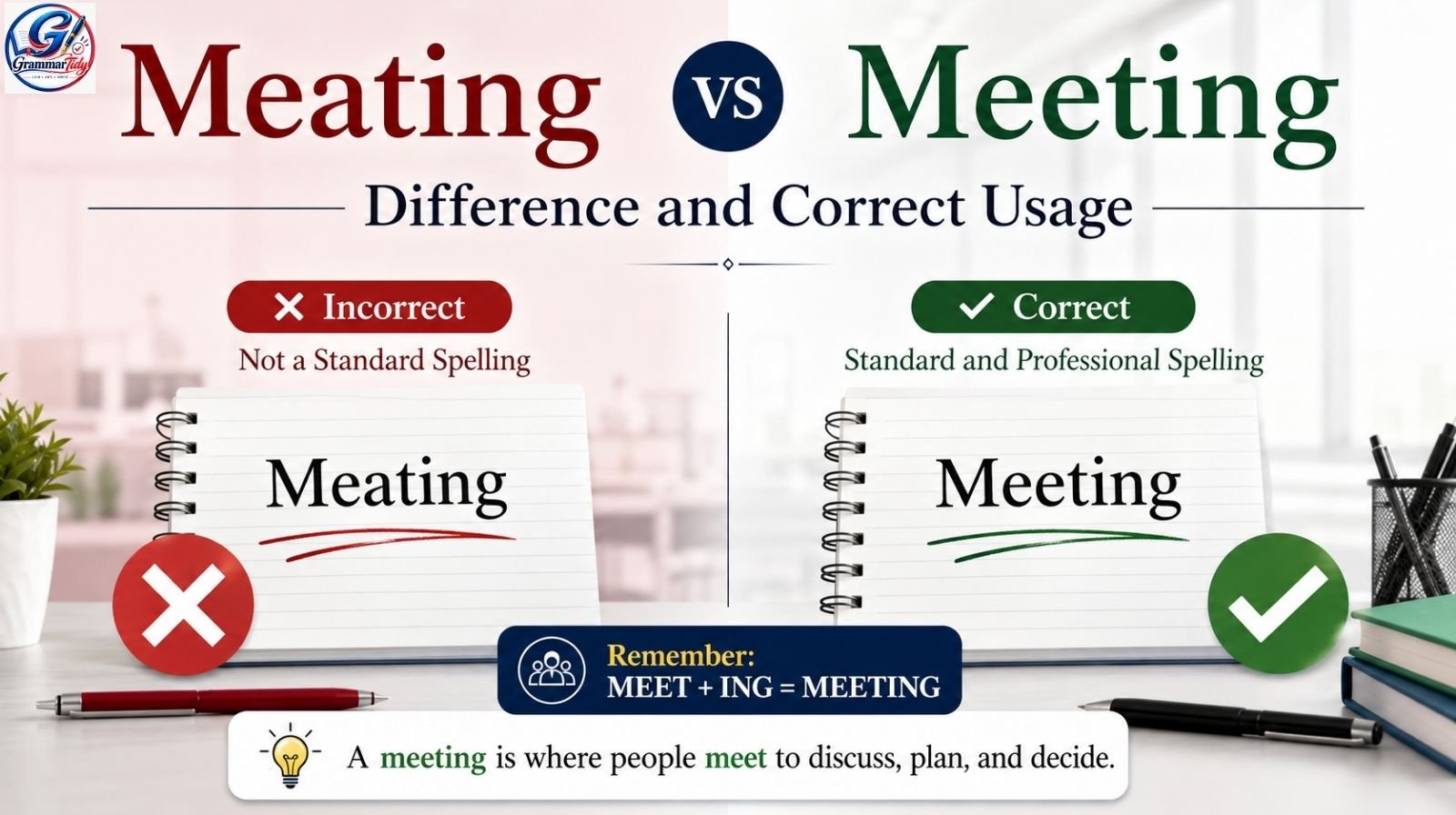
If you have ever wondered about meating vs meeting, you are not alone. These two spellings look almost identical, but they are not interchangeable in standard English. In most everyday situations, meeting is the correct word when you mean an occasion where people come together to talk, work, or discuss something.
So, is meating a word, or is it simply a spelling mistake? The answer depends on context, but for ordinary communication, meeting is almost always the word you need.
In this guide, we will explain the meating vs meeting difference, their meanings, correct usage, pronunciation, common mistakes, and easy ways to remember the right spelling.
Meating vs Meeting: What Is the Difference?
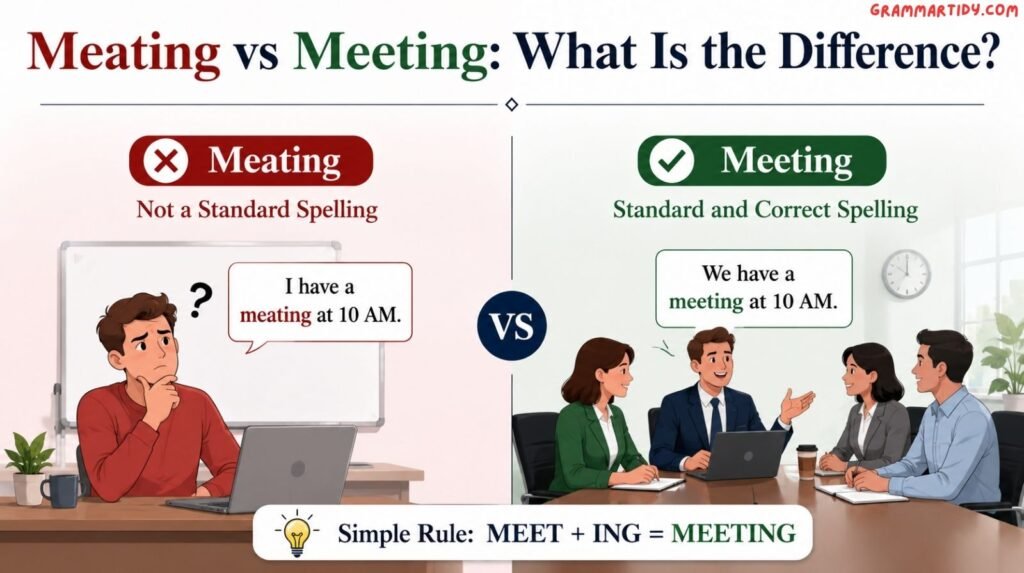
The main difference is simple: meeting is the standard English word, while meating is generally a misspelling when someone intends to write meeting.
What Does Meeting Mean?
Meeting is a noun that refers to an occasion when people come together for a particular purpose. It can happen face-to-face or online.
For example:
- We have a meeting at 10 a.m.
- The team held a meeting to discuss the new project.
- I cannot talk right now because I am in a meeting.
- Our next meeting will be online.
Cambridge Dictionary defines meeting as an occasion when people come together, either in person or online, usually to discuss something.
Also Read: Commit vs Comit: Correct Spelling And Usage
Is Meating a Correct English Word?
In standard modern English, meating is not the normal spelling of meeting.
If you are writing about a business discussion, appointment, gathering, or group discussion, use meeting.
Incorrect:
I have a meating with my manager tomorrow.
Correct:
I have a meeting with my manager tomorrow.
Therefore, when you are comparing meating vs meeting in everyday English, meeting is the correct choice.
Quick Comparison
| Word | Standard English? | Typical meaning | Example |
|---|---|---|---|
| Meeting | Yes | A gathering or discussion | We have a meeting today. |
| Meating | No, not for this meaning | Usually a spelling error for meeting | ❌ We have a meating today. |
Why Do People Write Meating Instead of Meeting?
The spelling mistake happens because English pronunciation does not always make spelling obvious. When people hear the word meeting, they may associate the long ee sound with different letter combinations.
Meeting Spelling and Pronunciation
Meeting is spelled:
M-E-E-T-I-N-G
It comes from the verb meet + -ing:
meet + ing = meeting
The word is commonly pronounced approximately as MEE-ting. Cambridge lists UK pronunciation as /ˈmiː.tɪŋ/ and US pronunciation as /ˈmiː.t̬ɪŋ/.
Why the Double E Matters
The word meet already contains ee:
meet → meeting
When you add -ing, the spelling remains:
meeting
That gives you a useful visual clue. If you are talking about people coming together, remember the base verb meet.
For example:
- meet → meeting
- greet → greeting
- greet → greeting
- sleep → sleeping
The important point is that meeting retains the spelling of meet.
A Simple Memory Trick
Think:
People MEET at a MEETING.
The connection is easy:
MEET → MEETING
If you remember the word meet, you are much less likely to write meating accidentally.
Meating vs Meeting: Meaning and Usage
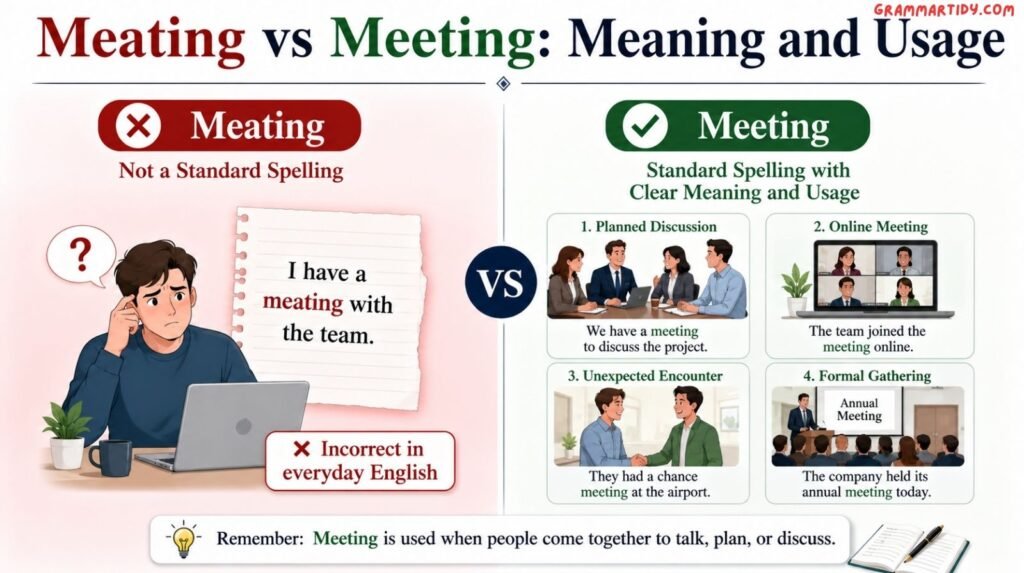
When discussing meating vs meeting, meaning is the easiest way to identify which spelling belongs in your sentence.
Meeting as a Planned Event
A meeting can be a planned gathering between two or more people.
Examples:
We scheduled a meeting for Monday.
The manager called a meeting with the staff.
The meeting lasted about an hour.
Meetings can be formal or informal, professional or personal, and in-person or online. Cambridge also gives examples involving business meetings and remote team meetings.
Meeting as an Unexpected Encounter
Meeting can also describe an occasion when people encounter one another, especially unexpectedly.
For example:
Their chance meeting at the airport changed everything.
Here, meeting does not necessarily mean a scheduled business discussion.
Common Expressions With Meeting
You will often see meeting in expressions such as:
- attend a meeting
- have a meeting
- hold a meeting
- schedule a meeting
- arrange a meeting
- cancel a meeting
- business meeting
- team meeting
- staff meeting
- online meeting
- board meeting
- emergency meeting
For example:
We need to schedule a meeting with the client.
The director will hold a meeting tomorrow.
The phrase hold a meeting is also established English usage; Cambridge defines it as arranging an occasion for people to come together, either in person or online, to discuss something.
Also Read: Symptomatology vs Symptomology: Differences, Meaning, And Usage
Common Mistakes With Meating and Meeting
Understanding the spelling is useful, but knowing the mistakes people make can make the distinction even clearer.
Mistake 1: Writing Meating for a Business Meeting
One of the most common errors is:
❌ We have a meating with the client.
The correct version is:
✅ We have a meeting with the client.
This is especially important in emails, reports, applications, and professional documents.
Mistake 2: Forgetting the Base Word Meet
A useful way to avoid the error is to remember that meeting comes from meet.
Think about these forms:
meet → meets → met → meeting
Notice that the spelling of meet gives you the first part of meeting.
Mistake 3: Confusing Spelling With Pronunciation
English contains many words whose pronunciation cannot be predicted perfectly from spelling. However, pronunciation should not cause you to change the spelling of meeting.
The correct written form remains:
meeting
not:
meating
A Quick Correction Checklist
Before submitting an email or document, ask:
- Am I talking about people coming together?
- Is the word derived from meet?
- Did I spell it M-E-E-T-I-N-G?
If the answer is yes, meeting is the correct spelling.
A Real-Life Example: How One Letter Can Matter
Imagine that Sarah works as a project coordinator for a small company. She sends a weekly email to her team about an upcoming discussion with a client. While writing quickly, she types:
“The client meating will take place at 2 p.m.”
Sarah knows exactly what she means, so the message may still be understandable to her coworkers. However, meating is an incorrect spelling for this context. Because the email is professional communication, the error can make the message look rushed or poorly proofread.
She changes the sentence to:
“The client meeting will take place at 2 p.m.”
Now the sentence uses the standard English spelling.
This example shows why the meating vs meeting distinction matters beyond grammar exercises. Small spelling mistakes can affect how polished and trustworthy written communication appears, especially in professional settings.
The same issue can occur in a calendar invitation, presentation, report, job application, or business proposal. Someone might type meating simply because the word sounds the way they imagine it should be spelled. But remembering the base verb meet provides a reliable solution.
The correction is straightforward: whenever you mean a gathering or discussion, use meeting. If you are unsure, break the word down mentally:
meet + ing = meeting
That simple habit can prevent the mistake in future writing.
How to Remember the Correct Spelling of Meeting
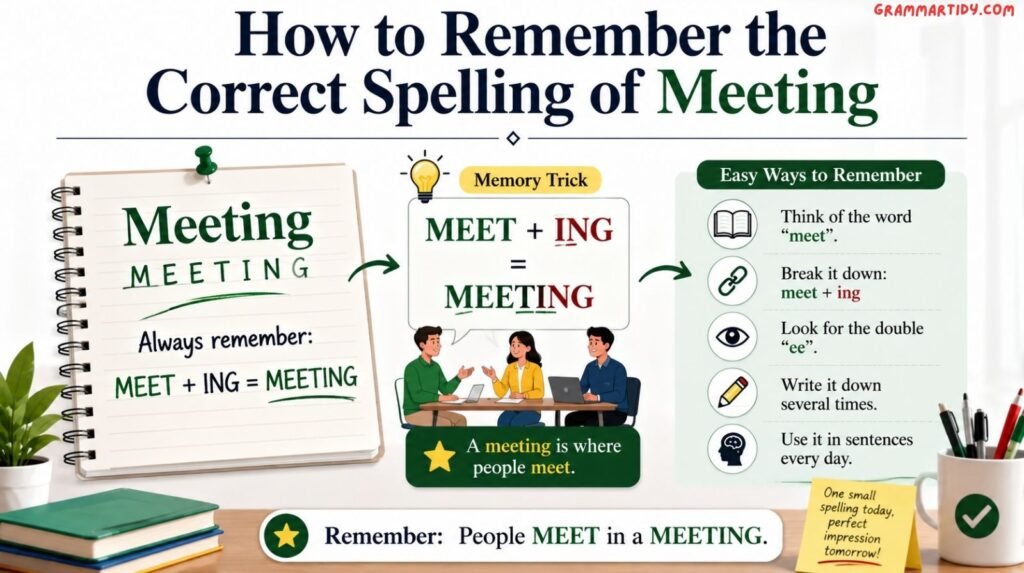
The best way to remember meeting is to connect it directly to the verb meet.
Use the “Meet + ing” Rule
Instead of memorizing the entire word separately, think:
MEET + ING = MEETING
This works because meeting is the present participle/gerund form of meet.
For example:
I meet my team every Monday.
becomes:
We have a meeting every Monday.
Use a Short Mental Sentence
Try remembering:
We meet in a meeting.
The repeated meet/meeting pattern reinforces the spelling.
Another useful sentence is:
A meeting is where people meet.
It may sound simple, but simple memory associations are often easier to recall when you are writing quickly.
Also Read: Really vs Realy: Which Is Correct? And Proper Usage
Practice With Correct Examples
Read these sentences:
- I have a meeting at noon.
- The meeting starts at nine.
- We had an important meeting yesterday.
- She is attending a meeting online.
- The manager scheduled another meeting.
After seeing the correct spelling repeatedly, meeting becomes much more familiar.
Meating vs Meeting: 2025–2026 Usage and Digital Communication
The spelling distinction remains relevant because people increasingly communicate through digital channels, where short messages, emails, calendars, and online collaboration are part of everyday life.
Why Correct Spelling Still Matters Online
DataReportal reported 6.04 billion internet users worldwide at the start of October 2025, representing about 73.2% of the world’s population. It also reported that internet users grew by 294 million over the preceding 12 months.
That does not mean every internet user writes the word meeting, of course. However, it illustrates the enormous scale of online communication, where written English is used across workplaces, education, customer support, social platforms, and international communication.
As more communication happens online, small spelling distinctions can appear in:
- Email messages
- Calendar invitations
- Video-call descriptions
- Workplace chats
- Online courses
- Business documents
- Social media posts
Google’s current Search guidance also emphasizes useful, reliable, people-first content and recommends clear, descriptive language rather than writing primarily for search engines.
For a spelling-focused article such as this one, that means the priority should be straightforward: give readers a clear answer, explain why it is correct, and provide examples they can actually use.
Meating vs Meeting: Quick Comparison Guide
| Feature | Meating | Meeting |
|---|---|---|
| Standard spelling for a gathering | ❌ No | ✅ Yes |
| Used for business discussions | ❌ No | ✅ Yes |
| Used for online discussions | ❌ No | ✅ Yes |
| Related to the verb “meet” | ❌ Incorrect form | ✅ Yes |
| Recommended in formal writing | ❌ No | ✅ Yes |
| Example | ❌ Team meating | ✅ Team meeting |
Which One Should You Use?
Use meeting whenever you mean an occasion where people come together.
Correct:
I have a meeting at 3 p.m.
Incorrect:
I have a meating at 3 p.m.
Therefore, for normal English writing, there is no real choice between the two: meeting is the correct spelling.
1. Which Spelling Is Correct?
Which spelling is correct when talking about a planned discussion?
A) Meating
B) Meeting
C) Meeteing
D) Meting
Answer: B) Meeting
2. What Does “Meeting” Mean?
What does meeting usually refer to?
A) A meal
B) A gathering or discussion
C) A journey
D) A celebration
Answer: B) A gathering or discussion
3. Spot the Correct Sentence
Which sentence is correct?
A) I have a meating today.
B) I have a meeting today.
C) I have a meting today.
D) I have a meetting today.
Answer: B) I have a meeting today.
Also Read: Excited vs Exited: Learn The Difference And Usage
4. Remember the Base Word
The word meeting comes from which verb?
A) Meet
B) Meat
C) Met
D) Mate
Answer: A) Meet
5. Complete the Word
Choose the correct spelling:
Meet + ing = ?
A) Meating
B) Meting
C) Meeting
D) Meetting
Answer: C) Meeting
6. Which One Belongs in an Email?
Which sentence would look correct in a professional email?
A) The meating starts at 10.
B) The meeting starts at 10.
C) The meting starts at 10.
D) The meetting starts at 10.
Answer: B) The meeting starts at 10.
7. Quick Spelling Check
Which word contains the correct ee spelling?
A) Meating
B) Meeting
C) Miting
D) Meting
Answer: B) Meeting
8. Can a Meeting Be Online?
Can a meeting happen online?
A) Yes
B) No
C) Only at work
D) Only in schools
Answer: A) Yes
9. Choose the Natural Phrase
Which phrase is standard English?
A) Schedule a meating
B) Schedule a meeting
C) Schedule a meting
D) Schedule a meetting
Answer: B) Schedule a meeting
10. Find the Spelling Mistake
Which sentence contains the spelling mistake?
A) We had a meeting yesterday.
B) The meeting starts soon.
C) She joined the meating online.
D) I will attend the meeting.
Answer: C) She joined the meating online.
11. Which Word Should You Remember?
If you forget how to spell meeting, which word can help you?
A) Meat
B) Meet
C) Mate
D) Met
Answer: B) Meet
12. Pick the Correct Calendar Entry
Which calendar entry is spelled correctly?
A) Team Meating
B) Team Meting
C) Team Meeting
D) Team Meetting
Answer: C) Team Meeting
13. What Is a “Chance Meeting”?
A chance meeting is usually:
A) A planned exam
B) An unexpected encounter
C) A business report
D) A scheduled meal
Answer: B) An unexpected encounter
14. Which Sentence Uses “Meeting” Correctly?
Choose the correct sentence.
A) We need to hold a meeting.
B) We need to hold a meating.
C) We need to hold a meting.
D) We need to hold a meetting.
Answer: A) We need to hold a meeting.
15. The Easiest Memory Trick
What is the easiest spelling trick to remember?
A) Meat + ing
B) Meet + ing
C) Met + ing
D) Mate + ing
Answer: B) Meet + ing
FAQs
Q1. Is “meating” a correct spelling of “meeting”?
A: No. If you mean an occasion when people come together, the standard spelling is meeting. Meating is generally a spelling error in this context.
Q2. What is the correct spelling: meating or meeting?
A: The correct spelling is meeting.
✅ We have a meeting tomorrow.
❌ We have a meating tomorrow.
Q3. Why do people spell meeting as meating?
A: People may write meating because of the way the word sounds or because they are unsure how the ee spelling works. Remembering meet + ing = meeting can help prevent the mistake.
Q4. How do you pronounce meeting?
A: Meeting is commonly pronounced approximately MEE-ting. Cambridge gives /ˈmiː.tɪŋ/ for British English and /ˈmiː.t̬ɪŋ/ for American English.
Q5. What is the difference between meet and meeting?
A: Meet is the verb, while meeting can function as a noun referring to an occasion when people come together.
For example:
We meet every Friday.
We have a meeting every Friday.
Q6. Is meeting always a business word?
A: No. A meeting can be professional, social, formal, informal, planned, or unexpected. For example, a chance meeting describes an unplanned encounter.
Q7. How can I remember the spelling of meeting?
A: Remember:
MEET + ING = MEETING
The word begins with meet, so the correct spelling contains ee.
Conclusion:
When it comes to meating vs meeting, the answer is straightforward: meeting is the correct standard spelling when you mean a gathering, discussion, appointment, or occasion where people come together.
The easiest way to remember it is:
meet + ing = meeting
So, write:
“I have a meeting tomorrow.”
not:
“I have a meating tomorrow.”
If you frequently confuse similar English spellings, bookmark this guide and use the meet → meeting trick whenever you are unsure. A small spelling check can make your emails, schoolwork, professional documents, and everyday messages much clearer.
Keep learning with more easy grammar lessons on GrammarTidy.com

Hi, I’m Noor Fatima, the author and creator of Grammar Tidy. I’m passionate about grammar, writing, and making language learning simple and enjoyable. Through Grammar Tidy, I share helpful tips, clear explanations, and practical guidance to help readers improve their writing, avoid common mistakes, and communicate with confidence. My goal is to make better grammar easy, useful, and accessible for everyone.