Choosing between less and fewer seems simple until you encounter sentences such as “less people attended the meeting” or “fewer money was spent this month.” Both words describe a smaller amount or number, but they do not always work in the same situations. Understanding the difference can make your writing clearer, more natural, and grammatically correct.
The basic rule is straightforward: use fewer with countable nouns and less with uncountable nouns. However, English has several exceptions, especially when discussing time, money, distance, measurements, and everyday expressions.
Whether you are writing a professional email, preparing a school assignment, or having a casual conversation, knowing when to use less or fewer can help you communicate more confidently.
In this guide, we will explore the difference between less and fewer, explain the simple grammar rule, examine situations where the rule bends, and provide practical examples you can use in everyday writing.
Also Read: Stigmatism vs Astigmatism
What Is the Difference Between Less and Fewer?
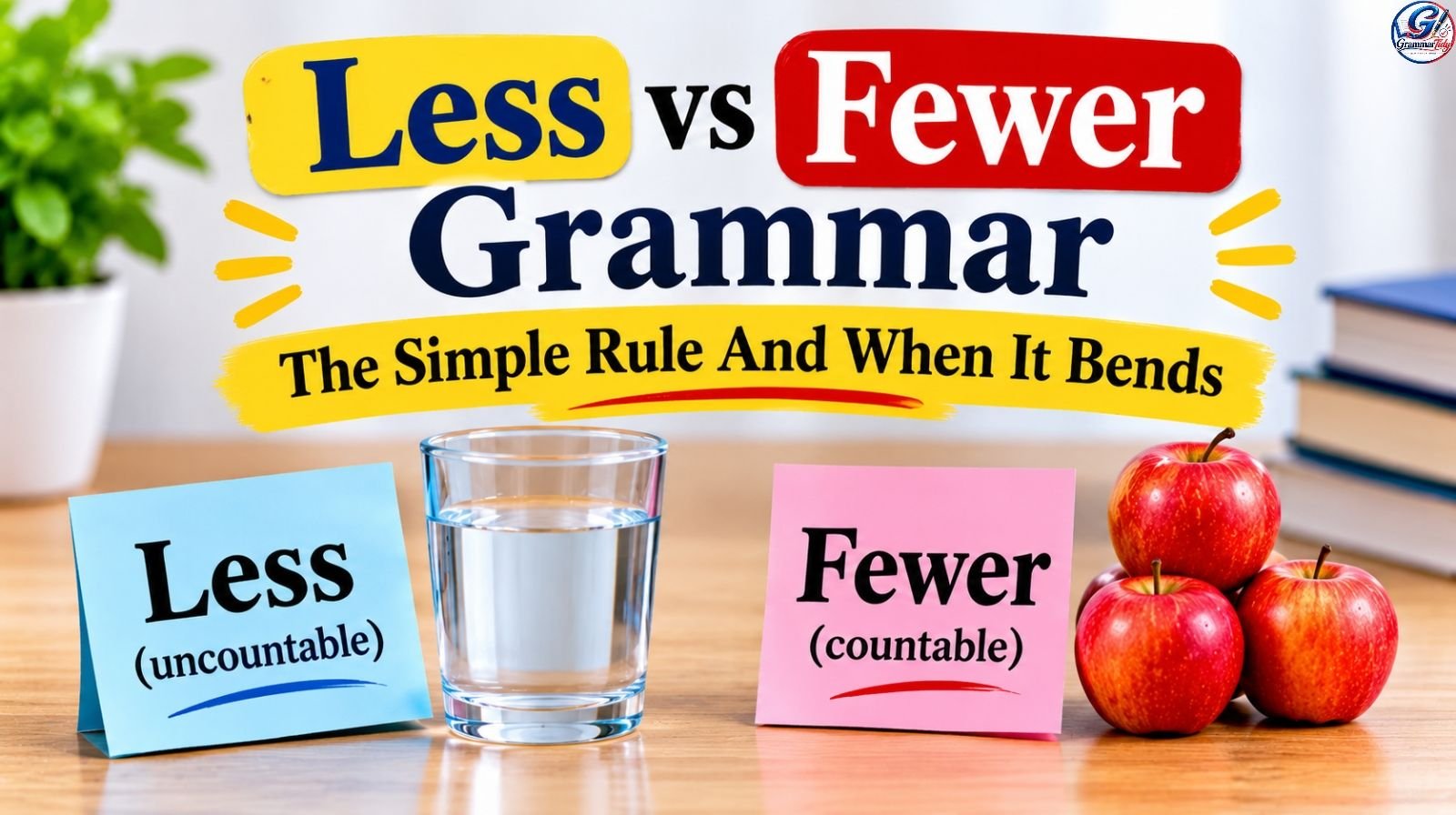
The main difference between less and fewer depends on whether the noun describes something countable or uncountable.
- Less refers to a smaller amount of something that cannot normally be counted individually.
- Fewer refers to a smaller number of things that can be counted separately.
Although both words communicate reduction, they serve different grammatical purposes.
Understanding Less
Less is used with uncountable nouns, also called noncount nouns. These nouns describe things that are measured by amount rather than counted individually.
Examples include:
- Water
- Sugar
- Money
- Time
- Information
- Traffic
- Furniture
- Patience
- Advice
Consider these sentences:
- I need less sugar in my coffee.
- We have less time to complete the project.
- Sarah wants to spend less money this month.
- There is less traffic on the road today.
- You should use less salt when preparing dinner.
In each example, the noun represents something measured as an amount rather than counted as separate individual items.
For instance, you can measure sugar in grams or teaspoons, but you do not normally count sugar as individual pieces.
Practical scenario: Grocery shopping
Imagine that Emma is shopping with her brother, Daniel. She wants to reduce the amount of sugar in their household.
She might say:
“Daniel, let’s buy less sugar this week because we already have enough at home.”
Here, less is correct because sugar is an uncountable noun.
Understanding Fewer
Fewer is used with countable nouns, meaning things that can be counted individually.
These nouns usually have both singular and plural forms.
Examples include:
- Books
- Students
- Cars
- Employees
- Emails
- Apples
- Questions
- Mistakes
- Chairs
Consider these examples:
- There are fewer students in the classroom today.
- I received fewer emails this morning.
- We need fewer chairs for the meeting.
- David made fewer mistakes in his latest assignment.
- The store sold fewer apples this weekend.
Each noun represents something that can be counted individually.
For example, you can count one email, two emails, or ten emails. Therefore, fewer is the appropriate choice.
Practical scenario: Office management
Suppose a manager named Olivia notices that her department has received fewer customer complaints this month.
She might say:
“Our team received fewer complaints this month compared with last month. That’s a positive sign that our customer service is improving.”
The word fewer works because complaints are individual, countable items.
Also Read: Says or Sais
The Simple Grammar Rule: Countable vs. Uncountable Nouns
The easiest way to remember the difference between less and fewer is to ask yourself one question:
Can I count the noun individually?
If the answer is yes, use fewer. If the answer is no, use less.
This simple test works in most everyday situations.
When to Use Less With Uncountable Nouns
Use less when talking about substances, concepts, or conditions that are measured rather than counted.
Examples:
| Incorrect | Correct |
|---|---|
| Fewer water | Less water |
| Fewer information | Less information |
| Fewer patience | Less patience |
| Fewer traffic | Less traffic |
| Fewer furniture | Less furniture |
| Fewer advice | Less advice |
Example in everyday conversation:
“Could you please add less milk to my tea?”
This sentence is correct because milk is an uncountable noun.
Example in a workplace email:
Hi Michael,
I reviewed our monthly expenses and noticed that we could save money by using less paper and reducing unnecessary printing. Please encourage the team to use digital documents whenever possible.
Best regards,
Rachel
In this email, less is appropriate because paper is being discussed as an amount or material rather than as individual sheets.
When to Use Fewer With Countable Nouns
Use fewer when the noun refers to separate items, people, or objects that can be counted.
Examples:
| Incorrect | Correct |
|---|---|
| Less employees | Fewer employees |
| Less books | Fewer books |
| Less mistakes | Fewer mistakes |
| Less customers | Fewer customers |
| Less questions | Fewer questions |
| Less opportunities | Fewer opportunities |
Example in everyday conversation:
“I bought fewer clothes this month because I am trying to save money.”
Clothes are countable items, so fewer is correct.
Example in a professional email:
Hi Jessica,
Our department received fewer customer complaints this week than it did last week. This improvement reflects the team’s hard work and attention to customer concerns. Thank you for your continued efforts.
Best regards,
Andrew
Here, fewer is correct because customer complaints can be counted individually.
Also Read: Sustain vs Substain
When the Less vs. Fewer Rule Bends
Although the countable-versus-uncountable rule is useful, English does not always follow it strictly.
There are several situations where less is traditionally accepted even when a countable noun or numerical measurement is involved.
Understanding these exceptions is important because they appear frequently in conversations, advertisements, signs, and professional writing.
1. Less With Time
Time is generally considered uncountable when discussing its overall amount or duration.
For example:
- I need less time to finish this assignment.
- We have less than an hour before the meeting.
- She spends less time watching television now.
However, when referring to separate units of time, fewer may also be appropriate.
For example:
- There are fewer than five days left until the deadline.
- We have fewer hours available this week.
Practical scenario: Project deadline
Imagine that James is managing a project and needs to update his colleague, Sophia.
He could write:
Hi Sophia,
We have less time than expected to complete the project, so I suggest focusing on the most important tasks first. There are also fewer working days available this month because of the upcoming holidays. Let’s discuss how we can adjust the schedule.
Best regards,
James
Notice how both words appear naturally. Less describes the overall amount of time, while fewer describes the countable working days.
2. Less With Money
Money is usually treated as an uncountable noun when discussing an overall amount.
For example:
- I need to spend less money this month.
- The company earned less revenue this quarter.
- We should use less cash for unnecessary purchases.
However, when discussing individual currency units, fewer may be appropriate.
Examples:
- I have fewer than ten coins in my wallet.
- The cashier received fewer banknotes than expected.
Practical scenario: Monthly budgeting
Suppose a person named Emily wants to reduce her monthly expenses.
She might say:
“I want to spend less money on entertainment and make fewer unnecessary purchases this month.”
Both expressions are correct because money is uncountable, while purchases are countable.
3. Less With Measurements and Distances
One of the most common exceptions involves measurements.
English frequently uses less with amounts of distance, weight, time, and other measurements, even when the units themselves are countable.
Examples:
- The journey takes less than three hours.
- This package weighs less than five kilograms.
- The hotel is less than ten miles away.
- The temperature dropped to less than five degrees.
Why does this happen?
In these sentences, the measurement is treated as a single quantity rather than a collection of separate units.
For example, three hours describes a duration of time, not three individual objects.
Practical scenario: Travel planning
Imagine that Daniel is explaining a travel route to his friend, Olivia.
He might say:
“The new route takes less than two hours, so we should arrive before lunchtime.”
This sounds natural because less refers to the total duration of the journey.
Also Read: Lended vs Lent
4. Less in Expressions Involving Numbers
You may have noticed expressions such as:
- Less than 50 dollars
- Less than 100 kilometers
- Less than 20 minutes
- Less than 10 pounds
These expressions are common because less often introduces a numerical measurement or quantity.
However, when counting separate objects, fewer remains the better choice.
Compare:
- The package weighs less than 10 kilograms.
- We received fewer than 10 packages.
The first sentence discusses weight, while the second counts individual packages.
5. Less in Everyday Expressions
Some expressions have become established through common usage, even when they appear to bend the traditional grammar rule.
One familiar example is:
“Less than 10 items.”
You may see this expression on checkout signs in supermarkets.
Traditional grammar recommends:
“Fewer than 10 items.”
This is because items are countable nouns.
However, less than is widely used in everyday English, including some established signs and informal contexts.
For formal writing, academic work, and careful editing, fewer than 10 items is the safer choice.
Common Mistakes People Make With Less and Fewer
Even fluent English speakers sometimes confuse these two words. The problem often occurs when a sentence sounds natural but does not follow the traditional grammatical rule.
Here are some frequent mistakes and their correct forms.
Using Less With Countable Plural Nouns
Incorrect: There are less people at the event this year.
Correct: There are fewer people at the event this year.
People are countable because you can count individuals.
Another example:
Incorrect: Our company hired less employees this quarter.
Correct: Our company hired fewer employees this quarter.
Employees are individual people, so fewer is the appropriate choice.
Using Fewer With Uncountable Nouns
Incorrect: I need fewer information about the new project.
Correct: I need less information about the new project.
Information is uncountable in standard English. You can count pieces or details of information, but not information itself.
Another example:
Incorrect: We should use fewer electricity.
Correct: We should use less electricity.
Electricity is measured by quantity rather than counted as individual objects.
Confusing Amount and Number
Another common mistake is forgetting the difference between amount and number.
Generally:
- Use amount with uncountable nouns.
- Use number with countable nouns.
Examples:
- A smaller amount of water is needed.
- A smaller number of students attended the class.
- A larger amount of information was collected.
- A smaller number of applications was received.
Remembering this distinction can make choosing between less and fewer much easier.
Also Read: Gluing or Glueing
Less vs. Fewer in Professional and Everyday Writing
Understanding grammar rules is useful, but applying them in real situations is even more important.
Both words appear frequently in professional emails, workplace reports, academic assignments, and everyday communication.
Let’s look at some practical examples.
In Professional Emails
When writing professional emails, correct word choice helps your message appear polished and clear.
Consider this example:
Hi Daniel,
I noticed that our weekly meetings have been taking too much time. I suggest scheduling fewer meetings and allowing less time for discussions that do not require the entire team’s attention. This change could help everyone focus on their main responsibilities. Please share your thoughts.
Best regards,
Olivia
Why are both words correct?
- Fewer meetings: Meetings are countable.
- Less time: Time is uncountable.
In Academic Writing
Students frequently encounter less and fewer when writing essays, research papers, and assignments.
Examples:
- Students should make fewer spelling mistakes in their essays.
- Academic research requires less speculation and more evidence.
- The revised assignment contains fewer unnecessary paragraphs.
- This explanation provides less confusion for beginners.
Practical scenario: Student assignment
A teacher named Rebecca might give this feedback:
“Your latest essay contains fewer grammatical errors and demonstrates less repetition than your previous submission.”
This sentence correctly uses fewer for countable errors and less for the uncountable concept of repetition.
In Business Reports
Businesses regularly compare quantities, expenses, customers, and performance figures.
Examples:
- The company spent less money on advertising.
- We received fewer customer inquiries this month.
- The department used less electricity after installing new equipment.
- The sales team completed fewer transactions during the holiday period.
These examples demonstrate how both words can appear naturally in the same business report.
How to Remember the Difference Between Less and Fewer
If you frequently forget which word to use, a few simple techniques can help you remember the distinction.
Use the Counting Test
Ask yourself whether you can count the noun individually.
For example:
- Apples: One apple, two apples, three apples. Use fewer apples.
- Water: You cannot normally count water individually. Use less water.
- Books: One book, two books, three books. Use fewer books.
- Furniture: Furniture is uncountable. Use less furniture.
This is one of the easiest ways to identify the correct word.
Remember the Singular and Plural Forms
Countable nouns generally have singular and plural forms.
Examples:
- One student, five students.
- One chair, four chairs.
- One mistake, several mistakes.
These nouns usually take fewer when you are talking about a smaller quantity.
Uncountable nouns generally do not have ordinary plural forms when used in their standard meanings.
Examples:
- Water
- Knowledge
- Equipment
- Advice
- Research
These nouns usually take less.
Read Your Sentences Aloud
Sometimes, reading a sentence aloud helps you notice grammatical problems.
For example:
“There are less books on the shelf.”
Although you might hear this expression in casual conversation, fewer books is the grammatically preferred form in standard edited English.
Practicing with everyday sentences can gradually make the correct choice feel natural.
Also Read: Damnit or Dammit
Less vs. Fewer: Quick Comparison Table
The following table summarizes the most important differences and exceptions.
| Situation | Correct Usage | Example |
|---|---|---|
| Uncountable nouns | Less | Less water |
| Countable plural nouns | Fewer | Fewer students |
| Money as an amount | Less | Less money |
| Individual coins | Fewer | Fewer coins |
| Overall time | Less | Less time |
| Separate days | Fewer | Fewer days |
| Distance measurement | Less | Less than five miles |
| Individual objects | Fewer | Fewer than five boxes |
| Information | Less | Less information |
| Mistakes | Fewer | Fewer mistakes |
The key is to identify whether you are discussing an overall amount, a measurement, or individual countable things.
Mini Quiz: Test Your Understanding of Less vs. Fewer
1. Which sentence is grammatically correct?
A. I need fewer water in my bottle.
B. I need less water in my bottle.
Answer: B. I need less water in my bottle.
Water is an uncountable noun, so less is correct.
2. Choose the correct word to complete the sentence: “There were _____ customers in the store today.”
A. Less
B. Fewer
Answer: B. Fewer.
Customers are countable individuals, so fewer is the correct choice.
3. Which expression is preferred in formal writing?
A. Less than 10 items.
B. Fewer than 10 items.
Answer: B. Fewer than 10 items.
Items are countable nouns, so fewer is preferred in standard formal writing.
Frequently Asked Questions
1. Is less or fewer grammatically correct?
Both less and fewer are grammatically correct, but they are used in different situations. Less generally describes uncountable nouns, while fewer describes countable plural nouns. For example, say “less sugar” but “fewer cookies.”
2. Can I use less with countable nouns?
Yes, less is traditionally accepted with certain numerical measurements, amounts, and established expressions. For example, “less than five miles” and “less than an hour” are perfectly natural. However, with ordinary countable plural nouns, fewer is generally preferred.
3. Is it less people or fewer people?
Fewer people is the preferred grammatical expression because people refers to individuals who can be counted. For example: “Fewer people attended the conference this year.” Although less people appears in informal conversation, fewer people is the better choice in professional and formal writing.
4. Is it less money or fewer money?
Less money is correct because money is an uncountable noun. You can count individual coins, banknotes, or dollars, but money itself is generally treated as an amount. For example: “I want to spend less money on unnecessary expenses.”
5. Why do people say less than 10 items?
The expression less than 10 items is common in everyday English, particularly on supermarket checkout signs. However, traditional grammar recommends fewer than 10 items because items are countable nouns.
6. Is less than 100 dollars correct?
Yes, less than 100 dollars is correct because the expression describes a total monetary amount. For example: “The repair should cost less than 100 dollars.”
7. Can less and fewer be used in the same sentence?
Absolutely. Both words can appear in one sentence when they refer to different types of nouns. For example: “Our department needs fewer meetings and less paperwork.” Meetings are countable, while paperwork is uncountable.
Conclusion
Understanding less vs. fewer grammar does not have to be complicated. The main rule is simple: use less for uncountable nouns and fewer for countable plural nouns.
Use less when discussing things such as water, money, information, time, and electricity. Choose fewer when referring to individual items, people, books, employees, or mistakes.
However, remember that English has exceptions. Expressions involving measurements, distances, money, and time often use less naturally, even when numbers are involved.
The most useful habit is to ask yourself whether you are describing an amount or counting individual things. This small question can prevent many common grammar mistakes.
Whether you are writing an email, preparing a business report, or having a casual conversation, choosing the right word will make your English clearer and more polished. Master the basic rule, understand its exceptions, and you will know when to use less and fewer with confidence.
Keep learning with more easy grammar lessons on GrammarTidy.com

Hi, I’m Noor Fatima, the author and creator of Grammar Tidy. I’m passionate about grammar, writing, and making language learning simple and enjoyable. Through Grammar Tidy, I share helpful tips, clear explanations, and practical guidance to help readers improve their writing, avoid common mistakes, and communicate with confidence. My goal is to make better grammar easy, useful, and accessible for everyone.