Have you ever stopped while writing an email, assignment, or professional document because you were unsure whether to write orientated or oriented? You are not alone. These two words look similar, sound similar, and often communicate exactly the same meaning.
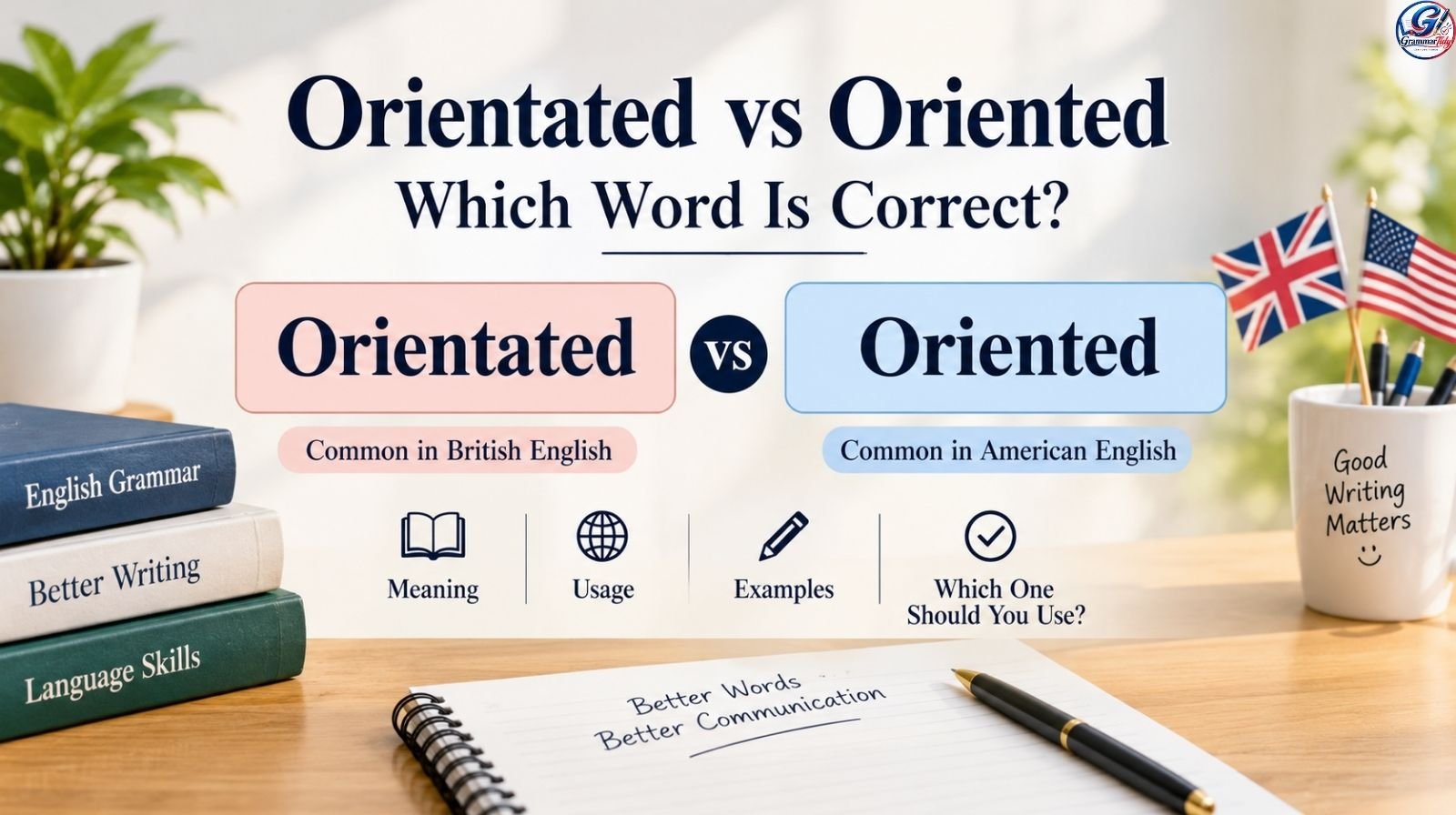
When comparing orientated vs oriented, the important thing to know is that both words are correct English.
However, oriented is the more widely preferred choice in American English, while orientated is particularly common in British English. Both words can describe something directed toward a particular goal, interest, position, or purpose.
In this guide, you will learn the meaning of each word, understand the differences in regional usage, explore practical examples, and discover which spelling works best in academic writing, business communication, and everyday conversation.
What Is the Difference Between Orientated and Oriented?
The main difference between orientated and oriented is regional preference rather than meaning. Both forms can describe someone or something that is positioned, directed, or focused toward a particular person, subject, or objective.
What Does Oriented Mean?
Oriented is the past tense and past participle of the verb orient. It can describe someone who understands their surroundings or something directed toward a specific goal.
For example:
- The new employee is well oriented to the company’s procedures.
- Our business is customer-oriented.
- She is highly career-oriented.
- The course is oriented toward beginners.
The word is particularly common in American English and appears frequently in professional and academic writing.
What Does Orientated Mean?
Orientated is the past tense and past participle of the verb orientate. It generally has the same meaning as oriented and is especially associated with British English.
For example:
- The training program is orientated toward new employees.
- The company has a customer-orientated approach.
- The building is orientated toward the east.
- The school offers a career-orientated curriculum.
These sentences are understandable and grammatically acceptable in varieties of English that use orientated.
Are Both Words Grammatically Correct?
Yes. Both forms are recognized in English, although their regional preferences differ.
The easiest rule is to choose the form that suits your intended audience and use it consistently throughout your writing.
Orientated vs Oriented in British and American English
Regional English conventions explain why some writers prefer orientated while others naturally choose oriented. Neither form needs to be treated as universally incorrect.
American English: Prefer Oriented
In American English, oriented is the usual choice. It is widely used in business, education, technology, and everyday communication.
Examples:
- The company is results-oriented.
- The software is user-oriented.
- The workshop is oriented toward professional development.
- He is detail-oriented when reviewing documents.
Although readers may understand orientated, it is less conventional in American writing.
British English: Both Forms Are Used
British English accepts oriented and commonly uses orientated as well. The preferred form can depend on the writer, publication, and context.
Examples:
- The organization is community-oriented.
- The organization is community-orientated.
- The course is orientated toward practical skills.
- The team is oriented toward improving customer service.
Both versions can communicate the intended meaning. If you are writing for a British publication, follow its house style where one exists.
Which Form Should International Writers Choose?
If your readers come from different countries, oriented is usually the safest default. It is widely recognized and works naturally in American and British English.
For example, a website targeting an international audience could use:
- Goal-oriented learning
- Customer-oriented service
- Career-oriented advice
- Results-oriented planning
The same principle applies to resumes, business reports, educational resources, and blog posts: consistency and audience awareness matter more than adding an extra syllable.
How to Use Oriented and Orientated Correctly
Choosing the right form becomes easier when you understand the sentence and the meaning you want to express. Both words can describe physical direction, personal awareness, or a focus on a particular objective.
Use Oriented for Goals and Interests
Oriented is especially useful when describing priorities, professional interests, and intended outcomes.
Examples:
- Goal-oriented: She is a goal-oriented student who works hard to achieve her targets.
- Customer-oriented: The company provides customer-oriented services.
- Family-oriented: He prefers a family-oriented lifestyle.
- Detail-oriented: My manager is detail-oriented and checks every report carefully.
- Career-oriented: She is a career-oriented professional.
These compound adjectives are widely recognized in professional English.
Use Orientated When It Fits Your Regional Style
If you follow British English conventions, orientated can be appropriate in the same types of sentences.
Examples:
- The organization has a customer-orientated approach.
- The course is career-orientated.
- Our teaching methods are student-orientated.
- The project is results-orientated.
The meaning generally remains the same. However, if your organization has a preferred spelling style, follow it throughout your document.
Understand the Verb Forms
The difference also comes from the base verbs orient and orientate.
| Base verb | Past tense | Past participle |
|---|---|---|
| Orient | Oriented | Oriented |
| Orientate | Orientated | Orientated |
For example:
- Present: The trainer orients new employees.
- Past: The trainer oriented new employees.
- Alternative past form: The trainer orientated new employees.
The final example is acceptable in varieties of English that use orientate. You do not need to add the extra syllable to make the sentence correct.
Orientated vs Oriented: Comparison Table and Common Mistakes
A quick comparison can help you decide which spelling to use without second-guessing yourself.
Side-by-Side Comparison
| Feature | Oriented | Orientated |
|---|---|---|
| Correct English? | Yes | Yes |
| Basic meaning | Directed or focused | Directed or focused |
| American English | Preferred | Less common |
| British English | Common and accepted | Common and accepted |
| Formal writing | Excellent choice | Appropriate in suitable regional styles |
| Business writing | Widely used | Used in some British contexts |
| Compound adjective | Goal-oriented | Goal-orientated |
| International audience | Recommended default | Depends on audience and style |
Common Mistakes to Avoid
Mistake 1: Assuming orientated is always incorrect.
Incorrect assumption: “Orientated is not a real English word.”
Correction: It is a recognized word, particularly in British English.
Mistake 2: Assuming the two forms have different meanings.
In most contexts, oriented and orientated communicate the same idea.
Mistake 3: Mixing styles without a reason.
For example, using customer-oriented in one paragraph and customer-orientated in another may make an article look inconsistent. Choose a preferred form and stick with it.
Mistake 4: Changing a correct spelling just because a spellchecker flags it.
A spellchecker configured for American English might flag orientated. That does not automatically mean the word is wrong in British English.
A Simple Step-by-Step Guide
Follow these three steps when deciding which word to use.
- Identify your audience. Are you writing for American readers, British readers, or an international audience?
- Choose your spelling convention. Prefer oriented for American English and as a broadly suitable international choice. Use orientated when it fits your British English style.
- Check consistency. Use the same form throughout your article, assignment, resume, or business document unless you have a specific reason to preserve another form.
A Real-Life Example: Choosing the Right Word in a Business Report
Imagine that a marketing manager is preparing a report for a company that serves customers in the United States and the United Kingdom. The report explains the company’s plans to improve customer satisfaction, train employees, and measure business results.
In the first draft, the manager writes:
“Our customer-orientated team is developing a results-orientated strategy. The new training program will be orientated toward improving communication.”
The sentences are understandable, and the word forms are valid in appropriate English varieties. However, the company uses American English for its reports, website, and internal documentation. An editor reviewing the draft recommends a consistent revision:
“Our customer-oriented team is developing a results-oriented strategy. The new training program will be oriented toward improving communication.”
The editor has not changed the fundamental meaning of the report. Instead, the revision makes the wording more consistent with the company’s chosen style.
Now imagine the same report is being prepared for a British publication that regularly uses customer-orientated and results-orientated. In that setting, the original wording might fit the publication’s style perfectly well.
This example illustrates an important principle: correct word choice depends on accepted usage, audience, and consistency not simply on which form looks shorter.
For writers, editors, and businesses, the practical lesson is to establish a style convention before publishing. Doing so reduces unnecessary corrections, makes documents more consistent, and helps readers focus on the message rather than spelling variations.
Orientated vs Oriented: Usage Data and Statistics for 2025–2026

Understanding current spelling preferences requires reliable evidence rather than invented percentages. Dictionaries establish whether a word is recognized, while language corpora help researchers examine how frequently words appear in published material.
What Do Recent Language Resources Tell Us?
As of October 2026, the following points provide useful context:
- 2024: A major update to a widely used English-language book corpus introduced additional historical data and tools for comparing word frequency across different English varieties.
- 2025–2026: Dictionary descriptions continue to support the distinction between orientated as a form particularly associated with British English and oriented as a broadly used alternative.
- Publication coverage: Historical book-frequency databases allow readers to compare how often words appear in published books. However, book data does not represent every conversation, website, email, or social media post.
Are There Exact Statistics Showing Which Word Is More Popular in 2026?
There is no verified 2025–2026 percentage established in this article showing exactly how often English speakers use oriented compared with orientated across all forms of communication.
Therefore, it would be misleading to claim that a particular percentage of writers prefer one form without a defined dataset and a documented measurement method.
The available usage distinctions support a practical conclusion: oriented is the broadly useful default, particularly in American English, while orientated remains a valid regional alternative.
For a deeper investigation, researchers can compare both words in historical book collections and examine American and British English separately.
Any results should be described as measurements of the selected collection rather than universal statistics for 2025 or 2026.
Frequently Asked Questions
1. Is orientated or oriented correct?
Both are correct. Oriented is the usual choice in American English, while orientated is especially common in British English.
2. Is orientated grammatically incorrect?
No. Orientated is a recognized English word. Although it is less conventional in American English, it is an accepted form in British usage.
3. Is oriented American or British English?
Oriented is strongly established in American English and is also used in British English. It is not exclusive to either variety.
4. Why do British people say orientated?
Orientated developed as a form of the verb orientate and became established in British usage. It can convey the same meaning as oriented.
5. Should I use oriented or orientated in formal writing?
For most formal writing, especially if your audience is American or international, oriented is a reliable choice. However, orientated can be appropriate in British English when it matches the document’s style.
6. Are goal-oriented and goal-orientated both correct?
Yes. Both forms can describe someone who focuses on achieving goals. Goal-oriented is the more broadly familiar choice, particularly in American English.
7. Does oriented mean the same as orientated?
In most contexts, yes. Both can mean directed toward a particular position, interest, or objective. The main difference is regional preference and usage.
Conclusion:
When comparing orientated vs oriented, remember that neither form is universally incorrect. Both are recognized English words, and they generally carry the same meaning.
Use oriented when writing for an American audience or when you want a widely accepted spelling for international readers. Choose orientated when it suits your British English style or the requirements of your publication.
The most important rule is to consider your audience and maintain consistency. Whether you are writing a blog post, an academic assignment, a resume, or a business report, a clear and consistent writing style helps your message stand out.
Ready to improve your English? Explore more spelling and grammar guides to build confidence, avoid common writing mistakes, and communicate clearly in every situation.
Discover More Article
- Goodmorning or Good Morning: The Correct Usage (And Why It Actually Matters)
- Natzi or Nazi: The Correct Spelling, Meaning, And Why It Matters
- Win or Lose Episodes: Complete Episode Guide (2026)
- Seperate vs Separate: How to Spell It Correctly
Keep learning with more easy grammar lessons on GrammarTidy.com

Hi, I’m Noor Fatima, the author and creator of Grammar Tidy. I’m passionate about grammar, writing, and making language learning simple and enjoyable. Through Grammar Tidy, I share helpful tips, clear explanations, and practical guidance to help readers improve their writing, avoid common mistakes, and communicate with confidence. My goal is to make better grammar easy, useful, and accessible for everyone.