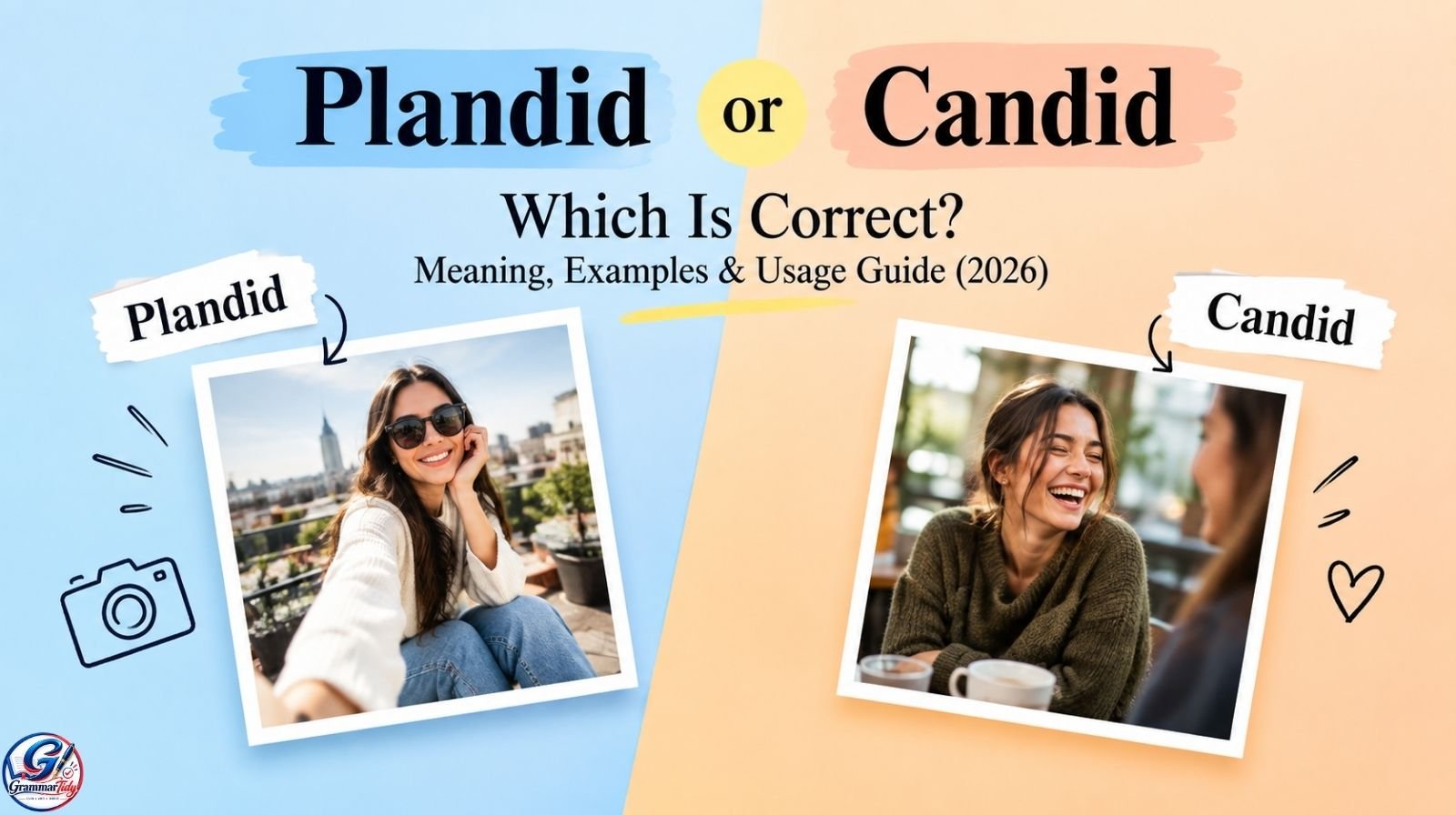
Have you ever seen a photo that looks completely natural but seems a little too perfect to be spontaneous? You might hear someone describe it as a “plandid” or a “candid” photo. But are these words interchangeable, and which one is correct in standard English?
Candid is the standard English word meaning honest, open, or informal and unposed, especially when describing a photograph.
Plandid is an informal blend of “planned” and “candid,” commonly used in social media contexts to describe a photo that looks spontaneous but was actually planned or arranged.
In this guide, you’ll learn the difference between plandid and candid, understand their meanings, explore real-life examples, and discover when to use each expression in 2026.
Also Read: Transferred vs Transfered: Which Is Correct?
What Does Candid Mean?
The word candid is a standard English adjective used to describe someone who is honest and straightforward or something that is natural and unposed.
It is commonly used in conversations, professional communication, photography, and everyday writing.
Meaning of Candid
According to its common dictionary meanings, candid can describe:
- A person who speaks honestly and openly.
- A photograph taken naturally, without a formal pose.
- A conversation in which people express their genuine thoughts.
For example:
- “She gave me a candid answer about the project.”
- “We captured a beautiful candid photo at the wedding.”
- “He was candid about his mistakes.”
In each sentence, candid communicates honesty or a lack of artificial posing.
Candid in Photography
In photography, a candid photo typically captures a person naturally, often while they are engaged in an activity rather than deliberately posing for the camera.
Examples include:
- A child laughing while playing.
- Friends talking at a café.
- Guests enjoying themselves at a wedding.
However, a candid-looking photograph is not necessarily spontaneous. A photographer may arrange a scene to create a natural appearance.
How to Use Candid in a Sentence
Here are some simple examples:
| Sentence | Meaning |
|---|---|
| “She took a candid photo of her friends.” | The photo looks natural and unposed. |
| “Please be candid about your feedback.” | Speak honestly. |
| “That was a candid conversation.” | The conversation was open and sincere. |
Quick tip: Use candid when you mean honest, open, or naturally unposed.
Plandid or Candid: What Is the Difference?
The main difference between plandid and candid is the element of planning.
Candid is a standard English word. Plandid is an informal social-media blend of “planned” and “candid,” often used for a photograph that appears spontaneous but was intentionally arranged.
What Does Plandid Mean?
Plandid combines two words:
- Planned
- Candid
It describes a photograph that has the appearance of an unposed, spontaneous moment but involves some planning, direction, or preparation.
For example, someone might arrange their outfit, choose a location, and ask a friend to take a photo while pretending to be caught in a natural moment.
A person might caption such a picture:
“Just a casual moment… definitely not a plandid!”
This expression is often used humorously on social media.
Quick Comparison: Plandid vs Candid
| Feature | Candid | Plandid |
|---|---|---|
| Standard English word? | Yes | No, informal slang |
| Origin | Established English word | Blend of planned + candid |
| Main meaning | Honest, open, or unposed | Planned photo that looks candid |
| Common use | Writing, speech, photography | Social media and informal captions |
| Example | “A candid wedding photo” | “A carefully arranged plandid” |
Which Word Should You Use?
Use candid in standard writing, professional communication, and when describing genuine honesty or an unposed photograph.
Use plandid in casual social media captions or conversations when you specifically mean a planned photo designed to look spontaneous.
For example:
- Standard: “We captured a candid moment during the ceremony.”
- Informal: “This coffee-shop photo is such a plandid.”
Is Plandid a Real Word or Just Internet Slang?
Plandid is used in informal online language, particularly in conversations about photography and social media. However, it is not an established standard-English equivalent of candid.
Why Do People Use the Word Plandid?
Social media users often want photos that look natural while still being visually appealing.
They might:
- Choose a specific location.
- Plan their outfit and lighting.
- Decide how to position themselves.
- Take several photos before selecting one.
The word plandid gives people a playful way to describe this combination of planning and a candid appearance.
Also Read: Accross vs Across: Which Is The Correct Spelling?
Is Plandid Acceptable in Formal Writing?
It depends on the context.
In a casual Instagram caption, blog post about social media, or informal conversation, plandid may be perfectly understandable.
However, in academic essays, business reports, or formal articles, it is better to use more widely recognized wording.
For example:
Instead of:
“She posted a plandid from the event.”
Write:
“She posted a carefully staged photograph designed to look candid.”
This makes the meaning clear to readers who may not know the slang term.
Why Do People Confuse Plandid and Candid?
People confuse these expressions because they both relate to photographs that look natural.
However, the difference becomes clearer when you consider how the photo was created.
Similar Appearance, Different Process
A candid photograph generally captures a natural, unposed moment. A plandid, by contrast, usually involves some planning to achieve that natural appearance.
Consider these examples:
Candid: Your friend takes a picture while you are genuinely laughing during a conversation.
Plandid: You ask your friend to take a picture while you pretend to laugh naturally at a café.
Both pictures may look similar, but the circumstances behind them differ.
The Influence of Social Media
Social media encourages users to share attractive, engaging photographs. Some people carefully plan pictures while trying to maintain a relaxed, spontaneous appearance.
Plandid provides a convenient, humorous label for this type of image.
However, not every carefully composed photograph is a plandid. The term is informal, and people may use it differently depending on the platform or conversation.
Case Study: A Candid Wedding Photo or a Plandid?
Imagine a wedding photographer named Sarah who is capturing photographs during a reception.
During the evening, she notices a group of friends laughing together near the dance floor. She takes a photograph without interrupting their conversation. The friends are unaware of the exact moment the picture is taken, and their expressions are natural.
Sarah later shares the photograph with the couple, describing it as a candid wedding photo.
Now consider a second situation.
The couple wants a beautiful photograph for their wedding album. Sarah asks them to stand near a window, hold hands, and look at each other while smiling. She adjusts the lighting and takes several shots until they achieve a natural-looking result.
Although the photograph looks spontaneous, the couple has followed specific directions. In an informal social media caption, someone might jokingly call it a plandid.
What Can We Learn From This Example?
The distinction is not simply about whether a photo looks attractive or professional. It is about how the moment was created.
A candid photograph can be beautifully composed, and a planned photograph can look relaxed. The labels describe different aspects of the image rather than strict categories of photographic quality.
In professional writing, Sarah should use clear descriptions such as “unposed wedding photograph” or “directed portrait” when the exact process matters.
In a casual caption, however, plandid can communicate the playful idea of a carefully arranged moment that looks natural.
This example shows why understanding the context is more useful than treating the two words as interchangeable.
Also Read: Symptomatology vs Symptomology: Differences, Meaning, And Usage
Plandid or Candid: 2025–2026 Usage and Search Trends
People may encounter both expressions while browsing photography websites, social media captions, and online discussions. However, their usage should be understood in context.
Is Plandid Becoming More Popular?
Plandid belongs to informal internet vocabulary, where new expressions can spread through social media and online communities.
However, I cannot verify a reliable 2025–2026 search-volume figure or year-over-year growth rate for plandid from the information available here. It would be misleading to invent a percentage or claim that the word has become more popular without supporting data.
The fact that a word appears online does not automatically establish how frequently it is used or whether its popularity is increasing.
Also Read: Quantify vs Qualify: Differences And Correct Usage
How to Check Search Interest in 2026
If you want to investigate current interest in these terms, you can compare them using Google Trends.
Compare the search interest for “plandid” and “candid” over a selected period.Explore Search Trends
Google Trends reports relative search interest, not the total number of searches. Results can vary by region, time period, and search category.
What Does This Mean for English Learners?
For everyday communication, the important distinction is that candid is established standard English, while plandid is informal slang.
If you are writing an educational article, business email, or academic assignment, choose candid or explain the intended meaning with a descriptive phrase.
Fun Mini Quizzes: Plandid or Candid?
Test your English skills with these 15 quick and easy quizzes! Each question helps you understand the difference between plandid and candid, with the answer right after it.
Quiz 1: The Correct Word Challenge
Which is the standard English word?
A) Plandid
B) Candid
C) Planid
Answer: B) Candid It is the standard English word.
Quiz 2: The Natural Photo
Your friend takes a picture while you are laughing without posing. What is it?
A) Candid
B) Plandid
C) Planned
Answer: A) Candid It captures a natural moment.
Quiz 3: The Instagram Moment
You plan your pose but want the photo to look spontaneous. What might you call it?
A) Candid
B) Plandid
C) Honest
Answer: B) Plandid It is informal slang for a planned candid-looking photo.
Quiz 4: Fill in the Blank
“She gave me a ______ answer about the mistake.”
A) Plandid
B) Candid
C) Plannid
Answer: B) Candid It means honest and straightforward.
Quiz 5: Spot the Slang
Which word is an informal blend of “planned” and “candid”?
A) Candid
B) Plandid
C) Plan
Answer: B) Plandid It combines the two words.
Quiz 6: The Wedding Photo
A photographer captures guests laughing naturally without directing them. What kind of photo is it?
A) Candid
B) Plandid
C) Scripted
Answer: A) Candid It captures an unposed moment.
Also Read: Courtesy vs Curtesy: Meaning, Usage And Common Mistakes
Quiz 7: Formal Writing Test
Which word is generally suitable for a formal business email when you mean “honest”?
A) Plandid
B) Candid
C) Both
Answer: B) Candid It is standard English.
Quiz 8: True or False?
Plandid is a standard-English synonym for candid.
Answer: False Plandid is informal slang, not a standard synonym.
Quiz 9: Choose the Best Caption
You carefully arrange a photo to look spontaneous. Which caption fits the playful slang?
A) “A candid moment”
B) “My little plandid”
C) “An honest answer”
Answer: B) “My little plandid” It playfully suggests the photo was planned.
Quiz 10: Meaning Match
What does “candid” mean when describing someone’s response?
A) Carefully staged
B) Honest and open
C) Secretly planned
Answer: B) Honest and open Candid can describe direct, sincere communication.
Quiz 11: Find the Correct Sentence
Which sentence uses candid correctly?
A) “She was candid about her feelings.”
B) “She was plandid about her feelings.”
C) “She candid her feelings yesterday.”
Answer: A) “She was candid about her feelings.” Candid is an adjective meaning honest and open.
Quiz 12: The Photo Planning Test
You ask your friend to pose naturally for several photos until you get the perfect shot. Which informal word could describe the result?
A) Candid
B) Plandid
C) Candidly
Answer: B) Plandid It can describe a planned photo made to look candid.
Quiz 13: Quick Vocabulary Check
Which word can describe both an honest conversation and an unposed photograph?
A) Plandid
B) Candid
C) Planned
Answer: B) Candid It has both meanings.
Quiz 14: The Best Formal Alternative
You want to describe a planned photo that looks natural in an academic article. Which phrase is clearest?
A) “A plandid”
B) “A staged photograph designed to look natural”
C) “A candid answer”
Answer: B) “A staged photograph designed to look natural” It explains the meaning clearly without relying on slang.
Quiz 15: Final Spelling Showdown
Complete the sentence:
“Plandid is a blend of ______ and candid.”
A) Planted
B) Planned
C) Planning
Answer: B) Planned Plandid combines “planned” and “candid.”
FAQs
1. Is plandid or candid correct?
Candid is the standard English word. Plandid is an informal slang blend used mainly for planned photographs that look spontaneous.
2. Is plandid a real English word?
Plandid is a word used in informal online communication, but it is not a standard-English equivalent of candid.
3. What does plandid mean on Instagram?
On Instagram, plandid usually refers to a photograph that has been planned or staged but is intended to look natural and unposed.
4. What does candid mean in photography?
A candid photograph typically captures a natural moment without deliberate posing or directing the subject.
5. Can a planned photo still look candid?
Yes. A planned photograph can look natural and spontaneous. However, if the distinction matters, describing it as a staged or directed photograph may be more precise.
6. Should I use plandid in formal writing?
Generally, no. Use standard expressions such as “planned photograph,” “staged photo,” or “natural-looking portrait” when writing formally.
Conclusion:
When comparing plandid or candid, remember that candid is the standard English word, while plandid is an informal expression formed from “planned” and “candid.”
Candid can describe honesty, openness, or an unposed photograph. Plandid usually refers to a photograph that looks spontaneous but has been planned or arranged.
Use candid in formal writing, professional communication, and everyday English. Save plandid for casual conversations and social media captions where its playful meaning is clear.
Ready to improve your English vocabulary? Explore more spelling and word-usage guides to learn how similar-looking words can have different meanings and uses.
Discover More Article
- Submission vs Submittion: Learn The Difference
- Fiend or Feen: Which Spelling Is Correct & Why In 2026?
- Naive vs Nieve: Which Spelling Is Correct And How To Use It?
Keep learning with more easy grammar lessons on GrammarTidy.com

Hi, I’m Noor Fatima, the author and creator of Grammar Tidy. I’m passionate about grammar, writing, and making language learning simple and enjoyable. Through Grammar Tidy, I share helpful tips, clear explanations, and practical guidance to help readers improve their writing, avoid common mistakes, and communicate with confidence. My goal is to make better grammar easy, useful, and accessible for everyone.