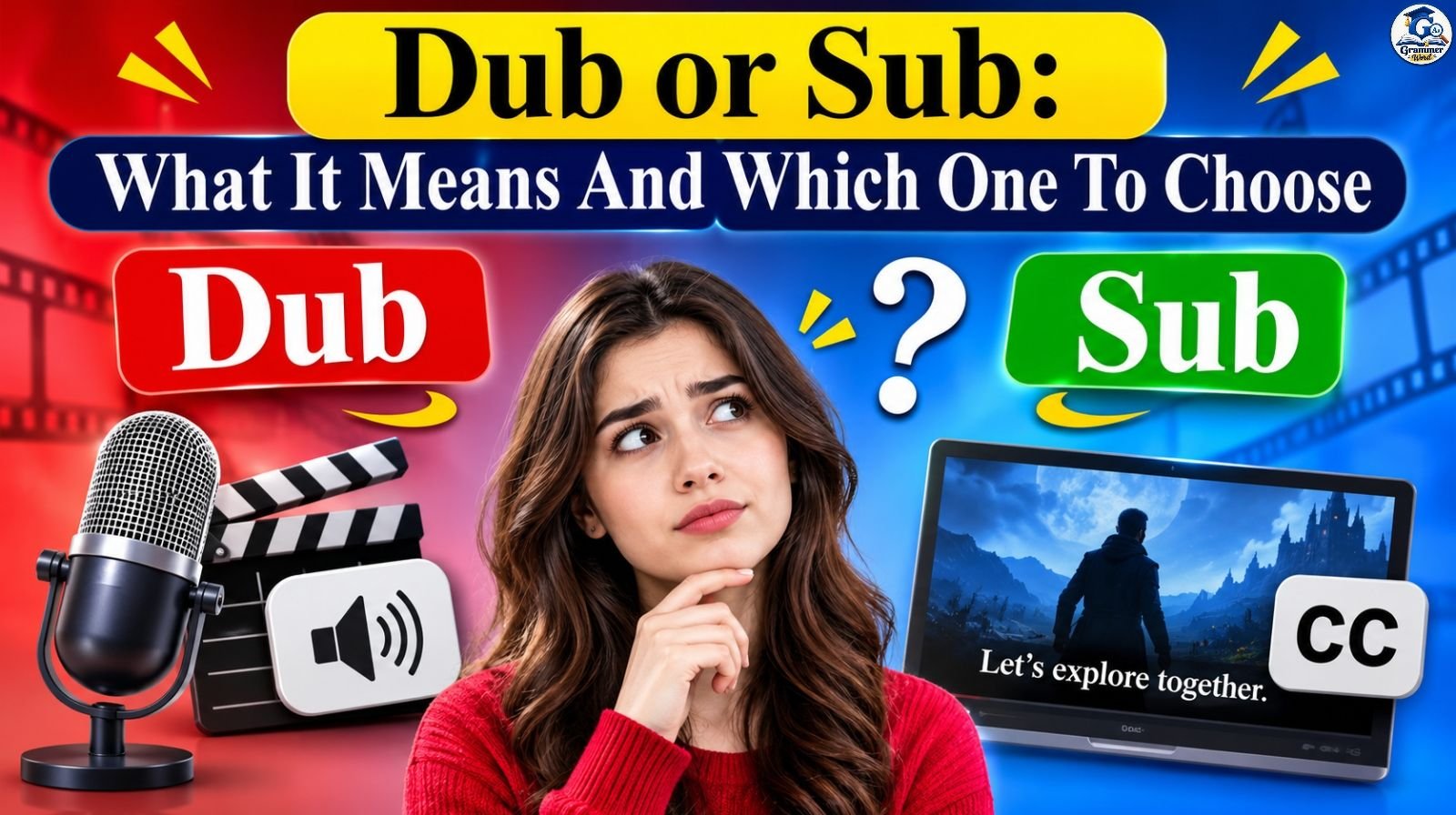
When watching a foreign-language movie, anime, television series, or online video, you may come across two familiar options: Dub and Sub. Streaming platforms often let viewers choose between dubbed audio and subtitles, but which option provides the better experience?
The debate over Dub or Sub is common among movie lovers, anime fans, and people who enjoy international entertainment.
Some viewers prefer hearing characters speak in their native language, while others enjoy the original voices and follow the dialogue through subtitles.
Both options have advantages and disadvantages. The right choice depends on your viewing habits, language preferences, and the kind of experience you want. In this guide, we will explain what dub and sub mean, how they differ, when to choose each option, and provide practical examples to help you make the right decision.
Also Read: Bachelor vs Batchelor
What Does Dub Mean?
Dub is short for dubbing, a process in which the original spoken dialogue in a movie, television show, or video is replaced with dialogue recorded in another language.
For example, imagine watching a Japanese anime originally recorded in Japanese. If you select the English dub, you will hear English-speaking voice actors performing the characters’ dialogue instead of the original Japanese voices.
Dubbing makes entertainment easier to understand for people who do not speak the original language. Viewers can follow conversations without constantly reading subtitles.
How Does Dubbing Work?
Dubbing involves several steps to create a translated audio experience.
- Translation: The original dialogue is translated into the target language.
- Script adaptation: Translators adjust the dialogue to sound natural and fit the timing of the original performance.
- Voice recording: Professional voice actors record the translated lines.
- Audio synchronization: Editors match the new dialogue with the characters’ mouth movements and scenes as closely as possible.
- Final editing: Sound engineers balance voices, music, and background effects.
The result is a version of the original production that viewers can understand through their preferred language.
Examples of Dub in Everyday Entertainment
Here are some common situations where you might choose dubbed content:
- Watching anime: You select English audio instead of the original Japanese dialogue.
- Watching foreign movies: A Spanish movie plays with Hindi voice actors.
- Watching documentaries: A documentary originally recorded in French is available with English narration.
- Watching children’s programs: Animated characters speak in a language familiar to young viewers.
In each situation, dubbing allows viewers to enjoy the content without depending entirely on written translations.
What Does Sub Mean?
Sub is short for subtitles. It refers to written translations or transcriptions displayed on the screen while the original audio remains unchanged.
For example, if you watch a Korean drama with English subtitles, the actors continue speaking Korean while English translations appear at the bottom of the screen.
Unlike dubbing, subtitles do not replace the original voices. Instead, they help viewers understand the dialogue while preserving the original language and voice performances.
Also Read: Accross vs Across
How Do Subtitles Work?
Subtitles are created by translating or transcribing spoken dialogue and displaying it at appropriate moments.
The process usually involves:
- Transcribing dialogue: The original conversations are written down.
- Translation: The dialogue is translated into the viewer’s preferred language when necessary.
- Timing: Each subtitle is synchronized with the corresponding scene.
- Formatting: Text is adjusted to remain readable and fit the screen.
- Quality checking: Editors review the translations for accuracy and timing.
Some subtitles are translations, while others simply display dialogue in the same language as the original audio.
Examples of Sub in Everyday Entertainment
You might choose subtitles in several situations:
- Watching Korean dramas: You listen to Korean conversations and read English translations.
- Watching Japanese anime: You keep the original Japanese voices and use English subtitles.
- Watching French films: You enjoy the original performances while reading translated dialogue.
- Learning another language: You listen to foreign-language conversations while following the written meaning.
Subtitles are especially useful for people who appreciate original performances or want additional language exposure.
Dub or Sub: What Is the Main Difference?
Although both options help viewers understand foreign-language entertainment, they provide different experiences.
The biggest difference is how translated dialogue is presented.
With dubbing, the original spoken dialogue is replaced by newly recorded voices. With subtitles, the original audio stays the same, and translated text appears on the screen.
Here is a simple comparison:
| Feature | Dub | Sub |
|---|---|---|
| Full meaning | Dubbing | Subtitles |
| Original audio | Usually replaced | Preserved |
| Translation | Spoken dialogue | Written text |
| Reading required | Usually no | Yes |
| Original voice acting | Usually unavailable in the selected audio | Preserved |
| Visual attention | Easier to focus on visuals | Requires reading |
| Language learning | Less exposure to original speech | More exposure to original speech |
| Accessibility | Helpful for viewers who prefer audio | Helpful for viewers who can read the subtitles |
Both options have their place. Neither is automatically better for every viewer.
Dub vs. Sub: Which One Is Better?
Choosing between dub and sub depends on what matters most to you.
If you want a relaxed viewing experience without reading, dubbing may be the better option. However, if you enjoy original performances and want to hear the actors’ actual voices, subtitles may be more appealing.
Let’s explore the advantages of each option.
Also Read: Naive vs Nieve
Advantages of Dub
1. Easier to Understand
Dubbed content allows viewers to understand conversations directly through audio. You do not need to read every line to follow the story.
2. Better for Multitasking
If you are eating, relaxing, or doing something that does not require your full attention, dubbed content can be more convenient.
3. Helpful for Younger Viewers
Children who are not comfortable reading subtitles may find dubbed cartoons and animated movies easier to follow.
4. More Comfortable for Some Viewers
Some people find reading subtitles tiring, especially during long movies or television episodes. Dubbing provides a more comfortable alternative.
5. Easier to Follow Fast Conversations
When characters speak quickly or several people talk at once, dubbed audio can make conversations easier to understand.
Disadvantages of Dub
Despite its convenience, dubbing has some limitations.
- Original voices are replaced: You may miss the natural voice performances of the original actors.
- Lip synchronization can be imperfect: Translated dialogue does not always match the characters’ mouth movements.
- Translation may change meaning: Some expressions, jokes, and cultural references are difficult to adapt.
- Voice preferences differ: A dubbed voice may not match how viewers imagine a particular character should sound.
Advantages of Sub
1. Preserves Original Performances
Subtitles allow viewers to hear the original actors’ voices, emotions, and delivery.
2. Provides a More Authentic Experience
You can experience the original language, pronunciation, tone, and cultural expressions while following the translated dialogue.
3. Useful for Language Learning
Watching foreign-language content with subtitles can help you become familiar with new vocabulary, sentence structures, and pronunciation.
4. Keeps Original Audio Intact
The original voice performances remain unchanged, which is particularly important for viewers who appreciate the actors’ work.
5. Offers Greater Language Flexibility
You can often combine original audio with subtitles in different languages, depending on the streaming platform.
Disadvantages of Sub
Subtitles also have a few drawbacks.
- Constant reading: You must pay attention to the text while watching.
- Missed visual details: Reading subtitles can make you overlook facial expressions or important background events.
- Reading speed: Fast dialogue may be difficult to follow.
- Translation limitations: Subtitles sometimes shorten conversations because of screen space and reading-time restrictions.
- Accessibility concerns: They may not be suitable for viewers who have difficulty reading quickly.
Also Read: Transferred vs Transfered
When Should You Choose Dub?
Dubbing is a good choice when comfort, convenience, and understanding are your main priorities.
Here are some practical situations where choosing dub makes sense.
1. When You Want a Relaxed Movie Night
Imagine that you have finished a busy day and want to watch an entertaining movie without concentrating too much.
You select an English-dubbed version of a Japanese animated film. Instead of reading subtitles throughout the movie, you can simply listen to the dialogue and enjoy the visuals.
Best choice: Dub, because it provides a more relaxed viewing experience.
2. When Watching With Children
Suppose you are choosing an animated movie for your younger family members. They enjoy the colorful characters but struggle to read subtitles quickly.
A dubbed version in their familiar language makes the movie easier to understand.
Best choice: Dub, because children can follow the story without constantly reading.
3. When You Are Multitasking
Imagine preparing dinner while listening to a foreign-language television series.
A dubbed version allows you to understand conversations without looking at the screen every few seconds.
Best choice: Dub, because it makes following the dialogue easier when your attention is divided.
When Should You Choose Sub?
Subtitles are ideal when you want to preserve original performances or improve your understanding of another language.
Consider these situations.
1. When Watching Anime
Imagine you are a dedicated anime fan who enjoys Japanese voice acting. You want to hear the original emotions, expressions, and character performances.
You select Japanese audio with English subtitles.
Best choice: Sub, because it preserves the original Japanese performances.
2. When Watching Foreign Films
Suppose you are watching a French romantic movie. The actors’ original voices and emotional delivery are important to the experience.
You choose French audio with English subtitles to understand the conversations without replacing the original performances.
Best choice: Sub, because it maintains the original audio.
3. When Learning a New Language
Imagine you are learning Korean and want to improve your listening skills.
You watch a Korean drama with Korean audio and English subtitles. You listen to the pronunciation while reading the translation to understand the conversation.
Best choice: Sub, because it exposes you to the original spoken language.
Real-Life Scenario Examples: Dub or Sub?
Understanding the difference becomes easier when you see how people use these terms in everyday conversations.
Scenario 1: Asking a Friend About an Anime
Sarah wants to watch a popular Japanese anime but is unsure which audio option to select.
She sends her friend Daniel a message:
Email Example:
Subject: Should I Watch This Anime Dubbed or Subbed?
Hi Daniel,
I am planning to start a new Japanese anime this weekend. I noticed that it has both English dub and Japanese sub options. Which one would you recommend? I usually prefer understanding the dialogue without reading subtitles, but I also want to experience the original voice acting. Let me know what you think!
Best regards,
Sarah
In this example, Sarah uses dubbed to refer to translated spoken dialogue and subbed to refer to the original audio with subtitles.
Scenario 2: Recommending a Movie to a Friend
Michael recently watched a Korean movie and wants to recommend it to his friend Emily.
He sends her this message:
“Hey Emily! You should watch this Korean movie. I watched the subbed version because I wanted to hear the original actors. The subtitles were easy to follow, and the story was amazing!”
Here, subbed version means that the movie uses its original Korean audio with translated subtitles.
Also Read: Dysregulated vs Disregulated
Scenario 3: Choosing a Version for a Family Movie Night
Jessica is organizing a movie night with her younger cousins.
She asks her brother:
“Should we play the dubbed version? The kids might find subtitles difficult to follow.”
Her brother replies:
“Yes, let’s choose the English dub. Everyone can enjoy the movie without having to read the dialogue.”
In this situation, dub is the more practical choice because the audience includes younger children.
Scenario 4: Discussing Language Learning
Alex is learning Japanese and wants to improve his listening skills.
He tells his classmate:
“I usually watch anime subbed because I want to hear Japanese conversations. I sometimes pause the episode to understand new words and expressions.”
This example demonstrates how subbed content can support language-learning activities.
Is Dubbed or Subbed Better for Anime?
The question of dubbed or subbed anime is especially popular among anime fans.
Both options offer different experiences, and the better choice depends on personal preference.
Why Some Anime Fans Prefer Dub
Some viewers enjoy English-dubbed anime because:
- They can concentrate on animation and action scenes.
- They understand the conversations without reading.
- They can enjoy episodes while doing other activities.
- They prefer certain English voice actors.
Why Some Anime Fans Prefer Sub
Other viewers prefer subbed anime because:
- They enjoy original Japanese voice acting.
- They appreciate the original emotional delivery.
- They want to experience Japanese expressions.
- They prefer hearing the performances as originally recorded.
Our recommendation: If you are new to anime, try both versions. You may discover that some series work better for you in English dub, while others are more enjoyable in Japanese with subtitles.
Does Dub or Sub Affect the Original Meaning?
Yes, both dubbing and subtitles can sometimes change how dialogue is presented.
Translation is not always a word-for-word process. Languages have different expressions, sentence structures, humor, and cultural references.
For example, a Japanese character might use a culturally specific expression that does not have a direct English equivalent.
A translator may adapt that expression into a natural English phrase so viewers can understand the intended meaning.
With dubbing, the translated script may also need adjustments to match the timing of the characters’ mouth movements.
With subtitles, the translation may be shortened to fit the screen and remain readable.
However, professional translators work to preserve the original meaning, tone, and context as accurately as possible.
Can You Watch Dub and Sub Together?
Yes! Many streaming platforms allow viewers to combine different audio and subtitle settings.
For example, you can select:
- English audio with English subtitles.
- English audio with Spanish subtitles.
- Japanese audio with English subtitles.
- Korean audio with Hindi subtitles.
Watching dubbed audio with subtitles in the same language can also be useful if you want to follow dialogue more carefully.
For language learners, original audio combined with subtitles in the same language can provide additional listening and reading practice.
The available combinations depend on the streaming service and the specific movie or show.
Also Read: Moment vs Momment
Common Mistakes When Using Dub and Sub
Although these terms are widely used in entertainment, people sometimes misunderstand their meanings.
Here are a few common mistakes to avoid.
1. Thinking Dub and Sub Mean the Same Thing
They are not interchangeable. Dub refers to replacement audio, while sub refers to subtitles displayed on the screen.
2. Assuming Sub Always Means English Subtitles
Subtitles can be available in many languages. The language depends on the streaming platform and the available subtitle tracks.
3. Believing Dub Is Always Less Accurate
A professionally dubbed version can communicate the original story effectively. Quality depends on translation, voice acting, and adaptation.
4. Assuming Sub Is Always Better
Subtitles preserve the original voices, but that does not automatically make them the best option for everyone. Personal preferences and accessibility needs matter.
5. Confusing Subbed With Subscribing
In entertainment discussions, subbed usually means that a video includes subtitles. It does not mean subscribing to a streaming service or channel.
Dub or Sub: Which One Should You Choose?
The final decision depends on what you want from your viewing experience.
| Your Preference | Recommended Option |
|---|---|
| Watching without reading | Dub |
| Hearing original voice actors | Sub |
| Watching with young children | Dub |
| Learning a foreign language | Sub |
| Multitasking while watching | Dub |
| Enjoying original performances | Sub |
| Following fast-paced visuals | Dub |
| Experiencing original dialogue | Sub |
There is no universal winner. Both options serve different purposes, and you do not need to choose only one.
You can enjoy dubbed anime today and watch a subbed foreign movie tomorrow. The most important thing is choosing the format that makes entertainment enjoyable and comfortable for you.
Frequently Asked Questions
1. What does dub or sub mean?
Dub means replacing the original spoken dialogue in a movie, anime, or television show with recorded voices in another language. Sub means subtitles, where the original audio remains unchanged while translated text appears on the screen.
2. Is dub or sub better for watching anime?
It depends on personal preference. Dubbed anime is convenient for viewers who prefer listening in their native language, while subbed anime is ideal for fans who enjoy original Japanese voice acting and translated subtitles.
3. What is the difference between dubbed and subbed movies?
A dubbed movie uses newly recorded dialogue in another language, replacing the original voices. A subbed movie keeps the original audio and displays translated text so viewers can understand the conversations.
4. Is watching subbed anime better for learning Japanese?
Yes, watching subbed anime can help learners become familiar with Japanese pronunciation, vocabulary, and listening patterns. However, subtitles alone do not guarantee language fluency. Regular practice and additional learning resources are also important.
5. Why do some people prefer dubbed movies?
Some people prefer dubbed movies because they can understand conversations without reading subtitles. Dubbing also makes it easier to focus on visuals, follow fast dialogue, and enjoy entertainment while multitasking.
6. Does dubbing change the original meaning of a movie?
Dubbing can sometimes change certain expressions, jokes, or cultural references because translators adapt dialogue to sound natural in another language. However, professional dubbing aims to preserve the original story, meaning, and emotions.
7. Can I watch a dubbed movie with subtitles?
Yes, many streaming platforms allow viewers to watch dubbed movies with subtitles. For example, you can select English audio and English subtitles or choose another available subtitle language.
8. Should beginners choose dub or sub when watching foreign movies?
Beginners may find dub easier because they can understand the dialogue without reading. However, sub is a good option for people who want to experience original performances and become familiar with another language.
Conclusion
Understanding Dub or Sub: What It Means and Which One to Choose makes it easier to select the right viewing experience for movies, anime, and television shows.
Dub replaces the original dialogue with recorded voices in another language, making entertainment easier to follow without reading. Sub preserves the original audio and displays translated text on the screen, allowing viewers to enjoy the original performances.
If you prefer convenience, relaxed viewing, and audio in a familiar language, choose dub. If you value original voice acting, cultural authenticity, and language exposure, choose sub.
Ultimately, the best choice is the one that makes your viewing experience more enjoyable. Try both options and decide which works best for the content you love.
Keep learning with more easy grammar lessons on GrammarTidy.com

Hi, I’m Noor Fatima, the author and creator of Grammar Tidy. I’m passionate about grammar, writing, and making language learning simple and enjoyable. Through Grammar Tidy, I share helpful tips, clear explanations, and practical guidance to help readers improve their writing, avoid common mistakes, and communicate with confidence. My goal is to make better grammar easy, useful, and accessible for everyone.