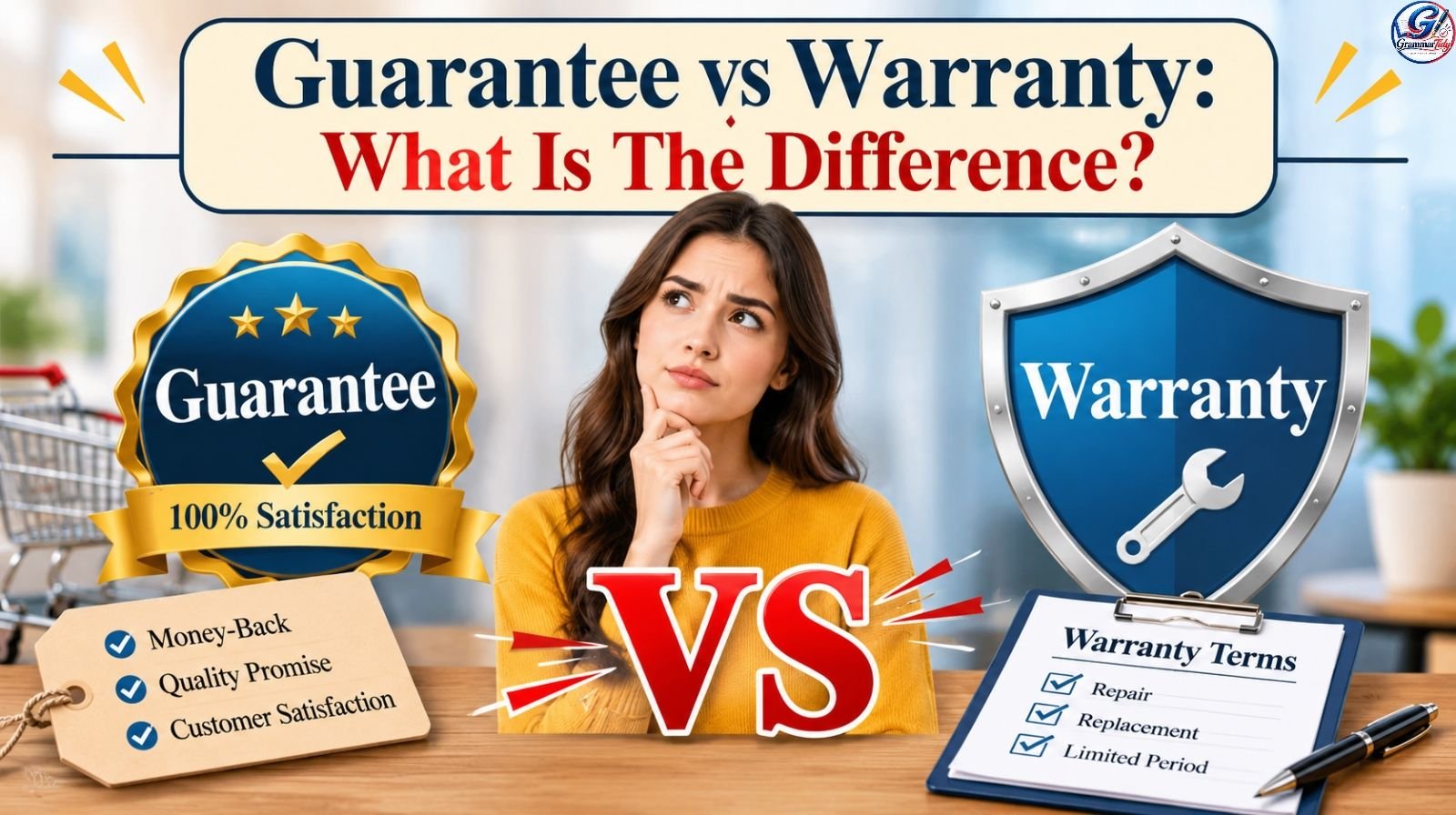
When purchasing a product, signing an agreement, or dealing with a service provider, you may come across the words guarantee and warranty. Both terms are commonly used to describe promises about quality, performance, and customer satisfaction. However, they do not always mean the same thing.
Understanding guarantee vs warranty can help you make better purchasing decisions, protect your rights, and avoid confusion when something goes wrong with a product.
For example, a company might guarantee that its product will meet certain quality standards, while another company may offer a two-year warranty covering repairs or replacement if the product develops a manufacturing defect.
Although these terms are sometimes used interchangeably, there are important differences in their meaning, purpose, and application.
In this guide, we will explain what a guarantee and a warranty mean, explore their key differences, and provide practical examples to show how each term is used in everyday situations.
Also Read: Capital vs Capitol Money
What Does Guarantee Mean?
A guarantee is a promise made by a manufacturer, seller, or service provider that a product or service will meet certain expectations. It gives customers confidence that they will receive the quality, performance, or results that have been promised.
If a product does not meet the stated conditions, the company may offer a refund, replacement, repair, or another suitable solution, depending on the guarantee’s terms.
Guarantees are often associated with customer satisfaction and product quality. They can also apply to services, business agreements, and professional commitments.
For example, imagine purchasing a washing machine from a store. The salesperson tells you that the machine comes with a 30-day money-back guarantee. If you are unhappy with its performance during that period, you may be able to return it and receive your money back, provided you meet the stated conditions.
Common Features of a Guarantee
A guarantee generally includes several important characteristics:
- Promise of quality: The company promises that its product or service will meet specific standards.
- Customer protection: It gives customers additional confidence when making a purchase.
- Possible refund or replacement: Depending on the terms, customers may receive a refund, replacement, or repair.
- Flexible coverage: A guarantee may cover product quality, performance, satisfaction, or specific results.
- Written or verbal promise: Some guarantees are provided in writing, while others may be communicated verbally, subject to applicable laws.
Examples of Guarantee in Everyday Situations
Here are some practical situations that demonstrate how a guarantee works.
Example 1: Furniture Purchase
Sarah purchases a new sofa from a furniture store. The seller guarantees that the sofa’s fabric will not fade under normal indoor use for two years.
If the fabric fades within the covered period despite normal use, Sarah can contact the seller and request a solution under the guarantee.
Example 2: Online Shopping
Daniel orders a pair of shoes from an online retailer. The website offers a 14-day satisfaction guarantee.
After receiving the shoes, Daniel discovers that they are uncomfortable. He checks the return conditions, submits a return request, and receives a refund because his purchase meets the guarantee’s requirements.
Example 3: Professional Service
A digital marketing agency guarantees that it will deliver a completed website within 30 days.
If the agency fails to deliver according to the agreed conditions, the client may request an appropriate remedy under their agreement.
These examples show that a guarantee focuses on a promise or assurance that a customer can rely on when purchasing a product or service.
Also Read: Less vs Fewer Grammar
What Does Warranty Mean?
A warranty is a formal promise, usually provided by a manufacturer or seller, that a product will meet certain quality and performance standards for a specified period.
If the product develops a covered defect or stops functioning properly because of a manufacturing or material issue, the responsible company may repair it, replace it, or provide another remedy.
Warranties are particularly common with electronic devices, household appliances, vehicles, machinery, and other physical products.
For example, when purchasing a new laptop, you might receive a one-year manufacturer’s warranty. If the laptop develops a covered hardware problem during that period, the manufacturer may repair or replace the faulty component without charging you for the covered repair.
However, warranties have specific terms and conditions. They may exclude accidental damage, misuse, unauthorized repairs, or normal wear and tear.
Common Features of a Warranty
A warranty usually has the following characteristics:
- Specified coverage period: It generally applies for a defined period, such as one, two, or five years.
- Product-related protection: It usually covers defects in materials, workmanship, or specified product components.
- Repair or replacement: The manufacturer or seller may repair or replace defective parts under the warranty.
- Terms and conditions: Customers must follow the requirements stated in the warranty document.
- Limited coverage: Certain types of damage, including accidental damage, may not be covered.
Examples of Warranty in Everyday Situations
Let’s look at a few examples to understand how warranties work.
Example 1: Smartphone Purchase
Michael purchases a new smartphone with a one-year manufacturer’s warranty.
After six months, the phone develops a charging problem caused by a defective internal component. Michael contacts the manufacturer, provides proof of purchase, and submits the phone for inspection.
The manufacturer confirms that the issue is covered and repairs the phone without charging him for the covered repair.
Example 2: Car Purchase
Emily purchases a new car with a five-year powertrain warranty.
After three years, the engine develops a manufacturing-related defect. Because the issue falls within the warranty coverage, the dealership arranges the necessary repair according to the warranty terms.
Example 3: Refrigerator Purchase
David buys a refrigerator with a two-year warranty.
After 18 months, its cooling system stops working because of a covered manufacturing defect. David contacts the seller, provides his warranty information, and arranges a repair.
These situations demonstrate that a warranty primarily protects customers against specified product defects or failures during an agreed coverage period.
Also Read: Damnit or Dammit
Guarantee vs Warranty: What Is the Main Difference?
The main difference between a guarantee and a warranty is the type of promise each one provides.
A guarantee is generally a broader assurance about a product’s quality, performance, or customer satisfaction. A warranty is usually a more specific commitment to repair, replace, or otherwise address covered product defects within a defined period.
Although both provide customer protection, their coverage and conditions can vary depending on the company, product, country, and applicable consumer protection laws.
Consider the following comparison:
| Feature | Guarantee | Warranty |
|---|---|---|
| Meaning | A promise about quality or performance | A promise covering specified product defects or failures |
| Main purpose | Customer confidence and satisfaction | Protection against covered defects |
| Coverage | May cover quality, performance, or satisfaction | Usually covers materials, workmanship, or specified components |
| Duration | May have a specific period or conditions | Generally has a defined coverage period |
| Remedy | May include a refund, replacement, or repair | Commonly includes repair or replacement |
| Application | Products and services | Primarily physical products |
| Documentation | Written or verbal | Usually provided in written documentation |
| Conditions | Depends on the stated promise | Depends on specific warranty terms |
Important: These are general distinctions, not universal legal rules. Some guarantees are limited to specific defects, while some warranties offer broader benefits. The actual written terms matter more than the label used by a company.
Key Differences Between Guarantee and Warranty Explained
The comparison table gives a quick overview, but understanding the differences in more detail can help you use these terms correctly.
1. Difference in Meaning
A guarantee is an assurance that something will meet a particular expectation. It communicates confidence in the quality, performance, or reliability of a product or service.
A warranty, on the other hand, is a commitment to provide a remedy when a product experiences a problem covered by the warranty terms.
For example:
- Guarantee: A furniture company promises that its products will meet specific quality standards.
- Warranty: A furniture manufacturer agrees to repair a defective chair frame within three years of purchase.
The guarantee focuses on the promise, while the warranty usually focuses on the conditions under which defects will be addressed.
2. Difference in Duration
Another important distinction is the coverage period.
A guarantee may have a specific duration, such as a 30-day money-back guarantee, or it may apply under certain conditions without following the same structure as a traditional product warranty.
A warranty generally specifies a coverage period. For example, a television might have a one-year warranty, while a vehicle may have a five-year warranty covering certain components.
Always check the duration and starting date because coverage may begin on the purchase date, delivery date, or another date specified in the agreement.
Also Read: Stigmatism vs Astigmatism
3. Difference in Coverage
Guarantees can cover different expectations, including customer satisfaction, product performance, and quality standards.
Warranties generally focus on specific defects or problems with a product.
For example, a company might guarantee that its water purifier will deliver a particular level of filtration performance when properly installed and maintained.
Its warranty might separately cover defects in the motor or electronic components.
This means a single product can come with both a guarantee and a warranty.
4. Difference in Customer Protection
Both guarantees and warranties can protect customers, but the protection they provide depends on their terms.
A satisfaction guarantee might allow customers to return a product if they are unhappy with it.
A product warranty might cover repairs if the item stops working because of a manufacturing defect.
For instance, if you purchase a pair of headphones with a 30-day satisfaction guarantee and a one-year warranty, you may have different options depending on when and why you experience a problem.
The guarantee may provide a return option, while the warranty may provide repair or replacement coverage.
Guarantee vs Warranty: Real-Life Scenario Examples
Sometimes, the easiest way to understand the difference between two terms is to see how they work in realistic situations.
Here are some common scenarios.
Scenario 1: Buying a New Laptop
Imagine that Olivia purchases a laptop from an electronics store.
The store offers a 30-day satisfaction guarantee, while the manufacturer provides a one-year limited warranty.
After two weeks, Olivia decides that the laptop does not meet her expectations. She contacts the store and requests a return.
Because the purchase falls within the 30-day guarantee period and meets the return conditions, the store accepts the return.
Now imagine that Olivia keeps the laptop for eight months, and its keyboard stops working because of a manufacturing defect.
She contacts the manufacturer and requests a repair under the one-year warranty.
What does this scenario teach us?
The guarantee provides a possible return option based on satisfaction, while the warranty addresses a covered product defect.
Also Read: Modelling or Modeling
Scenario 2: Purchasing a New Car
James purchases a new vehicle from a dealership.
The manufacturer provides a five-year warranty covering certain engine and transmission defects.
The dealership also offers a separate satisfaction guarantee under which the customer can return the vehicle within a specified period if the stated conditions are met.
After three years, James notices an engine problem.
He contacts the dealership, and the manufacturer determines that the issue is covered by the warranty.
In this situation, the warranty provides the relevant protection because the problem involves a covered mechanical defect.
Scenario 3: Buying a Washing Machine
Emma purchases a washing machine that comes with a two-year warranty and a 60-day performance guarantee.
After 20 days, she notices that the machine does not clean clothes as effectively as advertised.
She contacts the seller and explains the issue.
The seller reviews the guarantee conditions and offers an appropriate solution.
Several months later, the washing machine develops a motor problem caused by a manufacturing defect.
Emma contacts the manufacturer and requests warranty service.
This example shows how a guarantee and warranty can provide different types of protection for the same product.
Guarantee vs Warranty: Email Examples
Both terms are frequently used in professional emails, especially when customers contact sellers, manufacturers, and service providers.
Understanding how to use them correctly can make your communication clearer and more professional.
Email Example 1: Asking About a Product Guarantee
Suppose you purchase a new office chair and want to know whether the seller offers a money-back guarantee.
Here is an example:
Dear Mr. Anderson,
I recently purchased an office chair from your store and would like to ask about the product guarantee. Could you please confirm whether the chair comes with a satisfaction guarantee? I would also appreciate information about the conditions for requesting a refund or replacement if the product does not meet the advertised quality standards. Thank you for your assistance.
Best regards,
Sophia Miller
In this email, the word guarantee is appropriate because Sophia is asking about the seller’s promise regarding product quality and customer satisfaction.
Also Read: Messege or Message
Email Example 2: Requesting a Warranty Repair
Imagine that you purchase a new printer, but it develops a technical problem within the warranty period.
You can write:
Dear Customer Support Team,
I purchased an HP printer from your store approximately six months ago. Unfortunately, the printer has recently stopped functioning properly. Since the product is still within its one-year warranty period, I would like to request assistance with a possible repair or replacement. I have attached my purchase receipt and warranty details for your reference. Please let me know the next steps.
Kind regards,
Daniel Wilson
Email Example 3: Asking About Both Guarantee and Warranty
Sometimes, customers need information about both forms of protection.
Dear Customer Service Team,
I am interested in purchasing your latest refrigerator and would like some clarification about its customer protection policies. Could you please confirm whether the product includes a satisfaction guarantee and a manufacturer’s warranty? I would also appreciate details about the warranty duration, covered components, and the conditions for requesting a refund, repair, or replacement. Thank you for your time. I look forward to your response.
Best regards,
Olivia Carter
This example uses both terms correctly because the customer is asking about two different types of protection.
When Should You Use Guarantee?
Use guarantee when discussing a promise, assurance, or commitment about quality, satisfaction, performance, or a particular result.
It is commonly used in the following situations:
- Product satisfaction: A company offers a 30-day satisfaction guarantee.
- Quality assurance: A manufacturer guarantees that its products meet specific standards.
- Service commitments: A cleaning company guarantees customer satisfaction.
- Business promises: A supplier guarantees delivery within a specific timeframe.
- Performance expectations: A company guarantees that its product will perform according to stated specifications.
Guarantee in Sentences
Here are some additional examples:
- The store offers a money-back guarantee on selected products.
- Our company guarantees high-quality customer service.
- The manufacturer guarantees that the product meets its advertised specifications.
- The seller provided a written guarantee for the furniture.
- We guarantee that your order will be delivered according to the agreed schedule.
In each sentence, the word guarantee communicates a promise or assurance.
When Should You Use Warranty?
Use warranty when referring to a formal agreement that covers specified product defects, failures, or repairs under particular conditions.
It is especially common in conversations about electronic equipment, vehicles, appliances, and machinery.
Common situations include:
- Electronics: A smartphone comes with a one-year manufacturer’s warranty.
- Vehicles: A car includes a five-year powertrain warranty.
- Home appliances: A refrigerator has a two-year limited warranty.
- Machinery: Industrial equipment comes with a warranty covering manufacturing defects.
- Computer equipment: A laptop includes a warranty covering certain hardware problems.
Warranty in Sentences
Here are some examples:
- My new laptop comes with a two-year warranty.
- The manufacturer repaired the television under its warranty.
- You should check the warranty before purchasing the appliance.
- Accidental damage is not covered by this limited warranty.
- The company replaced the defective component under the product warranty.
In these examples, warranty refers to a specific form of product protection.
Can a Product Have Both a Guarantee and a Warranty?
Yes! A product can have both a guarantee and a warranty.
In fact, many manufacturers and retailers offer different types of customer protection for the same purchase.
For example, imagine buying a new washing machine with the following benefits:
- A 30-day money-back guarantee from the retailer.
- A two-year manufacturer’s warranty covering specified manufacturing defects.
- A separate five-year motor warranty covering the motor under specific conditions.
These benefits serve different purposes.
The money-back guarantee may allow you to return the washing machine if you are dissatisfied within the stated period.
The manufacturer’s warranty may cover certain defects during the first two years.
The extended motor warranty may provide additional protection for a particular component.
However, customers should always read the documentation carefully because each benefit may have separate exclusions, requirements, and limitations.
Also Read: Fairing or Faring
Common Mistakes When Using Guarantee and Warranty
Although guarantee and warranty are related, using them incorrectly can create confusion.
Here are some common mistakes to avoid.
1. Treating Both Words as Exactly the Same
One of the most common mistakes is assuming that guarantee and warranty always mean the same thing.
Although both involve promises and customer protection, their typical purposes are different.
Better approach: Use guarantee for a general assurance and warranty for a defined product protection agreement.
2. Assuming Every Guarantee Offers a Refund
Not every guarantee promises a full refund.
Some guarantees offer repairs, replacements, or other remedies instead.
Better approach: Read the actual guarantee conditions before assuming what a company will provide.
3. Assuming Every Warranty Covers All Types of Damage
A warranty does not automatically cover every product problem.
For example, accidental drops, water damage, misuse, and unauthorized repairs may be excluded.
Better approach: Check the warranty document to understand exactly what is covered.
4. Ignoring the Coverage Period
Customers sometimes assume that a warranty remains valid indefinitely.
However, most warranties have specific starting dates and expiration periods.
Better approach: Keep your receipt, warranty certificate, and other purchase documents in a safe place.
Tips for Choosing Between a Guarantee and a Warranty
If you are purchasing an expensive product, understanding its guarantee and warranty can help you avoid unexpected expenses.
Consider these useful tips before making a purchase:
- Check the coverage period: Find out how long the guarantee or warranty remains valid.
- Read the conditions: Understand what situations are covered and excluded.
- Ask about refunds: Confirm whether a guarantee allows you to return the product.
- Understand repair policies: Check whether warranty repairs are free and where they can be performed.
- Keep proof of purchase: Save receipts, invoices, and warranty documents.
- Check manufacturer support: Make sure you know how to contact the company if a problem occurs.
- Compare additional protection: Consider whether an extended warranty provides useful benefits for the product.
These simple steps can help you make more informed purchasing decisions.
Also Read: Skiis or Skis
Frequently Asked Questions
1. Is a Guarantee Better Than a Warranty?
Neither is automatically better. A guarantee may provide benefits such as a refund or satisfaction assurance, while a warranty may cover specific product defects and repairs. The better option depends on your needs and the actual terms offered.
2. Is a Guarantee the Same as a Warranty?
No. A guarantee is generally a promise about quality, performance, or satisfaction, whereas a warranty is typically a formal commitment to address specified product defects or failures. However, their meanings can overlap depending on the agreement and applicable law.
3. Does a Warranty Mean You Get a Free Replacement?
Not necessarily. A warranty may provide free repairs, replacement parts, a complete replacement, or another remedy. The available solution depends on the warranty conditions and the nature of the problem.
4. Can You Get a Refund Under a Guarantee?
Yes, if the guarantee specifically offers a refund and you meet its conditions. For example, a 30-day money-back guarantee may allow customers to return an eligible product within the stated period.
5. What Is a Lifetime Guarantee?
A lifetime guarantee is a promise that remains valid for a defined lifetime, which may refer to the original purchaser’s lifetime or the expected lifetime of a product. The exact meaning depends on the company’s written terms.
6. What Is a Limited Warranty?
A limited warranty covers only certain defects, components, repairs, or periods. It may exclude accidental damage, misuse, normal wear and tear, and other specified situations.
7. Can a Company Offer Both a Guarantee and a Warranty?
Yes. A company can offer both. For example, a retailer might provide a 30-day satisfaction guarantee while the manufacturer offers a one-year warranty covering specified product defects.
Conclusion
Understanding guarantee vs warranty is important when purchasing products, comparing customer protection policies, or communicating with manufacturers and retailers.
A guarantee generally represents a promise about a product’s quality, performance, or customer satisfaction. A warranty, however, usually provides protection against specified product defects or failures for an agreed period.
For example, a money-back guarantee may allow you to return an unsatisfactory product, while a manufacturer’s warranty may cover repairs if the product develops a manufacturing defect.
Although both terms offer reassurance to customers, they serve different purposes and may include different conditions.
The most important thing is to read the terms carefully before making a purchase. Understanding what is covered, how long the protection lasts, and what remedies are available can help you make smarter decisions and avoid unnecessary problems.
Ultimately, both guarantees and warranties play valuable roles in building customer confidence and providing protection when products or services fail to meet expectations.
Keep learning with more easy grammar lessons on GrammarTidy.com

Hi, I’m Noor Fatima, the author and creator of Grammar Tidy. I’m passionate about grammar, writing, and making language learning simple and enjoyable. Through Grammar Tidy, I share helpful tips, clear explanations, and practical guidance to help readers improve their writing, avoid common mistakes, and communicate with confidence. My goal is to make better grammar easy, useful, and accessible for everyone.