Have you ever typed “nieve” and wondered whether it should actually be “naive”? You are not alone. The spelling can be confusing because the pronunciation of naive does not make its vowel order immediately obvious.
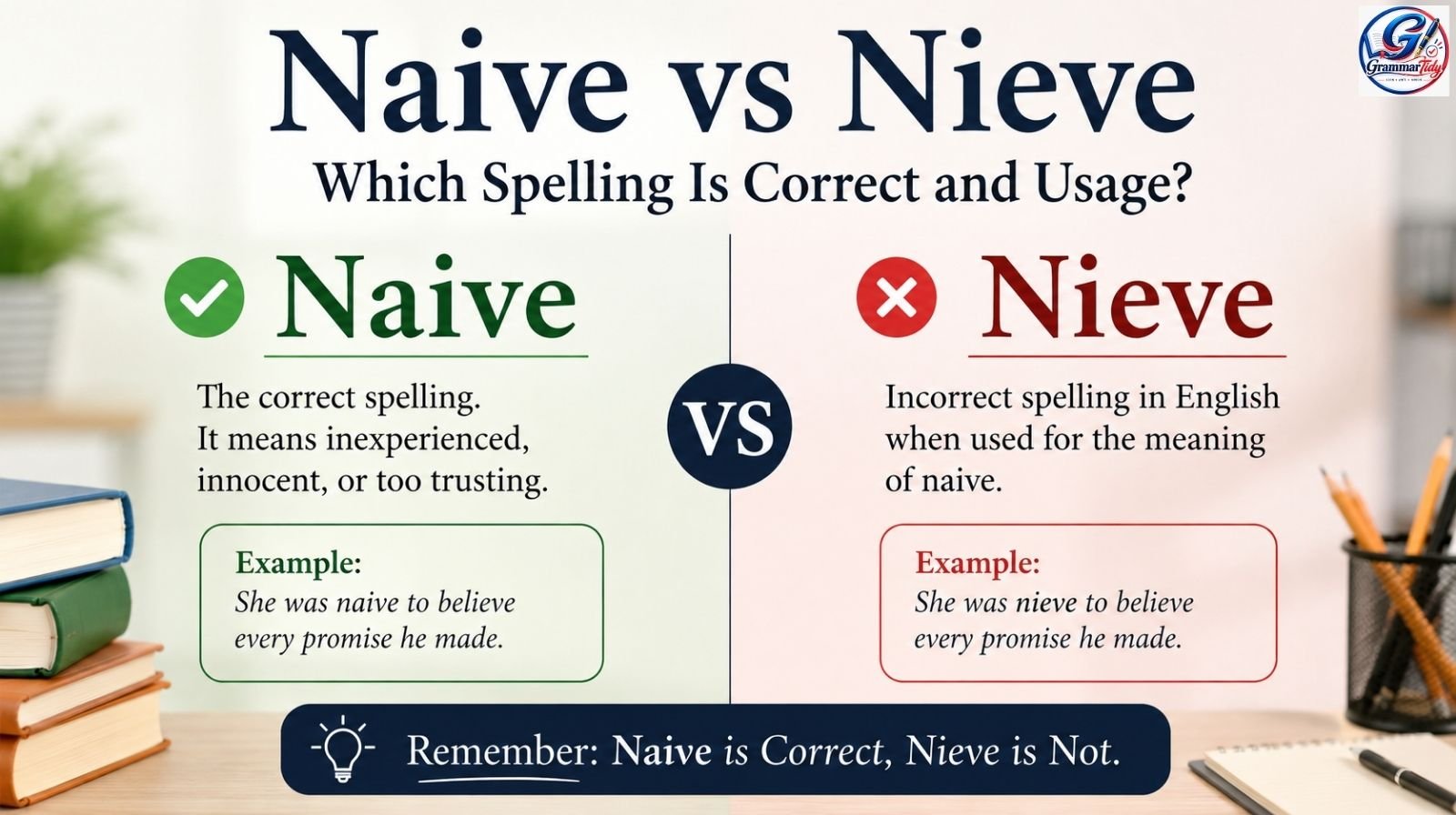
So, naive vs nieve is not really a choice between two standard English spellings. In standard English, naive is the correct spelling when you mean someone who is inexperienced, overly trusting, or lacking worldly judgment. Nieve is generally a misspelling of naive in English. You may also see the accented form naïve, which is an accepted variant.
In this guide, you will learn the difference between naive and nieve, what naive means, how to pronounce and use it, and simple ways to remember the correct spelling.
Naive vs Nieve: Which Spelling Is Correct?
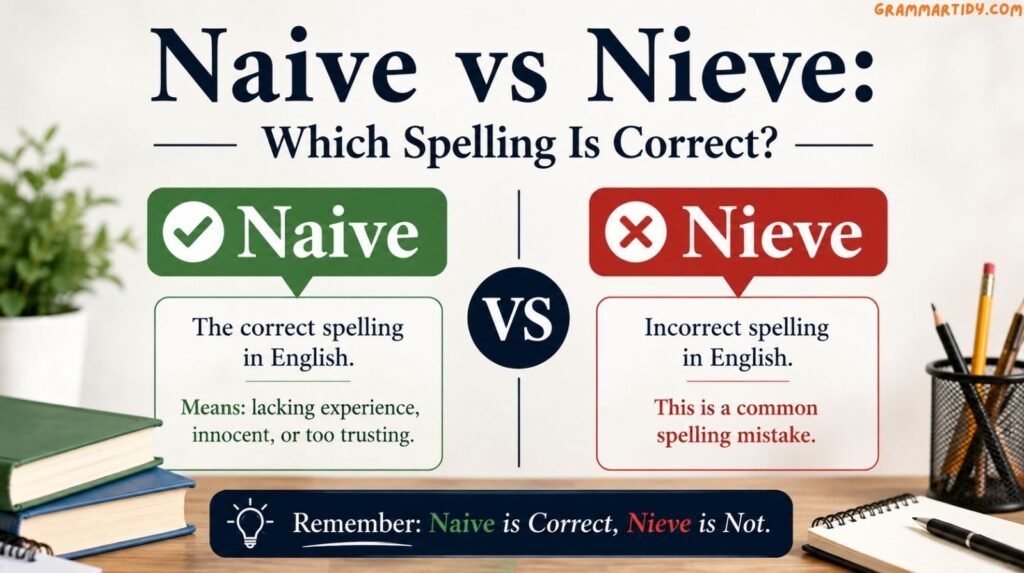
The short answer is simple: naive is the correct English spelling.
Naive is the standard English spelling
Naive is an adjective that describes someone who lacks experience, knowledge, or good judgment. It can also describe a belief, assumption, or approach that is overly simple or trusting.
For example:
- She was naive to believe every promise he made.
- It was a naive assumption that everyone would agree.
- His naive approach to business caused several problems.
Merriam-Webster lists naive as the standard form and also recognizes naïve as a variant. Its definitions include innocence or simplicity as well as a lack of experience or knowledge.
Nieve is usually a misspelling in English
If you want to describe someone as inexperienced or too trusting, nieve is not the correct English spelling.
❌ She was nieve about the dangers.
✅ She was naive about the dangers.
Therefore, when writing an essay, email, article, résumé, or social media post in English, choose naive.
Naive vs. naïve
Both naive and naïve are acceptable.
The two dots over the i are called a diaeresis. The accented spelling reflects the word’s French origin, but the unaccented naive is extremely common in modern English writing.
For everyday digital writing, naive is a perfectly acceptable choice.
Also Read: Excited vs Exited: Learn The Difference And Usage
What Does Naive Mean?
The meaning of naive depends slightly on context, but it generally relates to a lack of experience, worldly knowledge, or informed judgment.
Naive meaning in simple English
A person can be called naive when they trust people too easily or believe that situations are simpler or safer than they really are.
Cambridge defines naive as being too willing to believe people are telling the truth or that people’s intentions are good, often because of limited life experience.
For example:
He was naive enough to believe the stranger’s story.
This means he trusted the story without realizing that it might not be true.
Naive can describe ideas and assumptions
The word does not only describe people.
It can describe:
- beliefs
- assumptions
- expectations
- plans
- opinions
- approaches
- questions
Examples:
- That is a naive view of the problem.
- She made a naive assumption about the cost.
- The plan sounds naive but well-intentioned.
- His question was naive, but it was reasonable for a beginner.
Merriam-Webster also uses naive in specialized contexts, including scientific and medical writing, where it can describe something that has not previously been exposed to a particular experiment or situation.
Is naive always an insult?
No. Naive can be negative, neutral, or even mildly sympathetic depending on the sentence.
For example:
Negative:
He was naive to trust a complete stranger with his money.
Neutral:
Her naive question helped the team notice an assumption everyone else had overlooked.
Sympathetic:
She was young and naive when she first moved abroad.
So, context matters.
Naive vs Nieve: Meaning, Pronunciation, and Usage
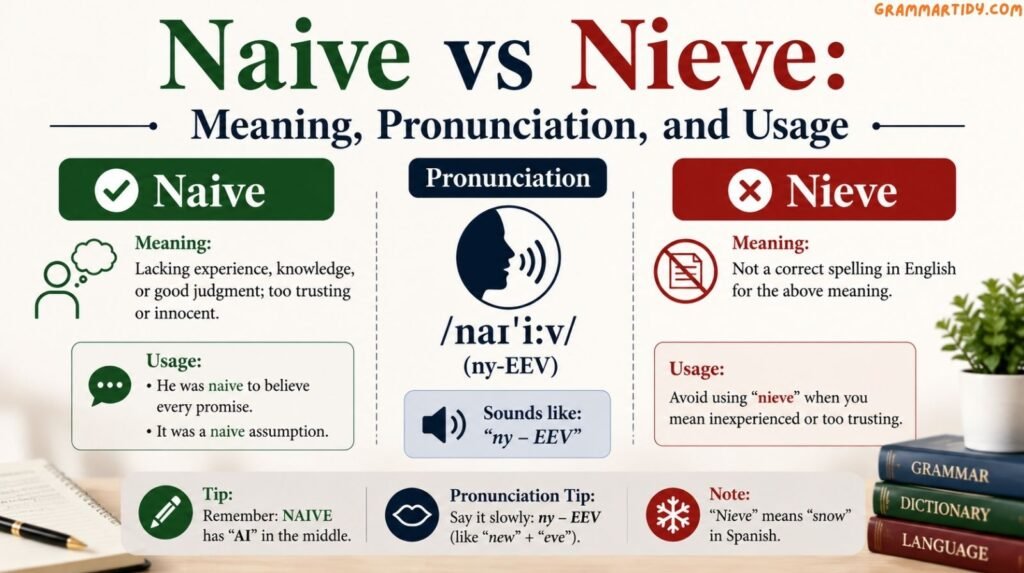
Understanding pronunciation and word history can make the spelling easier to remember.
How do you pronounce naive?
Naive is commonly pronounced approximately like “ny-EEV.” Cambridge gives the UK pronunciation /naɪˈiːv/ and also lists a US pronunciation.
The pronunciation can make the spelling confusing because the long ee sound might tempt writers to use ie, producing the incorrect form nieve.
Compare:
- ✅ naive
- ❌ nieve
The spelling naive should be memorized as a whole rather than guessed from its pronunciation.
Where does the word naive come from?
The word entered English through French. Merriam-Webster traces it to French naïve, the feminine form of naïf, ultimately connected to Latin nativus, meaning native or inborn.
That French connection also explains why you may encounter the spelling naïve.
Is nieve ever a real word?
This is an important distinction.
Nieve is not the standard English spelling of naive. However, words can have different meanings in other languages. For example, nieve is a Spanish word meaning snow.
Therefore, seeing nieve somewhere does not automatically mean the writer intended the English adjective naive. Context and language matter.
For English writing, however:
Use “naive” when you mean inexperienced, innocent, or overly trusting.
How to Use Naive Correctly in a Sentence
The easiest way to master naive is to see how it works in real sentences.
Naive vs Nieve in everyday sentences
Here are some useful examples:
| Incorrect | Correct |
|---|---|
| She was nieve about the situation. | She was naive about the situation. |
| It was a nieve assumption. | It was a naive assumption. |
| He seemed nieve and inexperienced. | He seemed naive and inexperienced. |
| That was a nieve expectation. | That was a naive expectation. |
| I was too nieve to understand the risk. | I was too naive to understand the risk. |
Naive with “to”
A common structure is:
naive + to + verb
Examples:
- It was naive to think the problem would disappear.
- She was naive to trust him immediately.
- He was naive to assume the offer was genuine.
This construction is especially useful when explaining why someone’s judgment was unrealistic.
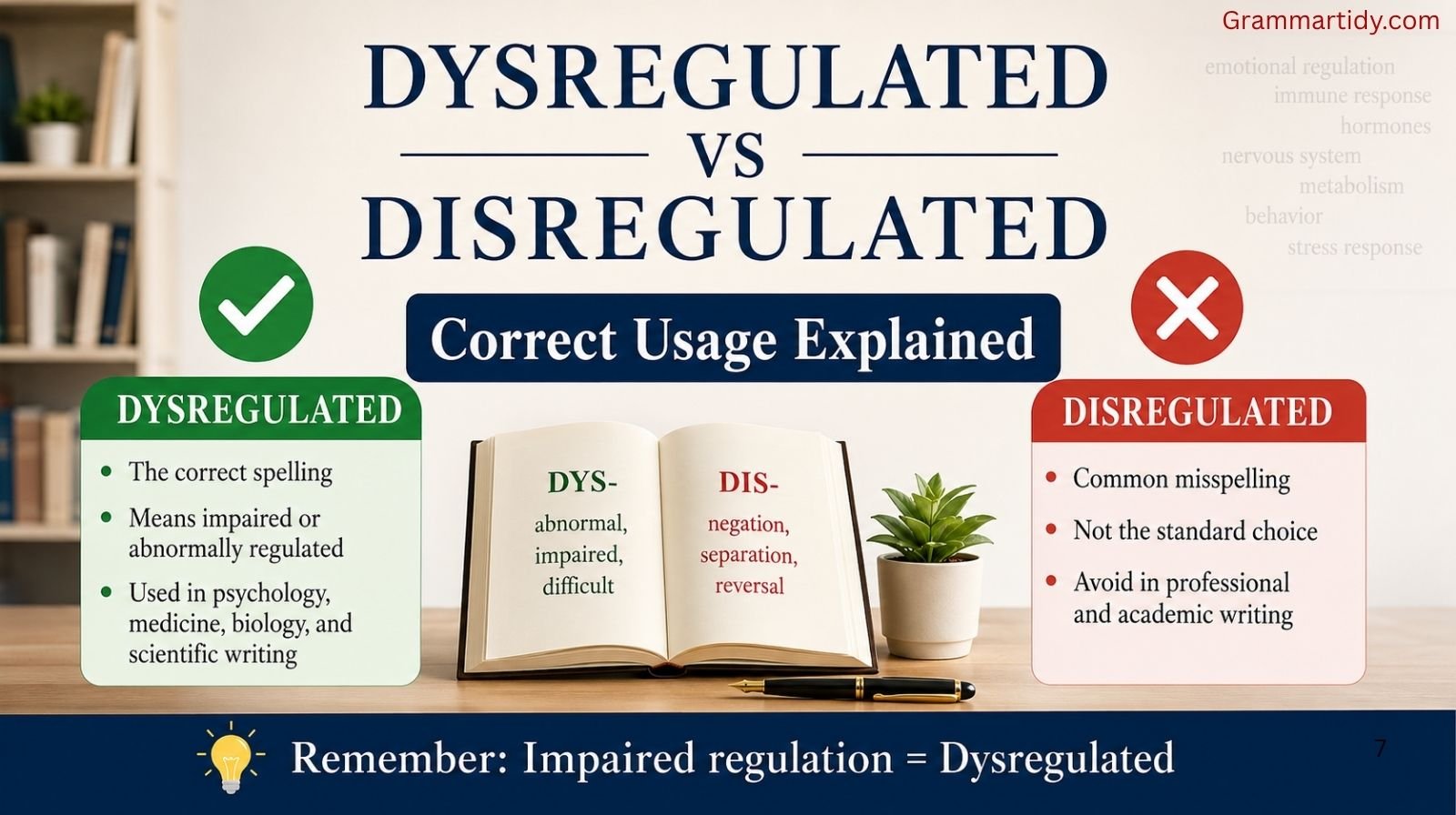
Also Read: Dysregulated vs Disregulated: Correct Usage Explained
Naive with “about”
Another common structure is:
naive + about + noun/topic
Examples:
- He was naive about business.
- She was naive about how difficult the process would be.
- They were naive about the risks involved.
Naive questions and beginner questions
Interestingly, calling a question naive does not necessarily mean the question is bad.
For example:
A naive question from a new employee revealed a problem nobody had noticed.
Here, naive means the person did not have much background knowledge. The question itself could still be valuable.
A Real-Life Example: Why Correct Spelling Matters
Imagine a recent graduate applying for an entry-level communications position. While describing a previous project, the applicant writes:
“At first, I had a nieve understanding of the market.”
The intended word is clearly naive, but the spelling error may distract the reader.
The applicant could instead write:
“At first, I had a naive understanding of the market.”
The difference is only one letter arrangement, but the second sentence looks polished and standard.
This matters because written communication is an important part of education and professional life. Research published in PLOS ONE found that spelling errors on résumés can negatively affect how applicants are perceived. The researchers found that even two or five spelling errors could function as negative signals concerning characteristics such as conscientiousness and interpersonal or mental abilities.
The lesson is not that one typo will automatically ruin an application. Rather, it shows why checking unfamiliar words is worthwhile when the writing matters.
The distinction between naive and nieve is particularly easy to fix because there is a straightforward rule: when you mean inexperienced or overly trusting, write naive. Once you recognize the correct form, repeated exposure in emails, articles, books, and professional documents makes the spelling much easier to remember.
2025–2026 Data: Why Spelling Still Matters
English is increasingly used across international education, business, and online communication. The British Council currently estimates that about 2.3 billion people speak English, while English is an official language in 67 nations and accounts for about 60% of internet content according to its Future of English research.
That makes small spelling distinctions relevant to a huge global audience, especially English learners.
There is also evidence that people actively pay attention to spelling when communicating online. A 2025 study of students’ English use on social media reported that 72% of participants said they focused greatly on correcting grammar and spelling in their English comments.
Professional communication provides another reason to care. Grammarly’s 2025 research emphasizes the continuing importance of effective written communication in the workplace, while its research with professional workers found that writing assistance could reduce communication errors significantly. (Grammarly)
So while nieve may seem like a tiny spelling mistake, choosing naive correctly contributes to clearer, more professional English.
Common Mistakes With Naive
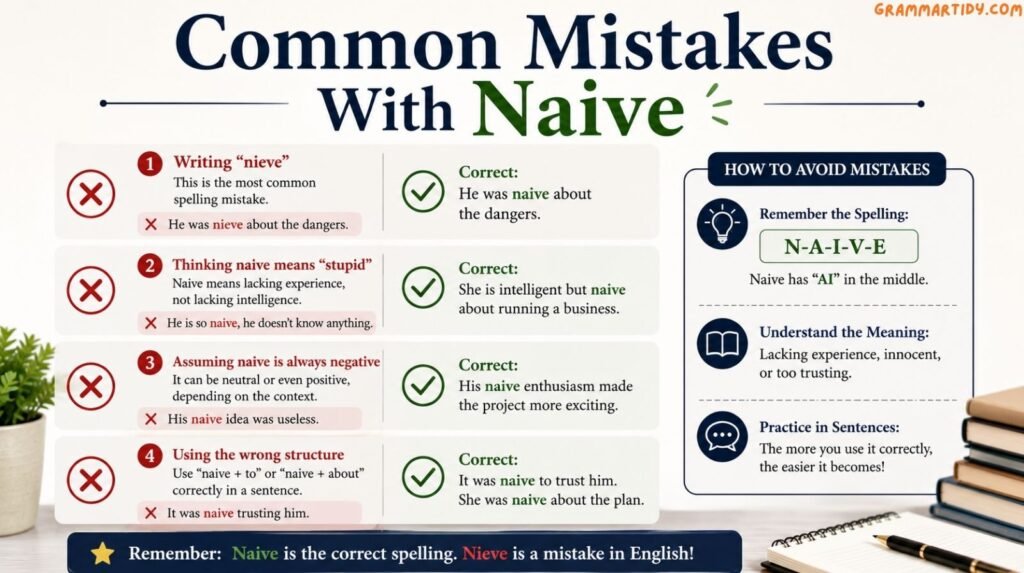
The spelling itself is not the only thing writers sometimes get wrong.
Mistake 1: Writing “nieve”
❌ He is nieve about politics.
✅ He is naive about politics.
Remember: NAIVE, not NIEVE.
Mistake 2: Thinking naive means “stupid”
Naive does not necessarily mean stupid.
Someone can be intelligent but inexperienced in a particular area.
For example:
She is an excellent programmer but naive about running a business.
This means she lacks business experience not that she lacks intelligence.
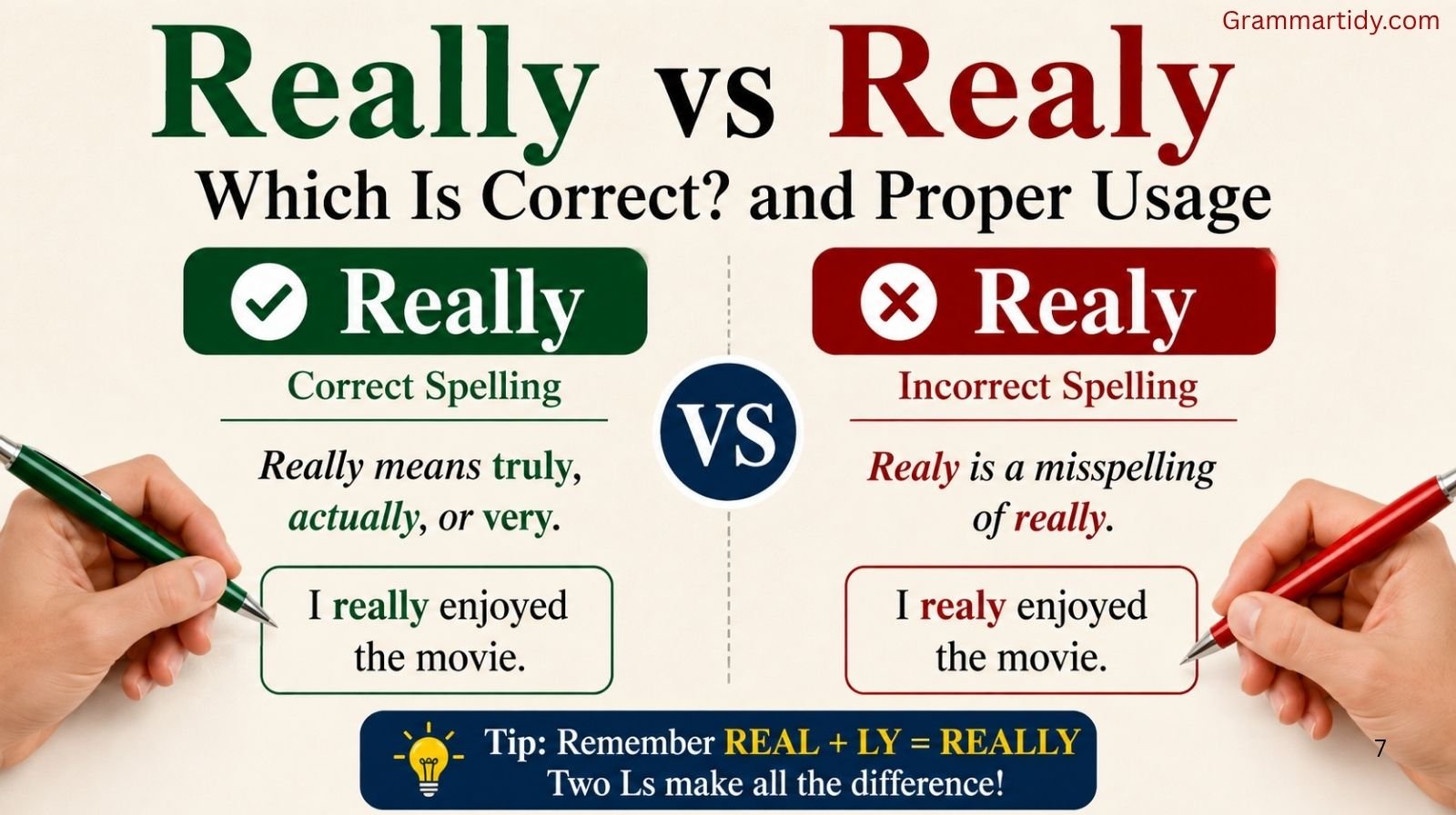
Also Read: Really vs Realy: Which Is Correct? And Proper Usage
Mistake 3: Assuming naive always has a negative meaning
The word can suggest poor judgment, but it can also describe innocence or lack of experience without harsh criticism.
For example:
His naive enthusiasm made the new project more exciting.
The sentence acknowledges his lack of experience without necessarily insulting him.
A quick way to remember the spelling
Use this simple visual:
NAIVE → NA + IVE
Think:
Naive has “AI” nieve does not.
When you mean inexperienced or overly trusting, stop and check whether you have written AI in the middle:
N-A-I-V-E ✅
1. Which spelling is correct?
A) Nieve
B) Naive
C) Neeve
D) Naivee
Answer: B) Naive
Why? Naive is the standard English spelling.
2. What does “naive” usually mean?
A) Very experienced
B) Extremely angry
C) Lacking experience or judgment
D) Highly educated
Answer: C) Lacking experience or judgment
Why? A naive person may be too trusting or inexperienced.
3. Which sentence is correct?
A) She was nieve about business.
B) She was naeve about business.
C) She was naive about business.
D) She was neive about business.
Answer: C) She was naive about business.
Why? Naive is the correct spelling in this sentence.
4. Is “naïve” an acceptable spelling?
A) Yes
B) No
C) Only in slang
D) Only in text messages
Answer: A) Yes
Why? Naïve is an accepted spelling variant of naive.
5. Which word is usually a misspelling in English?
A) Naive
B) Naïve
C) Nieve
D) Innocent
Answer: C) Nieve
Why? Nieve is not the standard English spelling of naive.
6. Which sentence uses “naive” correctly?
A) He was naive enough to trust the stranger.
B) He was nieve enough to trust the stranger.
C) He was naeve enough to trust the stranger.
D) He was neive enough to trust the stranger.
Answer: A) He was naive enough to trust the stranger.
Why? Naive correctly describes someone who trusts too easily.
7. What can “naive” describe besides a person?
A) Only animals
B) Ideas and assumptions
C) Only places
D) Only objects
Answer: B) Ideas and assumptions
Why? You can say a naive assumption or a naive approach.
8. Which spelling has the correct “AI” combination?
A) Nieve
B) Neive
C) Naive
D) Neave
Answer: C) Naive
Why? Remember the spelling: N-A-I-V-E.
9. How is “naive” commonly pronounced?
A) Nay-v
B) Ny-eev
C) Nee-vay
D) Nav
Answer: B) Ny-eev
Why? A common English pronunciation is approximately “ny-EEV.”
10. Does “naive” always mean stupid?
A) Yes
B) No
C) Only in formal English
D) Only when describing children
Answer: B) No
Why? Someone can be intelligent but inexperienced in a particular area.
11. Which sentence sounds correct?
A) It was a naive assumption.
B) It was a nieve assumption.
C) It was a neive assumption.
D) It was a naeve assumption.
Answer: A) It was a naive assumption.
Why? Naive assumption is the correct phrase.
12. What is the easiest spelling to remember?
A) N-I-E-V-E
B) N-A-I-V-E
C) N-E-I-V-E
D) N-A-E-V-E
Answer: B) N-A-I-V-E
Why? Think NAIVE = NA + IVE.
13. Which word is closest in meaning to “naive”?
A) Experienced
B) Trusting
C) Expert
D) Skilled
Answer: B) Trusting
Why? Naive can describe someone who trusts others too easily.
14. Choose the correct sentence.
A) I was too nieve to understand the risk.
B) I was too neive to understand the risk.
C) I was too naive to understand the risk.
D) I was too naeve to understand the risk.
Answer: C) I was too naive to understand the risk.
Why? Naive is the correct spelling when referring to a lack of experience or understanding.
15. Quick final challenge: Naive or Nieve?
Complete the sentence: “She was ___ about how difficult the job would be.”
A) Nieve
B) Neive
C) Naive
D) Naeve
Answer: C) Naive
Why? The correct sentence is: She was naive about how difficult the job would be.
FAQs
Q1. Is naive or nieve correct?
A: Naive is the correct standard English spelling when you mean inexperienced, innocent, or overly trusting. Nieve is generally a misspelling in English.
Q2. Is “naïve” also correct?
A: Yes. Naïve is an accepted spelling variant of naive. Major dictionaries, including Merriam-Webster and Cambridge, recognize the accented form.
Q3. What does naive mean?
A: Naive usually means lacking experience, knowledge, or worldly judgment. It can describe someone who trusts too easily or an idea that is overly simple.
Q4. How do you pronounce naive?
A: A common pronunciation is approximately “ny-EEV.” Cambridge lists /naɪˈiːv/ for both UK and US English, with additional US pronunciation information in its dictionary entries.
Q5. Is nieve a word in English?
A: Nieve is not the standard English spelling of the adjective naive. If you want to describe someone as inexperienced or overly trusting, use naive.
Q6. What is the difference between naive and innocent?
A: Innocent generally emphasizes a lack of guilt, wrongdoing, or harmful intention. Naive emphasizes a lack of experience or worldly understanding. A person can be innocent without being naive, and someone can be naive without being completely innocent.
Q7. What are synonyms for naive?
A: Depending on context, synonyms include inexperienced, innocent, trusting, unsophisticated, credulous, unworldly, and ingenuous. However, these words are not always interchangeable because each carries slightly different shades of meaning.
Conclusion:
When choosing between naive vs nieve, the answer is straightforward: naive is the correct English spelling for someone or something that is inexperienced, overly trusting, or lacking worldly judgment.
You may also write naïve, but nieve should not be used for this meaning in standard English.
The easiest spelling to remember is:
Naive = N-A-I-V-E ✅
Nieve = incorrect for this English meaning ❌
Whether you are writing an essay, email, résumé, blog post, or social media caption, using naive correctly helps your writing look polished and professional.
Save this guide for the next time you hesitate over “naive” vs “nieve,” and check the spelling before you hit publish.
Keep learning with more easy grammar lessons on GrammarTidy.com

Hi, I’m Noor Fatima, the author and creator of Grammar Tidy. I’m passionate about grammar, writing, and making language learning simple and enjoyable. Through Grammar Tidy, I share helpful tips, clear explanations, and practical guidance to help readers improve their writing, avoid common mistakes, and communicate with confidence. My goal is to make better grammar easy, useful, and accessible for everyone.