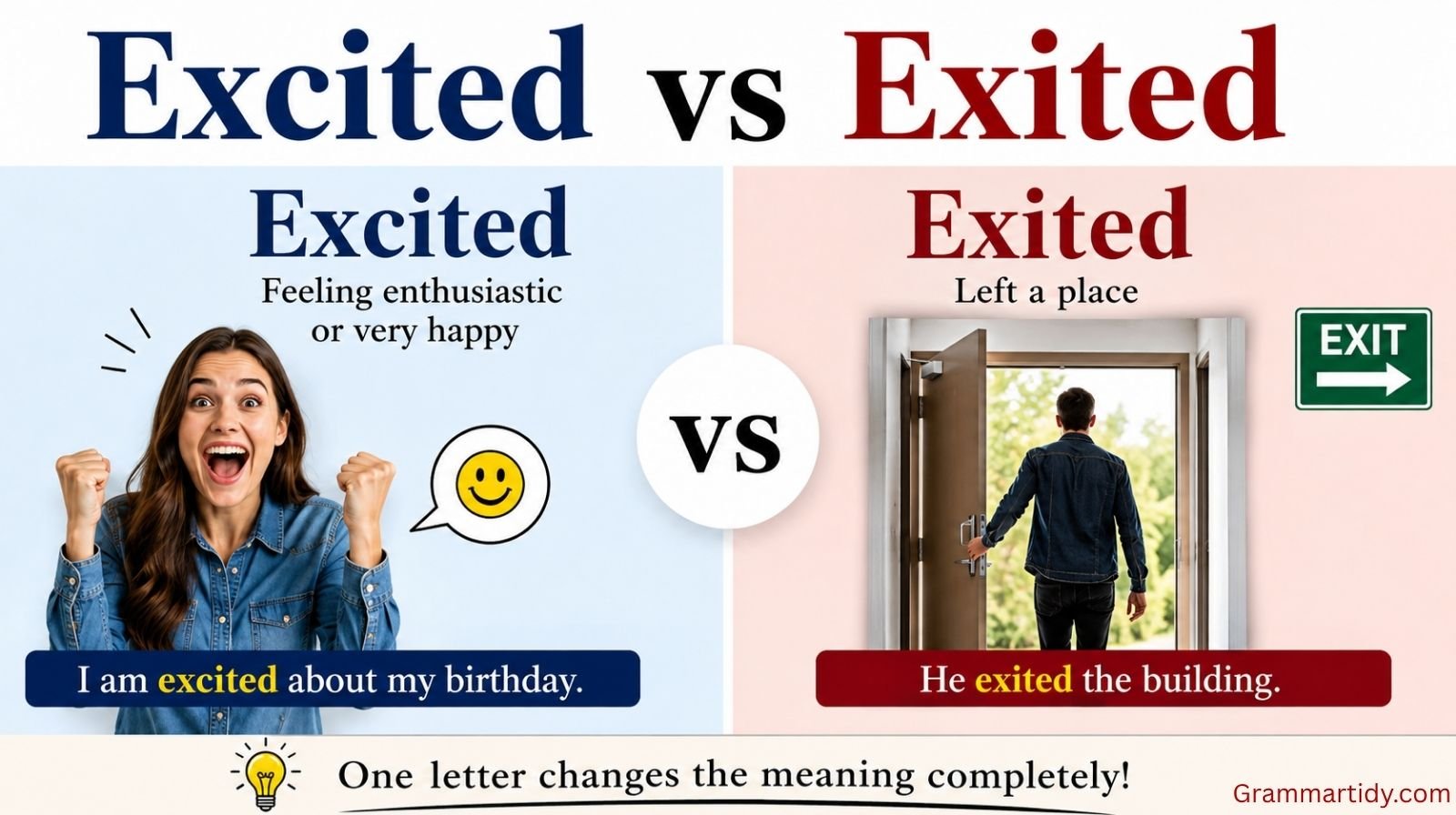
Have you ever written “I’m exited about the trip” when you actually meant “I’m excited about the trip”? You’re not alone. Excited vs exited is a common English confusion because the two words look almost identical, but their meanings are completely different.
Excited describes a feeling of enthusiasm, happiness, or anticipation. Exited, on the other hand, is the past tense of the verb exit, meaning that someone left a place.
In this guide, you’ll learn the difference between excited and exited, how to pronounce each word, when to use them, and simple examples that make the distinction easy to remember.
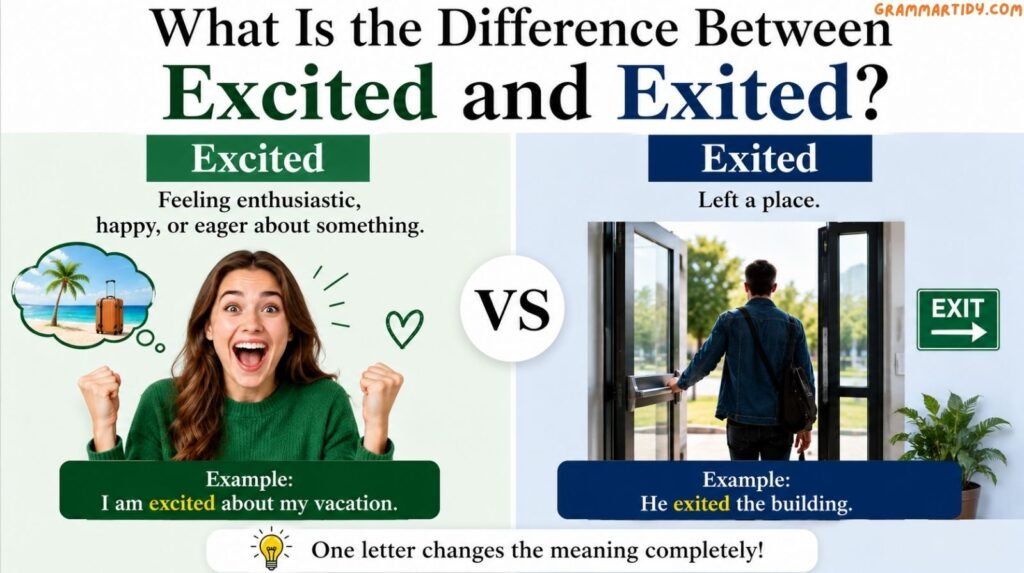
What Is the Difference Between Excited and Exited?
The simplest difference is this:
Excited means feeling enthusiastic or very happy about something, while exited means left a place.
Although they differ by only one letter, they belong to different grammatical categories and communicate entirely different ideas.
| Word | Meaning | Part of Speech | Example |
|---|---|---|---|
| Excited | Feeling enthusiastic, happy, or eager | Adjective | I am excited about my vacation. |
| Exited | Left a place | Verb, past tense | She exited the building. |
Cambridge Dictionary defines excited as feeling very happy and enthusiastic. Exited is the past simple and past participle form of exit, meaning to leave a place.
Excited Meaning
Excited is an adjective that describes a person’s emotional state.
You can feel excited about:
- A vacation
- A new job
- A birthday
- An upcoming event
- A sports match
- Meeting someone
- Learning something new
Examples:
- I am excited about my new job.
- The children were excited about the party.
- She is excited to meet her favorite author.
- We are excited about our upcoming trip.
Merriam-Webster similarly defines excited as being in a heightened state of energy, enthusiasm, or eagerness.
Exited Meaning
Exited is the past tense and past participle of exit.
It means that someone or something left a place.
Examples:
- He exited the room quietly.
- The passengers exited the bus.
- She exited the building through the back door.
- The driver exited the highway at the next ramp.
So, if someone exited, they went out or left.
Excited vs Exited: Meaning, Pronunciation, and Usage
Understanding pronunciation can make this pair much easier to remember.
How to Pronounce Excited
Excited is generally pronounced:
ik-SY-tid
The middle sound is similar to the word “sight.”
Example:
I’m excited about the concert.
The word has three syllables:
ex-cit-ed
The stress falls on the middle syllable.
How to Pronounce Exited
Exited is generally pronounced:
EK-si-tid
The first syllable sounds like “exit.”
Example:
We exited the theater after the movie.
The pronunciation difference is important because the words don’t just have different meanings—they also have different stress patterns.
A Simple Pronunciation Trick
Think about the words this way:
- excited → emotion
- exited → exit
If you’re talking about how you feel, you probably need excited.
If you’re talking about leaving, you probably need exited.
When to Use Excited
Use excited when you want to describe enthusiasm, anticipation, or happiness about something.
Excited About Something
The structure excited about + noun is extremely common.
Examples:
- I’m excited about the weekend.
- She is excited about her new project.
- They are excited about the wedding.
- Are you excited about the trip?
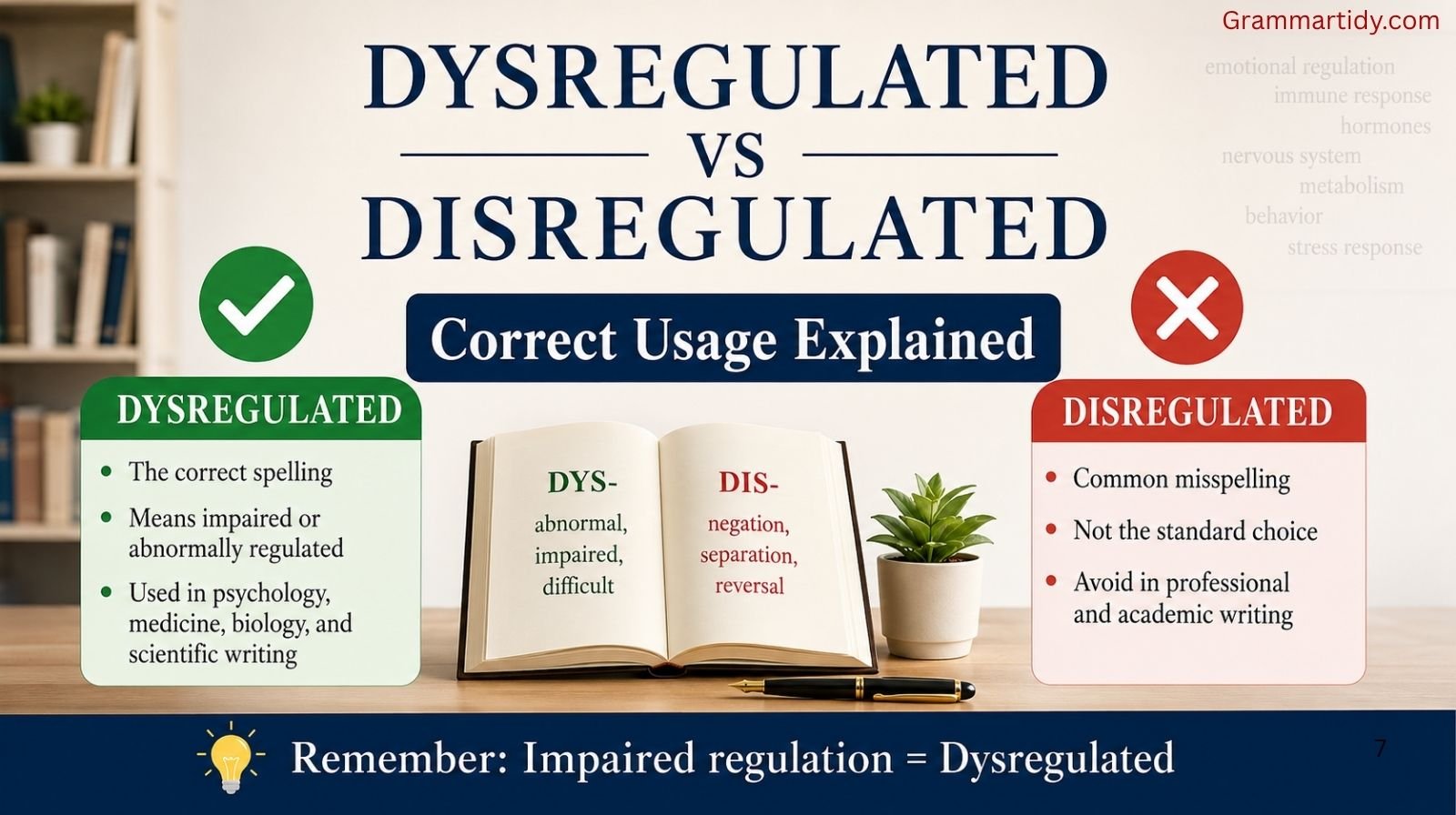
Also Read: Dysregulated vs Disregulated: Correct Usage Explained
Excited to Do Something
You can also use:
excited + to + verb
Examples:
- I’m excited to start my new job.
- We are excited to meet you.
- She is excited to learn more.
- He was excited to see his friends again.
Excited for Something
In informal English, especially in American English, excited for is also commonly used.
Examples:
- I’m excited for the weekend.
- She’s excited for her birthday.
- We’re excited for the game.
For more formal writing, excited about or excited to may sometimes be a better choice depending on the sentence.
When to Use Exited
Use exited when describing an action in which someone or something left a location.
Exited a Building or Room
Examples:
- The students exited the classroom.
- He exited the restaurant.
- She exited the office at 5 p.m.
- The audience exited the theater after the show.
Exited a Vehicle
You can also use exited when someone gets out of a vehicle.
Examples:
- The passengers exited the bus.
- He exited the car and walked toward the house.
- The passengers quickly exited the train.
Exited a Road or Highway
In driving contexts, exited can describe leaving a major road.
Example:
We exited the highway at the next ramp.
This is another useful clue: exited always involves leaving or moving out, while excited describes a feeling or state.
Excited vs Exited: Common Mistakes to Avoid
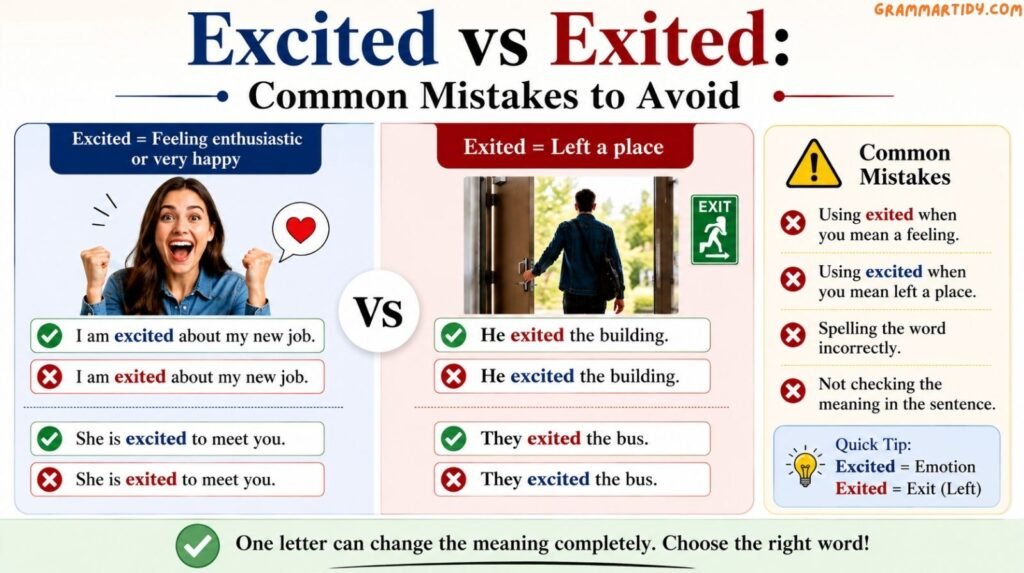
Because these words look so similar, spelling mistakes are easy to make.
“I Am Exited” vs “I Am Excited”
Compare these two sentences:
❌ I am exited about my vacation.
✅ I am excited about my vacation.
The second sentence is correct because the speaker is describing a feeling of enthusiasm.
Exited would only work if the sentence described leaving:
I exited the airport after collecting my luggage.
Notice how changing one letter completely changes the meaning.
“She Was Excited the Room”
This sentence is also incorrect:
❌ She was excited the room.
If you mean that she felt enthusiastic about the room, you could say:
She was excited about the room.
If you mean that she left the room, say:
She exited the room.
The surrounding words often tell you which word you need.
Quick Memory Rule
Use this simple rule:
Excited = emotion
Exited = exit
If you can replace the word with “enthusiastic”, use excited.
If you can replace it with “left”, use exited.
Real-Life Example: How One Letter Changes the Meaning
Imagine that Sarah has been waiting for her vacation for months. Her flight is tomorrow, and she has already packed her suitcase. When her friend asks about the trip, Sarah says:
“I’m really excited about my vacation!”
Here, excited is correct because Sarah feels happy and enthusiastic about something that is going to happen.
Now imagine the same Sarah arriving at the airport. After checking in and picking up her luggage, she leaves the terminal. You could say:
“Sarah exited the terminal at 10 a.m.”
This time, exited is correct because Sarah physically left a place.
The confusion becomes even clearer if you put both words in the same situation:
“Sarah was excited about her vacation, so she quickly exited the airport after collecting her luggage.”
Both words are correct, but they perform completely different jobs. Excited describes Sarah’s emotional state, while exited describes her action.
This is a useful way to remember the difference in everyday English. If the sentence is about feelings, anticipation, enthusiasm, or happiness, think excited. If it is about leaving a room, building, vehicle, road, or another location, think exited.
Excited vs Exited: A Quick Comparison
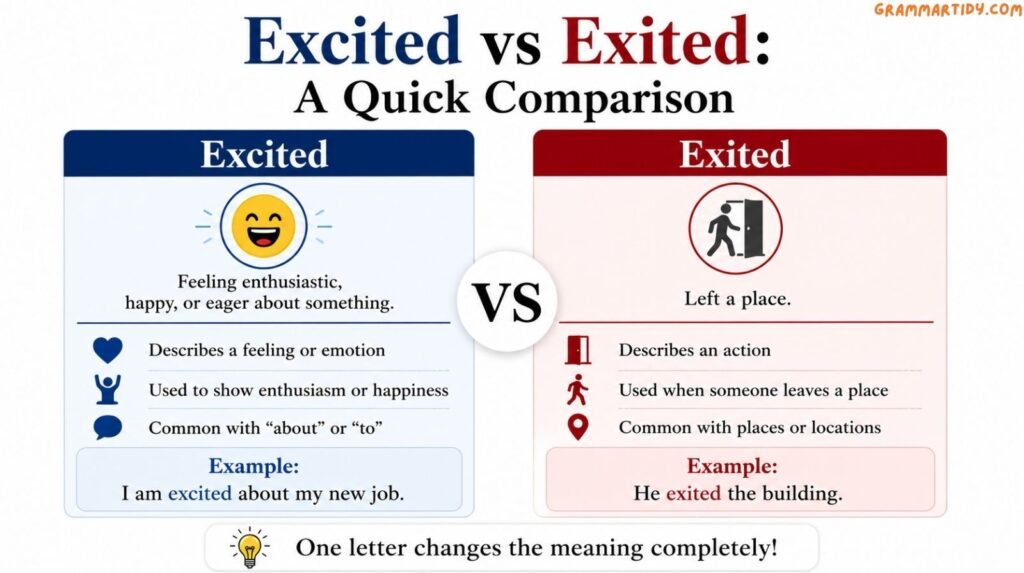
| Feature | Excited | Exited |
|---|---|---|
| Basic meaning | Feeling enthusiastic or happy | Left a place |
| Word type | Adjective | Verb |
| Base word | Excite | Exit |
| Main idea | Emotion | Movement |
| Common pattern | excited about | exited the building |
| Example | I’m excited about the news. | She exited the room. |
| Opposite/contrast | Unexcited | Entered |
Easy Checklist
Before choosing the word, ask yourself:
- Am I describing a feeling? → Excited
- Am I describing enthusiasm? → Excited
- Am I talking about anticipation? → Excited
- Am I describing someone leaving? → Exited
- Can I replace the word with “left”? → Exited
This simple checklist can prevent most excited vs exited mistakes.
Why These Words Are Commonly Confused
The confusion mainly comes from their similar spelling.
Both words begin with “exci/exi” and contain similar letters, but their origins and meanings are different.
Excited comes from the verb excite, which relates to causing or experiencing enthusiasm or stimulation.
Exited comes directly from exit, meaning to leave.
The difference is especially easy to miss when typing quickly because excited and exited differ by only one letter.
A Helpful Spelling Trick
Remember:
Excited has “cit” in it because excitement is involved.
And:
Exited contains “exit” because someone leaves.
You don’t need to memorize a complicated grammar rule. Just connect each spelling to its core meaning.
What Current Language and Search Data Tell Us
When creating educational content today, clarity matters more than simply repeating keywords. Google’s current Search guidance emphasizes helpful, reliable, people-first content and recommends creating material that genuinely satisfies the reader’s needs.
Recent marketing research also shows that SEO remains an important reason businesses create blog content. HubSpot’s 2025 blogging research found that 34% of businesses maintaining blogs cited SEO-related purposes among their reasons for publishing content.
For a simple language question like excited vs exited, that means a useful article should do more than define both words. It should answer the practical questions readers actually have: What do they mean? How are they pronounced? Which one should I use? And what are some real examples?
That is why examples, comparisons, and quick memory techniques are particularly useful for this topic.
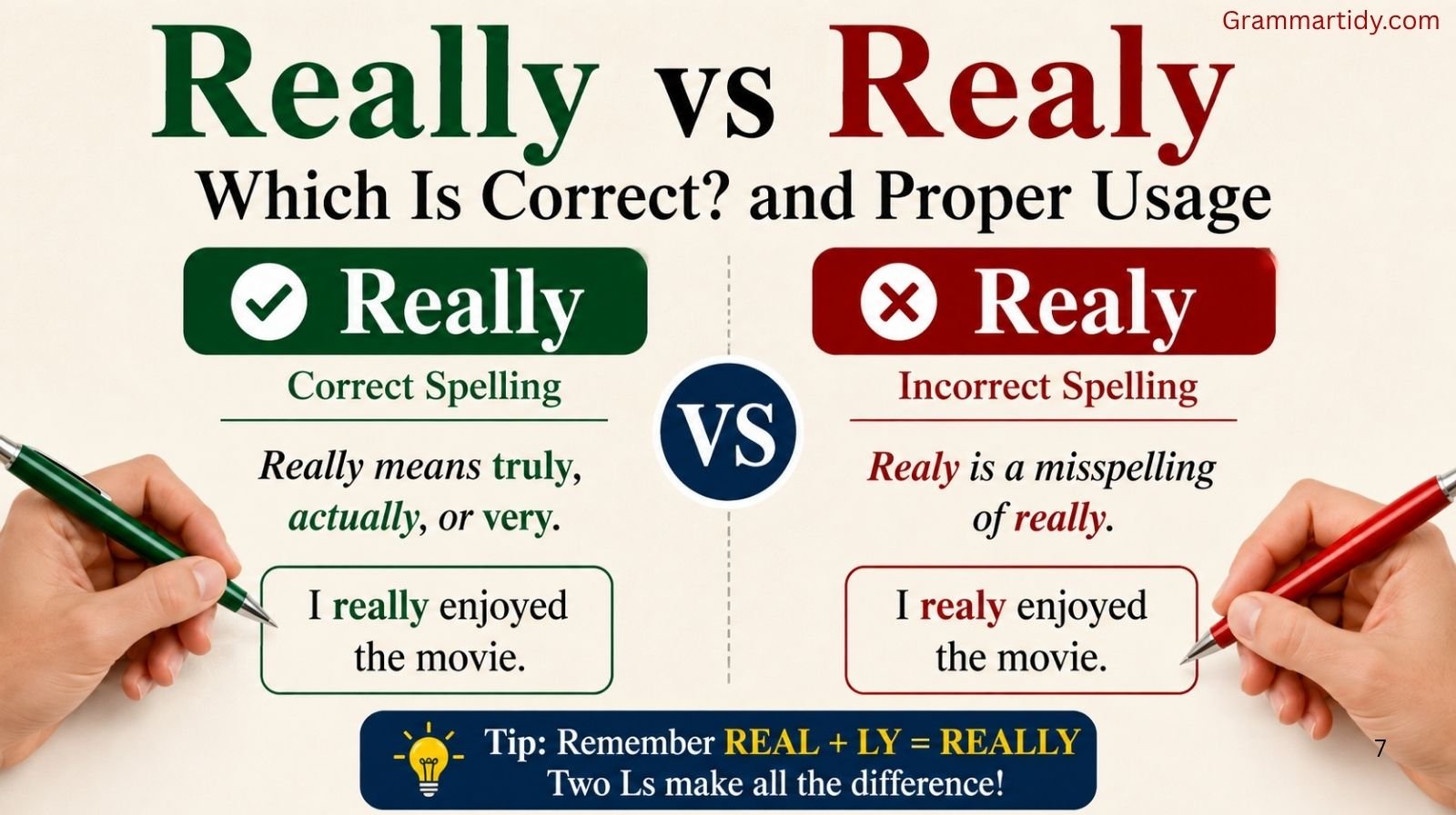
Also Read: Really vs Realy: Which Is Correct? And Proper Usage
1. Feeling Excited
Which sentence is correct?
A. I am exited about the trip.
B. I am excited about the trip.
C. I am exit about the trip.
D. I excited the trip.
Answer: B. I am excited about the trip.
2. Leaving a Place
Which word means “left a place”?
A. Excited
B. Exciting
C. Exited
D. Excite
Answer: C. Exited
3. Pick the Right Word
“She was ___ to see her favorite singer.”
A. exited
B. excited
C. exit
D. exiting
Answer: B. excited
4. Spot the Correct Sentence
Which sentence is correct?
A. He exited the building.
B. He excited the building.
C. He exited about the building.
D. He exciting the building.
Answer: A. He exited the building.
5. Emotion or Action?
“I’m really ___ about my birthday!”
A. exited
B. exit
C. excited
D. exiting
Answer: C. excited
6. A Quick Meaning Check
What does excited describe?
A. A feeling
B. A doorway
C. A road
D. A building
Answer: A. A feeling
7. What Does Exited Mean?
“She exited the classroom.”
What does exited mean here?
A. She entered the classroom.
B. She cleaned the classroom.
C. She left the classroom.
D. She enjoyed the classroom.
Answer: C. She left the classroom.
8. Choose the Natural Phrase
Which phrase is correct?
A. excited about the news
B. exited about the news
C. exited to the news
D. excited the news
Answer: A. excited about the news
9. Complete the Sentence
“We are ___ to meet you.”
A. exited
B. excited
C. exit
D. excite
Answer: B. excited
10. Which One Talks About Leaving?
Which sentence describes someone leaving?
A. She was excited about the party.
B. She was excited to dance.
C. She exited the party early.
D. She felt excited all evening.
Answer: C. She exited the party early.
11. The One-Letter Challenge
Which spelling is correct when you mean enthusiastic or happy?
A. Exited
B. Excited
C. Excitted
D. Exsited
Answer: B. Excited
12. Think “Exit”
Which sentence uses the word related to exit correctly?
A. I exited the car.
B. I exited about the car.
C. I excited the car.
D. I was exited for the car.
Answer: A. I exited the car.
13. Can You Catch the Mistake?
Which sentence needs correction?
A. I’m excited about the concert.
B. She exited the room.
C. We are excited to travel.
D. He is exited about his new job.
Answer: D. He is exited about his new job.
Correct version: He is excited about his new job.
14. Double-Word Challenge
Choose the sentence that uses both words correctly.
A. I was exited about the trip and excited the hotel.
B. I was excited about the trip and exited the hotel.
C. I was excited the trip and exited about the hotel.
D. I was exited the trip and excited about the hotel.
Answer: B. I was excited about the trip and exited the hotel.
15. Final Quick Test
Complete the sentence:
“After the movie, we ___ the theater feeling ___ about the next one.”
A. excited / exited
B. exited / excited
C. excited / excited
D. exited / exited
Answer: B. exited / excited
Why? We exited because we left the theater, and we were excited because we felt enthusiastic about the next movie.
FAQs
Q1. Is it “excited” or “exited”?
A: It depends on the meaning. Use excited when describing enthusiasm or happiness. Use exited when describing someone or something leaving a place.
Examples:
- I am excited about the trip.
- I exited the building.
Q2. What is the difference between excited and exited?
A: Excited describes a feeling of enthusiasm, eagerness, or happiness. Exited is the past tense of exit and means left a place.
Q3. Is “I am exited” grammatically correct?
A: It can be grammatically possible, but it usually does not mean what people intend. If you mean “I feel enthusiastic,” the correct sentence is:
I am excited.
Exited is normally used as a past-tense verb:
I exited the room.
Q4. How do you remember excited vs exited?
A: Use this simple memory trick:
Excited = emotion.
Exited = exit.
If you’re talking about feelings, choose excited. If you’re talking about leaving, choose exited.
Q5. Is “excited about” correct?
A: Yes. Excited about is a standard and very common construction.
I’m excited about my new job.
You can also use excited to + verb:
I’m excited to start my new job.
Q6. Is “excited for” correct English?
A: Yes, excited for is commonly used, particularly in informal English.
For example:
I’m excited for the weekend.
Depending on the context and level of formality, excited about or excited to may be preferable.
Conclusion:
The difference between excited vs exited is actually simple once you connect each word to its meaning.
Excited describes a feeling of enthusiasm, happiness, eagerness, or anticipation:
I’m excited about my new job.
Exited means that someone or something left a place:
She exited the building.
The easiest way to remember the difference is:
Excited = emotion
Exited = exit
So, the next time you’re writing about how you feel, choose excited. When you’re describing someone leaving a place, choose exited.
If you found this explanation helpful, bookmark it or share it with someone who frequently mixes up these two words. For more clear, practical English-word comparisons, keep exploring our language guides.
Keep learning with more easy grammar lessons on GrammarTidy.com

Hi, I’m Noor Fatima, the author and creator of Grammar Tidy. I’m passionate about grammar, writing, and making language learning simple and enjoyable. Through Grammar Tidy, I share helpful tips, clear explanations, and practical guidance to help readers improve their writing, avoid common mistakes, and communicate with confidence. My goal is to make better grammar easy, useful, and accessible for everyone.