When you feel frustrated, annoyed, or disappointed, a short expression like “dammit!” can communicate exactly how you feel. However, when you type it in a message, write it in a story, or use it in an informal email, you might wonder whether damnit or dammit is the correct spelling.
Both spellings appear in everyday English, online conversations, and informal writing. Although they express essentially the same emotion, one spelling is more widely recognized as the conventional form, while the other is a common alternative.
Understanding the difference between damnit and dammit can help you choose the right word for your writing style, audience, and situation. Whether you are composing a casual text, writing dialogue, or expressing frustration in a personal email, knowing how these spellings work will make your writing clearer.
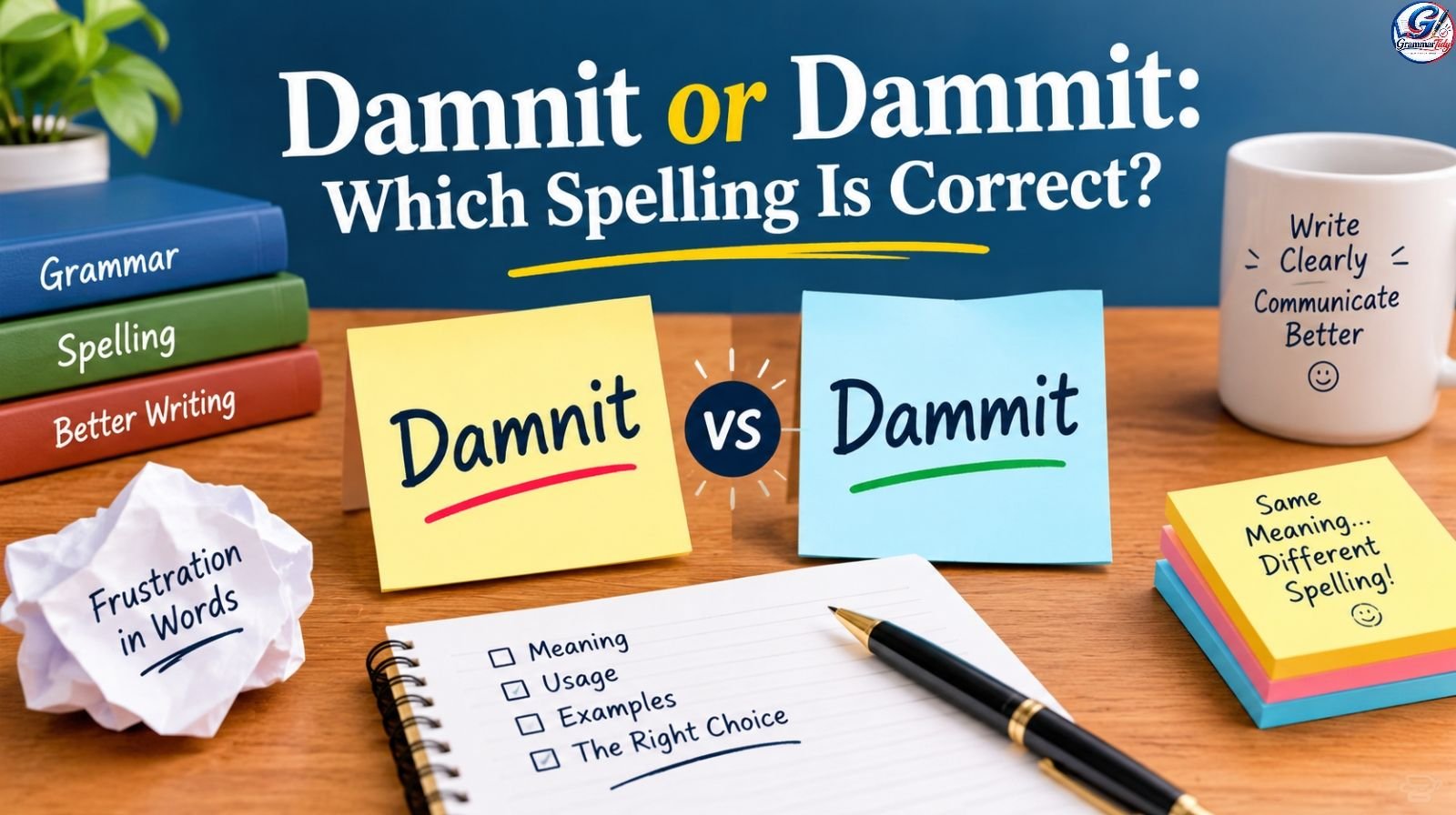
Damnit or Dammit: Which Spelling Is Correct?
Dammit is the more widely recognized spelling of this informal exclamation. It expresses anger, irritation, disappointment, or frustration. For example, someone might say, “Dammit, I forgot my keys!”
Damnit is also commonly used and understood as a spelling variant. It reflects the way some English speakers pronounce or interpret the expression, but it is generally less established than dammit in conventional written usage.
Here is a quick comparison:
| Spelling | Meaning | Usage |
|---|---|---|
| Dammit | An expression of anger or frustration | Widely recognized informal spelling |
| Damnit | The same expression of anger or frustration | Common alternative spelling |
| Damn it | The original two-word expression | Conventional form in many contexts |
The main point is that dammit and damnit generally communicate the same meaning. The difference is primarily spelling and convention rather than meaning.
If you are unsure which version to choose, use dammit in informal writing. If you prefer to keep the original phrase in its two-word form, write damn it.
What Does Dammit Mean?
Dammit is an informal interjection used to express a strong emotional reaction. It is usually associated with frustration, anger, annoyance, or disappointment.
The expression comes from the phrase “damn it,” in which damn expresses condemnation or frustration and it refers to the situation, object, or problem causing the reaction.
Over time, the phrase developed a familiar informal spelling: dammit.
People use it when something goes wrong, when they make a mistake, or when circumstances do not meet their expectations. The precise emotion depends on the context and the speaker’s tone.
For example:
- “Dammit, I missed the bus!” expresses frustration.
- “Dammit, I made the same mistake again!” expresses disappointment with oneself.
- “Dammit, why isn’t this computer working?” expresses irritation.
- “Oh, dammit! I spilled coffee on my notes.” expresses annoyance at an accident.
In each example, dammit communicates an immediate emotional reaction rather than providing factual information.
Because it is a swear word, even though it is relatively mild compared with stronger profanity, it may not be suitable for every audience or situation.
What Does Damnit Mean?
Damnit is an alternative spelling of the same informal exclamation. Writers often use it because the letters resemble the way the phrase sounds when spoken quickly.
For example, someone might write:
“Damnit, I forgot to attach the document!”
The intended meaning is clear: the writer is annoyed about forgetting the attachment.
However, damnit is not usually treated as the preferred spelling in conventional written usage. Readers will generally understand it, especially in casual digital communication, but some may consider it a spelling mistake.
This distinction matters when writing for a professional audience, publishing an article, or preparing material that will be carefully edited.
Consider these examples:
- “Damnit, I left my wallet at home!”
- “Damnit, the deadline is tomorrow.”
- “I studied all night, and damnit, I still got the answer wrong.”
Each sentence communicates frustration. The spelling, however, can be standardized to dammit or rewritten as damn it, depending on the tone and context.
The important thing to remember is that damnit is understandable, but dammit is generally the safer choice when you want the established informal spelling.
Why Do People Confuse Damnit and Dammit?
The confusion between damnit and dammit comes from pronunciation, informal writing habits, and the way English expressions change over time.
Both spellings represent essentially the same spoken expression. When people say “damn it” quickly, the words can blend together, making it difficult to determine how the expression should be written.
There are several reasons why writers mix them up.
Pronunciation Makes Both Spellings Seem Reasonable
In everyday speech, people often pronounce “damn it” as a single, connected expression. The final sound of damn blends into the beginning of it, so the phrase may sound like “dammit.”
Because of this pronunciation, some writers naturally choose dammit. Others use damnit, believing that the spelling should preserve the letters in damn it.
Both choices are understandable, but pronunciation does not always determine standard spelling.
English has many expressions whose conventional written forms differ from how people pronounce them in casual conversation.
Informal Writing Encourages Variations
Text messages, social media posts, online comments, and private chats often contain unconventional spellings.
People may write words the way they sound, shorten phrases, or use spellings they have encountered elsewhere. Repeated exposure can make an alternative spelling look correct, even when it is not the preferred form in edited writing.
For example:
- “Dammit, I forgot my password!”
- “Damnit, I forgot my password!”
Both are easy to understand. Nevertheless, the first is generally the better choice if you want to follow conventional spelling.
Spellcheckers May Not Treat Them Equally
Digital writing tools can also contribute to the confusion. Depending on the dictionary, application, and language settings, a spellchecker may recognize one form while flagging the other.
A tool might accept dammit, suggest damn it, or mark damnit as a possible error. These results can vary, so a spellchecker’s response should not be the only basis for deciding which spelling to use.
For polished writing, consistency and conventional usage matter more than simply choosing whichever spelling your keyboard accepts.
Dammit vs. Damn It: Is There a Difference?
Although dammit and damn it have essentially the same meaning in everyday use, their written forms are different.
Dammit is a single-word informal exclamation. Damn it is the two-word expression from which the exclamation developed.
Both can express frustration, anger, or annoyance.
Compare the following sentences:
- “Dammit, I missed the train!”
- “Damn it, I missed the train!”
Both sentences express the speaker’s frustration about missing the train.
The choice often depends on personal preference, the tone of the writing, and the conventions being followed. The one-word version is especially familiar in informal dialogue, while the two-word version preserves the original phrase.
When Should You Use Dammit?
Use dammit when you want a short, direct expression of frustration in informal writing.
It works well in dialogue, personal messages, fictional conversations, and casual online posts.
For example:
“Dammit, Sarah! I told you the meeting starts at nine.”
Here, the word communicates irritation and makes the dialogue sound spontaneous.
When Should You Use Damn It?
Use damn it when you prefer the conventional two-word expression or want to preserve the phrase’s original structure.
For example:
“Damn it, I should have checked the address before leaving.”
This sentence is natural and clearly communicates regret.
In formal writing, however, neither version is usually appropriate unless the expression is necessary for dialogue, quotation, or a specific stylistic purpose.
How to Use Dammit in Everyday Sentences
Understanding a word becomes easier when you see how people use it in realistic situations. Dammit usually appears at the beginning of a sentence or clause, but it can also occur later in a sentence for emphasis.
Here are several examples that demonstrate its use.
Expressing Frustration After Making a Mistake
Imagine that Daniel is preparing a presentation for work. He accidentally deletes a slide he spent an hour creating.
He might say:
“Dammit, I deleted the wrong slide!”
The expression shows Daniel’s frustration with his own mistake.
Another example:
“Dammit, I saved the document in the wrong folder again.”
In both sentences, dammit emphasizes the speaker’s immediate reaction.
Expressing Disappointment
Suppose Emily has been preparing for a driving test, but she discovers that she has forgotten her appointment confirmation.
She might say:
“Dammit, I thought I had everything ready.”
Here, the expression communicates disappointment rather than anger toward another person.
A similar example would be:
“Dammit, I really thought I had passed the exam.”
The word adds emotional intensity to the sentence.
Reacting to an Unexpected Problem
Imagine that Michael is getting ready to leave for an important event when his car refuses to start.
He might say:
“Dammit, the car won’t start!”
Or, after discovering that his internet connection has stopped working:
“Dammit, my internet just went down.”
In these examples, the expression reflects annoyance caused by an unexpected problem.
Using Dammit in Fictional Dialogue
Writers sometimes use dammit to make a character’s speech sound natural and emotionally convincing.
For example:
“Dammit, Rachel,” Noah said, shaking his head. “You promised you would call me when you arrived.”
This dialogue suggests frustration, concern, or disappointment, depending on the surrounding scene.
However, writers should avoid using profanity in every emotional exchange. A character’s language is more effective when it reflects their personality and the intensity of the situation.
Damnit or Dammit in Emails: Which Should You Use?
The choice between damnit and dammit becomes more important when you are writing emails because your audience and the purpose of your message affect how the expression will be received.
In a private email to a close friend, either spelling may be understood. In a workplace email, however, both can sound unprofessional or unnecessarily aggressive.
For professional emails, it is usually better to express frustration without using profanity.
Consider these practical scenarios.
Scenario 1: An Informal Email to a Friend
Suppose Olivia has planned to meet her friend Ethan for lunch, but she realizes that she has booked the restaurant for the wrong day.
She might write:
Subject: I Booked the Wrong Day
Hey Ethan,
Dammit, I just realized I booked the restaurant for Friday instead of Saturday! I’m sorry about the mix-up. I’ll call them and see if I can change the reservation. I’ll let you know what they say.
Olivia
In this informal situation, dammit communicates Olivia’s frustration with her own mistake. Because the recipient is a friend, the casual tone may be appropriate.
Scenario 2: An Email to a Colleague
Suppose James has been working on a report and discovers that he accidentally sent an outdated version to his colleague, Sophia.
He might be tempted to write:
“Damnit, I sent you the wrong file!”
Although Sophia would probably understand the message, the expression may sound careless or unprofessional.
A better email would be:
Subject: Correction: Updated Report Attached
Hi Sophia,
I just realized that I accidentally sent you an outdated version of the report. I’m sorry for the confusion. Please find the correct version attached to this email. Could you use this updated file instead? Thank you for your understanding.
Best regards,
James
This version communicates the problem clearly without using profanity. It also takes responsibility for the mistake and provides a solution.
Scenario 3: An Email to a Manager
Imagine that Ava discovers a scheduling error shortly before an important client meeting. She feels frustrated but needs to communicate professionally with her manager, Mr. Carter.
Instead of writing, “Dammit, the meeting is scheduled for the wrong time,” she could write:
Subject: Urgent: Meeting Schedule Correction
Dear Mr. Carter,
I’ve noticed a scheduling error affecting tomorrow’s client meeting. The calendar currently shows the wrong time. I’m checking the correct details now and will update the calendar as soon as they are confirmed. I apologize for the inconvenience and will keep you informed.
Best regards,
Ava
The lesson: Dammit may be acceptable in a casual email, but a professional message is usually stronger when it focuses on the problem and the solution rather than the writer’s frustration.
Damnit or Dammit in Text Messages and Social Media

Text messages and social media posts are among the most common places where people use dammit and damnit.
Informal communication allows more freedom in spelling, punctuation, and tone. Friends may understand either spelling without giving it a second thought.
For example:
- “Dammit, I left my headphones at home.”
- “Dammit! That was the last bus.”
- “Oh, dammit, I forgot to submit the assignment.”
- “Damnit, why does this keep happening?”
These examples are understandable in casual conversations. However, the fourth sentence uses the less conventional spelling.
If you want to avoid spelling criticism, choose dammit consistently, even when you are writing informally.
Example: A Text Message to a Friend
Suppose Liam is running late because he missed his usual bus. He sends a message to his friend Mia:
“Dammit, I just missed the bus! I’ll probably be about 15 minutes late. Sorry, Mia!”
The expression communicates immediate frustration, while the rest of the message explains the situation.
Example: A Social Media Post
Imagine that Sophie has spent an hour preparing a meal and accidentally burns it.
She might post:
“Dammit! I spent an hour making dinner, and I still managed to burn it. At least there’s always pizza.”
Here, dammit expresses annoyance, while the final sentence adds a little humor.
These examples demonstrate how the word functions naturally in informal communication. Still, remember that public posts can reach audiences with different expectations about language and profanity.
Common Mistakes to Avoid When Writing Damnit or Dammit
Even though the difference between these spellings is small, a few common mistakes can make your writing less polished.
Treating Damnit and Dammit as Completely Different Words
The two spellings do not generally have different meanings. Both are used to express frustration or annoyance.
The main distinction is that dammit is the more established informal spelling, while damnit is a variant.
Do not assume that one expresses stronger anger or a different emotion simply because it has an extra letter.
Using Dammit in Formal or Sensitive Situations
An expression can be grammatically understandable and still be inappropriate for its audience.
For example, writing “Dammit, you made another mistake” to a client may sound insulting or aggressive.
A more suitable alternative would be:
“Unfortunately, there appears to be another error. Could we review it together?”
This wording communicates the issue without unnecessarily escalating the situation.
Confusing Dammit With Damn
Although these forms are related, they do not always perform the same grammatical function.
- Damn: “Damn, I forgot my keys!”
- Dammit: “Dammit, I forgot my keys!”
- Damn it: “Damn it, I forgot my keys!”
All three can express frustration in these examples, but dammit is a more specific informal exclamation, while damn has several other uses as a verb, adjective, and exclamation.
Assuming Spellcheck Is Always Right
Spellcheckers are useful, but they may not recognize every informal expression or regional variation.
If a word processor flags damnit, consider changing it to dammit or damn it. When writing for publication, follow the relevant editorial style guide.
Forgetting That Profanity Depends on Context
A word that sounds harmless among friends might sound disrespectful in a business email or a formal presentation.
Before using dammit, consider your reader, your purpose, and the tone you want to establish.
Good writing is not only about correct spelling; it is also about choosing language that suits the situation.
What Are Some Polite Alternatives to Dammit?
Sometimes you want to express frustration without using profanity. Fortunately, English has many alternatives that communicate annoyance, disappointment, or surprise.
The best option depends on how strong you want your reaction to sound.
| Alternative | Typical meaning | Example |
|---|---|---|
| Darn it | Mild frustration | “Darn it, I forgot my umbrella.” |
| Oh no! | Concern or disappointment | “Oh no! I missed the deadline.” |
| Shoot! | Mild annoyance | “Shoot, I sent the wrong attachment.” |
| Ugh! | Irritation or exasperation | “Ugh, the printer is jammed again.” |
| What a shame! | Regret or disappointment | “What a shame! We missed the final train.” |
| Unfortunately | Professional acknowledgment of a problem | “Unfortunately, the file was not saved correctly.” |
These expressions can help you adjust your tone without changing the basic message.
For example, in a professional email, you could write:
“Unfortunately, I noticed an error in the report and will send a corrected version shortly.”
In a conversation with a friend, you might say:
“Darn it, I forgot to bring the tickets!”
Both alternatives express frustration, but they are suitable for different situations.
Is Dammit Considered a Bad Word?
Dammit is generally considered mild profanity or a swear word. It is commonly used in informal conversations to express anger or annoyance, but its acceptability varies by audience and setting.
Among close friends, it may be perfectly ordinary. In a classroom, workplace, formal email, or public speech, it may be considered inappropriate.
The word’s impact also depends on how it is used. Saying “Dammit, I forgot my keys” expresses frustration with a situation. Saying “Dammit, you never listen” may sound confrontational because it directs the frustration toward another person.
When in doubt, use a milder alternative.
If you are writing dialogue for a fictional character, however, dammit can be useful when it fits the character’s personality and the scene’s emotional tone.
Mini Quiz: Damnit or Dammit?
Question 1: Which is the more widely recognized spelling?
A. Damnit
B. Dammit
Answer: B. Dammit. It is the more established informal spelling of the expression.
Question 2: Which sentence uses the preferred spelling?
A. “Damnit, I forgot my phone!”
B. “Dammit, I forgot my phone!”
Answer: B. Both versions are understandable, but dammit is generally the preferred spelling.
Question 3: Which expression is usually more appropriate in a professional email?
A. “Dammit, I sent the wrong file!”
B. “I apologize for sending the wrong file. Please find the corrected version attached.”
Answer: B. The second option is more professional and focuses on correcting the mistake.
Frequently Asked Questions
1. Is Damnit or Dammit the Correct Spelling?
Dammit is the more widely recognized spelling of the informal expression used to show frustration, anger, or disappointment. Damnit is also commonly used, but it is generally considered a less conventional spelling variant.
2. What Is the Difference Between Damnit and Dammit?
The main difference is spelling, not meaning. Both expressions communicate frustration or annoyance. However, dammit is the more established one-word spelling in informal English.
3. Is Damnit a Real Word?
Yes, damnit is a commonly used spelling variant that readers can generally understand. However, dammit is the safer choice for writers who want to use the more conventional spelling.
4. Is Dammit the Same as Damn It?
Yes, they generally express the same meaning. Dammit is the informal one-word form, while damn it preserves the original two-word expression. Both can communicate anger, irritation, or disappointment.
5. Can I Use Dammit in a Professional Email?
It is better to avoid dammit in most professional emails because it may sound unprofessional or aggressive. Instead, use phrases such as “Unfortunately,” “I made a mistake,” or “I apologize for the confusion.”
6. Is Dammit Considered a Bad Word?
Dammit is considered mild profanity. It is commonly used in casual conversations to express frustration, but it may be inappropriate in formal settings, workplaces, or conversations with people who dislike swearing.
7. How Do You Use Dammit in a Sentence?
You can use dammit to express frustration or disappointment. For example: “Dammit, I forgot to submit my assignment!” In this sentence, the word emphasizes the speaker’s annoyance at forgetting an important task.
8. What Are Some Polite Alternatives to Dammit?
Common alternatives include “darn it,” “shoot,” “oh no,” and “unfortunately.” For example, instead of saying “Dammit, I sent the wrong file,” you could write, “Unfortunately, I sent the wrong file. Please find the corrected version attached.”
Final Verdict:
When deciding between damnit or dammit, remember that both spellings are used to express frustration, anger, or disappointment. However, dammit is the more widely recognized and conventional one-word spelling.
Damnit is a common variant, particularly in casual digital communication, but it may be viewed as a misspelling in edited writing. If you prefer the original phrase, damn it is another clear and conventional option.
Use dammit in informal conversations, personal messages, and fictional dialogue when the tone calls for it. In professional emails and formal writing, consider alternatives such as unfortunately, darn it, or I made a mistake.
Ultimately, choosing the right spelling is straightforward: use dammit for the familiar informal exclamation, damn it for the two-word phrase, and polite alternatives when your audience calls for a more professional tone.
Keep learning with more easy grammar lessons on GrammarTidy.com

Hi, I’m Noor Fatima, the author and creator of Grammar Tidy. I’m passionate about grammar, writing, and making language learning simple and enjoyable. Through Grammar Tidy, I share helpful tips, clear explanations, and practical guidance to help readers improve their writing, avoid common mistakes, and communicate with confidence. My goal is to make better grammar easy, useful, and accessible for everyone.